
Small Towns, Big Stories | Trail of History
Episode 58 | 27m 8sVideo has Closed Captions
Explore North Carolina small towns, hidden history, bourbon, mills & Main Streets.
Visit Matthews and its beloved farmers market, discover Mount Pleasant's forgotten college-town past, learn how Cramerton became "Khaki Town USA," and tour Maiden's century-old hardware store. From bourbon aging in a former prison to historic Main Streets, mill villages, museums, and local legends, these small towns prove that some of North Carolina's biggest stories are found off the beaten path.
Problems playing video? | Closed Captioning Feedback
Problems playing video? | Closed Captioning Feedback
Trail of History is a local public television program presented by PBS Charlotte
Sponsored by Bragg Financial
Support provided by:

Small Towns, Big Stories | Trail of History
Episode 58 | 27m 8sVideo has Closed Captions
Visit Matthews and its beloved farmers market, discover Mount Pleasant's forgotten college-town past, learn how Cramerton became "Khaki Town USA," and tour Maiden's century-old hardware store. From bourbon aging in a former prison to historic Main Streets, mill villages, museums, and local legends, these small towns prove that some of North Carolina's biggest stories are found off the beaten path.
Problems playing video? | Closed Captioning Feedback
Where to Watch Trail of History
Trail of History is available to stream on pbs.org and the PBS app.
Providing Support for PBS.org
Learn Moreabout PBS online sponsorship(bright orchestral music) - [Narrator] This is a production of PBS Charlotte.
(gentle orchestral tune) (cheery country music) There are more than 500 incorporated communities across North Carolina, hundreds of main streets, thousands of stories.
And some of the best stories are found in the places you'd least expect, a hardware store that helped build a town, a community forever shaped by World War II, bourbon aging behind prison walls, and a farmers market that has stood the test of time.
Coming up on "Trail of History," we visit four small North Carolina towns and explore the stories that define them.
(upbeat country music) (soft guitar music) Most of us try to avoid long lines, but for Matthews resident Jenna Dione, it's a weekly ritual.
- I get here about an hour early every week to make sure I'm in the front of the line 'cause it gets long.
Yeah, this ain't nothing.
It's gonna get longer.
- [Narrator] So, what's with the line?
Well, as the old saying goes, "The early bird gets the worm."
- By the time the opening bell rings at 8:00, we'll have 100 people in line.
You do it!
(bells jingling) - [Narrator] And right on cue, the bells ring out, and the dedicated early birds stream into the Matthews Community Farmers Market.
- People, like, run in here to get, you know, the first bread or the first cheese.
- It's an amazing place.
They have, you know, the best peaches that we've found anywhere in the area.
The produce is incredible.
- [Narrator] In operation for the past 35 years, market manager Jessica Thomas says this Saturday morning staple was created with a purpose.
- To help support the livelihood of farmers, so to bring farmers to their customer base.
We are a local-only farmers market, so anything you buy here, you're buying from the person who made it or grew it, and everything's from within 60 miles of the farmers market.
- [Narrator] But before the market, the historic downtown or even the town known as Matthews, this was once the Carolina backcountry.
- The Waxhaw of the Catawba Indians actually used this area for hunting and trading grounds.
Then when the settlers came in, a lot of Scots-Irish settlers came over.
- [Narrator] As settlers established the community and their farms, the area got its first name.
- They started cutting down all the trees, and this is early 1800s, and it was known as Stumptown 'cause there were stumps left everywhere.
- [Narrator] Now, according to Matthews Heritage Museum director Bob Aycock, that name didn't last too long.
- In 1825, a man named John Miles Fullwood built a home, and he became the first postmaster.
He was elected postmaster of the town, and it became known as Fullwood Station because his home was the basis for the stagecoach to stop and deliver mail.
- [Narrator] Then came yet another name change with the arrival of the Iron Horse.
- The train came through in 1874.
There happened to be a director in the company whose name was Edward Matthews.
And because he was a director, they decided to name our depot the Matthews Depot in his honor, so that was the name that stuck.
- [Narrator] But the railroad did more for the community than provide it with a name.
- We did a lot of farming in the area.
When the railroad came through, we could finally send out the things that we were farming, mostly cotton.
- [Narrator] With Matthews now on the map and the railroad providing an economic catalyst, the town started to flourish beyond just agriculture.
- [Bob Aycock] That's when our Heath and Reid General Store went up, which is a historic building that's still there right around railroad tracks.
And then, of course, Renfrow Hardware that opened in 1900 as well.
And then just several businesses just around our Trade Street area.
- [Narrator] When the town needed a new doctor, a prominent local resident got creative.
- When the house was built in 1879 by Mr.
Funderburk, he actually built it for Dr.
Massey, who was a doctor in Florida at the time, but he told Dr.
Massey if he'd move his family up here and, I think, become our second doctor in town, he could live here free for a year.
- [Narrator] Today, the house known as the Massey-Clark House serves as the Matthews Heritage Museum.
- The museum was founded in 2013 by the Matthews Historical Foundation.
We purchased this house, which is known as the Massey-Clark House from the town of Matthews in 2010, and renovated it for about three years to kinda take it back to the way it used to look when the Clarks lived here.
So, been here since 1879, the same year the town was founded, and it tells the history of Matthews from the 1800s till about the 1950s.
We have three different galleries.
We have a Commerce Gallery, so it's all about farming and businesses and how the town started growing after the railroad came through in 1874.
And then we've got the Lifestyle Gallery, and it's all about schools and early living at the turn of the century.
And then our Community Gallery finally talks about the community gathering places, like the drugstore and the old swimming pool.
We also have artifacts from different world wars.
- [Narrator] There's one item in the museum that helps tell a very unique town story, this old telephone switchboard.
- Two ladies we love to talk about are the Stoker sisters, so Mayme and Jo were their nicknames.
They ran the switchboard in town, so they lived right behind where is now Town Hall.
Their house isn't there anymore.
But the switchboard was in their living room, and like stories that you hear like Andy Griffith and everything else, they would listen in on all the phone calls, so they knew what was going on.
They would correct people's recipes that were being shared and say, "No, no, no, it's two cups of sugar.
It's not one."
But they were also helpful, so if someone, you know, was trying to, you know, call into the switchboard, you know, "Where's Marianne?"
"Oh, she's out right now.
She's in Charlotte, visiting her sister."
- [Narrator] In another part of the museum, you can learn the story of Crestdale, one of the oldest African American neighborhoods in North Carolina.
- It's predominantly African American because a lot of the workers on the railroad settled in there, so the railroad came through, built section houses that they could live in.
And then some of those section houses were moved later to the Crestdale neighborhood after the railroad came through.
So, that area had a couple churches.
One that's still there, Mount Moriah, so it's still an active church.
And they also had a Rosenwald schools.
- [Narrator] And it was a young man from Crestdale named Harvey Boyd, who, while working at The Charlotte Observer, won a design contest to create the Mecklenburg County seal.
(gentle classical music) Through the years, Matthews has continued to grow, expand, and become more dense.
- [Bob Aycock] We have 17 square miles now for the town of Matthews from the one square mile that we had in 1879 when the charter was written.
- We say it's a really nice, beautiful small town with lots of things to do.
We say it's changing a lot.
You know, this is a place that even the amount of time that we've been here has gone from feeling kind of more, like, suburban to something that's a little bit more, you know, up and coming and energetic.
And, you know, it's a place in transition.
- [Narrator] But even as Matthews has grown, the farmers market continues to bring people together every Saturday.
- The community here, getting to connect with people week after week, getting to know the vendors as well as the customers.
It's a very special, unique thing that I think is hard to find these days.
And the customers are amazing.
They show up rain or shine.
The vendors are kind to each other, support each other.
So, it's a wonderful place to be.
- The best part of Matthews is that you can have sort of a small-town feel, but have access to so many things that are, you know, part of a big city.
(bright classical music) - [Narrator] When you think of college towns in the Carolinas, Chapel Hill, Boone, Davidson, Clemson, and Elon probably come to mind.
But there's one small Cabarrus County town you might not think of as a college town, at least not anymore.
(car drones) Welcome to Mount Pleasant.
- [Melissa] Where we've got two stoplights and everybody knows everybody, we're kinda like Mayberry.
- [Narrator] For many, that sense of community is what keeps them here.
- We are a small town where community is number one.
Mount Pleasant is not like any other town, and we're all like family.
- [Narrator] Today, Main Street and Franklin Street make up the heart of downtown, but a few centuries ago, Mount Pleasant native and Eastern Cabarrus Historical Society volunteer, Ben Callahan, says this crossroads helped the town grow.
- You had a road that was called the Charleston Road that ran from Salisbury, technically to Camden, and eventually to Charleston, which was a north-south road.
And then after Concord was founded, there was a road that was called the Concord Road, actually the Concord-Fayetteville Road that ran east to west from Concord to Fayetteville.
Now, Albemarle is in between.
- [Narrator] But the one road that never came to Mount Pleasant- - We never got a railroad, and I've researched it, and they tried many, many times, but a railroad never made it here.
- [Narrator] While the railroad may have passed Mount Pleasant by, another opportunity arrived here in the 1850s when the Lutheran church chose the community as the home for a new school.
- [Ben] It first called Western Carolina Male Academy.
In 1859, it became a college called North Carolina College.
- [Narrator] That same year, another school opened its doors in Mount Pleasant.
- There was also a girls' school in town, and it was called Mont Amoena, which is Latin for Mount Pleasant.
It is sometimes said you went there to get a preacher, and then it is also said you went there to get training to become a well-rounded woman or to become a teacher.
- [Narrator] Just two years later, the Battle of Fort Sumter marked the start of the Civil War.
North Carolina College closed its doors.
When the war ended, the college reopened and continued educating students until 1901, but that wasn't the end of the campus's story.
- 1903, it reopened as what became Mount Pleasant Collegiate Institute, same years, but it was not a junior college, it was a prep school, so you could still come to school here.
And then in 1907, they changed to, quote, "the military model."
The military school with boys wore uniforms, they had ranks, and all that kinda stuff.
- [Narrator] But in 1933, Mount Pleasant Collegiate Institute closed its doors as the Great Depression continued to take a toll across the nation.
(gentle guitar music) For the next two decades, several of the campus buildings were converted into apartments, but as the years passed, the campus was largely abandoned until the Eastern Cabarrus Historical Society stepped in during the 1970s.
Their goal was to save the main school building and transform it into a museum.
For Robin McAllister, this isn't just local history.
It's family history.
- My grandfather's grandfather built the school, and then a son became the principal of the school and did his best to keep it open through very difficult times.
- [Narrator] By the time the historical society bought the building, it was in pretty rough shape.
- My father was born in '31 and too young for the war, but old enough to come up here and play tic-tac-toe in the windows with a rock.
Bring a buddy, three in a row, tic-tac-toe, so all the windows were broken.
- [Narrator] As it turned out, Robin's family wouldn't just help build the school.
They'd help save it, too.
- Was quite a project, and my mother was very involved, and my father, too, in being up here.
And they had hot dog sales.
They wrote the alumni for money.
And it was a love.
- [Narrator] After years of fundraising and restoration, the museum opened to the public in 1980.
- Everything here has been donated by local citizens.
It's almost 30 rooms of history, each room with its own theme, so you know, you've got a medical room and a music and arts room.
There's a room that looks like a one-room schoolhouse.
- [Narrator] With three floors to explore, there's something here for just about everyone.
- People are always amazed when they come in, you know.
I don't know what they're expecting, but they're always surprised at how much we have here.
- [Narrator] One exhibit highlights a formerly enslaved woman who left a lasting legacy in Mount Pleasant.
- Her name was Idella Misenheimer Heilig, and she was born a slave.
After she was freed, after the war and she was freed, she became a midwife and delivered, I don't know, how many, maybe 100 or more babies.
You go upstairs, and we have an honor roll from World War II, a big display that was in the center of town with a list of everyone serving.
When we have students come in, third graders, fourth graders, they come, and they see their family name up on the wall and they see that connection.
- [Narrator] Mount Pleasant was once a hub for education, and like many towns in the region, its textile mills helped drive the local economy.
- We had a movie theater that was a drugstore, which still exists.
The mills were open.
Most of the population from the 1930s, 1940s, 1950s, they all worked.
Not all of them, but they worked in the mills.
(car droning) - [Narrator] Today, those mills are long gone, but as Cabarrus County continues to grow, Mount Pleasant is experiencing a renaissance.
- [Robin] We're trying to attract more people.
- We are bringing back life to what once was and just bringing a new breath of fresh air.
- [Narrator] While downtown is seeing new life, there is another place helping put Mount Pleasant on the map, the bourbon map.
- [Thomas] Southern Grace Distilleries is a world-class bourbon producer located in Mount Pleasant.
- [Narrator] But to visit Southern Grace, you have to go behind bars.
- Today, we're in the original 1929 barrel house of the Mount Pleasant Prison.
It was once a minimum-security state prison.
Dorm was built in 1929, and it is our primary aging space for Conviction Bourbon.
- [Narrator] The company got its start in Concord, making moonshine, but to expand into bourbon, they needed more space, and found it inside the old prison.
- Immediately upon walking into this space, we knew it would be an excellent bourbon aging space 'cause that's really the thing.
If you don't have a good rack house, you really are not gonna serve your brand well in the long run.
- [Narrator] Southern Grace does more than make bourbon here.
Its unique location attracts visitors from all over who wanna tour the old prison.
- [Thomas] People who do bourbon tourism are putting us on their map.
- [Narrator] He says people come for the bourbon, but once they're paroled, so to speak- - We don't just want our business to succeed.
We want everything else that's going on here, we wanna contribute to their success as well.
- Mount Pleasant today, I think, is really on the rise.
(relaxing guitar music) (groovy guitar music) - [Narrator] For nearly 100 years, textiles were the lifeblood of hundreds of towns across the Southeast.
But only one community can claim the title of Khaki Town USA and have a goat island right in the heart of town.
Established in 1915, Cramerton grew from the vision of entrepreneur Stuart Warren Cramer, a man who left an enduring mark on the Carolinas textile industry.
- His vision for Cramerton was a model mill village.
They had indoor plumbing, had electricity.
The housing was top notch.
He wanted to educate them.
- [Narrator] But this Gaston County town wasn't always known as Cramerton.
- It was Mayesworth, and Mr.
Mayes and Mr.
Dodsworth started an original town in 1905, '06, and it was Mayes Mill, and then Stuart Cramer purchased it.
He was an investor already, but then he bought those two out to make it Cramer Mills, and then eventually, it was named after him.
- [Narrator] According to his grandson, R. Warren Cramer, Stuart W. Cramer was born in Thomasville, North Carolina, just three years after the Civil War.
He attended the US Naval Academy, then pursued a career in engineering.
- He ended up designing and building over 150 mills, which was about a third of the mills in the entire American South.
- [Narrator] His impact reached far beyond just Cramerton.
In 1906, Cramer is credited with coining a term we all still use today, air conditioning.
But of all his accomplishments, many feel Cramerton may be his greatest legacy.
- He built churches, schools, athletic facilities, golf courses.
He invested every effort into Cramerton and making Cramerton special.
- [Narrator] For people like Terry Ellington, Cramer's vision helped shape everyday life.
- Was born here in 1948.
Didn't know it at the time, but this was the best place in the world for kids to grow up.
- [Narrator] At the center of that close-knit community was the Mayworth School.
It's the same school that fourth-generation resident Jeff Ramsey once attended.
- I went there first through ninth grade.
- [Narrator] Cramer's vision for education went beyond the classroom.
- From what I understand from people who grew up in this town, Mr.
Cramer was able to recruit outstanding teachers from regions all around the Southeast.
- [Narrator] For those looking to dig deeper into Cramerton's past, the Cramerton Historical Society Museum offers clues to some of the town's most remarkable stories, like why is there a replica submachine gun on display?
- There were lots of stories and a little bit of worry being spread across the nation about all these gangs, so as the men went around the town to deliver the money that the mill workers had earned, they would take this submachine gun with them just in case any of those gangs decided to visit Cramerton.
Thankfully, it never had to be used.
- [Narrator] Also on display are Stuart Cramer's 1888 US Naval Academy sword and a golf club gifted to him by legendary golfer Bobby Jones.
- So, we're very proud of our history, and we continue to build out our museum.
- [Narrator] It's also the perfect place to learn why Cramerton is known as Khaki Town USA.
- We have a military family.
Grandfather was Annapolis.
His son Stuart was West Point.
And dad was a reserve officer.
- [Narrator] They believed they could develop a better fabric for military uniforms.
Their solution, Cramerton Army Cloth, which was patented in 1929.
- It was a wonderful cloth.
It was hard-wearing and durable and kept to press.
- [Narrator] The fabric became a success and provided a steady source of business for the mill during the Great Depression.
- [R. Warren] During the '30s, other mills were closing down, people were being fired left and right.
Grandfather said, "My people, I want not a single man to lose a job."
- [Narrator] At the onset of World War II, demand for Cramerton Army Cloth soared beyond what the company could produce.
Putting the needs of the nation ahead of profit, the Cramer family released their patent, allowing other textile mills to manufacture the very same fabric and help supply America's fighting forces.
In recognition of its outstanding contributions to the war effort, Cramerton Mills received the Army-Navy "E" Award for excellence in production in 1942.
Not long after the war ended, the Cramer family sold the mills to Burlington Industries, which expanded operations with a third facility in town.
But in 1999, the era of Cramerton Mills came to an end, bringing to a close nearly a century of textile production in the town.
But while the mills are gone, Cramerton's story is far from over.
Throughout town, landmarks like the old school, the churches, and even Maymont, Cramer's hilltop home overlooking the community he built stands as reminders of the vision that helped shape the community.
- Cramerton is probably the best place I've ever lived.
We moved here about 18, 19 years ago, and I can't imagine living anywhere else.
Everybody looks out for each other.
It's just a wonderful community, and it is becoming a place that people are seeking out.
- [Narrator] Today, Cramerton's revitalized town center is buzzing with restaurants, shops, and unique gathering places like Confluence.
- Confluence is our engagement space for the Catawba Riverkeeper.
It's our way of meeting people where they are.
If we can bring them in for live music or local art or cold beverages, we can talk to them about our mission.
- [Narrator] And just across the street, Goat Island Park offers easy access to the South Fork of the Catawba River.
- [Wendy] They have great trails, the fishing piers are wonderful, the kayak launches.
- [Narrator] Spaces like Goat Island Park and the revitalized downtown have helped make Cramerton a destination while also preserving its small-town charm.
- And if you have kids, it's great for the kids because of the parks and recreation.
If you don't have kids, it's great because we do have three major restaurants right downtown, plus Confluence, plus a wine bar known as Tannin.
I mean, it's just a lot of fun for, you know, everyone of all ages.
I think the town of Cramerton needs this kind of reinvestment just because it grows what we already have here.
It grows the sense of community.
It has great economic impact on, you know, our downtown.
You know, each of these businesses help the other businesses, so everything we do here just really goes back to enhance the quality of life for our citizens here.
- [Narrator] The mills may have built Cramerton, but today, it's the people who continue to build its future.
(bright country music) In the era of big-box stores and online shopping, many small-town businesses have a hard time competing, and when they disappear, once thriving main streets can often feel like ghost towns.
But in Maiden, one business has managed to stick around for more than a full century, Piedmont Hardware.
- [Samantha] The founding fathers opened Piedmont Hardware in 1910, and this building was built in 1922.
- [Narrator] Today, the store is owned by Samantha Saunders, who grew up helping her father run the business.
- Early '80s, my dad bought the store, and on day two, after the transaction, he said, "Get in the Jeep.
We're going to work.
You're coming to work with me."
I was very intrigued.
It was just a mystery in every box.
- [Narrator] She says some things here haven't really changed much over the years.
- I have an original nail bin.
I have an original scales date back to 1902.
The ladders.
Yeah, I like using my ladders.
- [Narrator] Around here, a little dust and a few creaky floorboards are just part of the charm.
- Yeah, they creak.
They pop.
I try to dust it, but if we don't get around to it, people, they forgive me for it.
They expect it.
If it were pristine and clean, it would be standoffish.
And the other unique experience that for someone that's never been in here is all of the trophies my dad has captured over the years, we have them on display.
- [Narrator] In the world of self-checkouts and big-box stores, it's this kind of service that helps keep locals coming back.
- Samantha, who runs the place, she knows where every screw's at and every nook and cranny.
She's quite knowledgeable in everything that she does.
- Or you go to the mega stores, you can't find somebody to help you or you can't find something.
- What I like about it is if you want one screw, you can get it.
One, not a whole pack or a box.
- [Narrator] After more than a century in business, Piedmont Hardware and the town of Maiden have pretty much grown up together.
The store sits at the corner of Main Street and Main Avenue.
Former Maiden mayor Bob Sigmon says, "This once marked the center of town."
- Originally, it was half a mile east-west, half mile north-south was the corporate limits.
- [Narrator] And as far as how Maiden got its name, Sigmon says there's a little local folklore behind it.
- There was two old maid ladies, lived somewhere down on the creek, and they named it Maiden Creek.
- [Narrator] While the legend may be hard to verify, the town of Maiden was officially incorporated in 1883.
In the years that followed, it grew into a big textile and manufacturing town.
- We had Carolina Mills, we had American & Efird Mills, we had Mohican Mills, several little behind-the-house spinning operations, and then furniture.
- [Narrator] One of the town's earliest mills was the Providence Cotton Mill, located along Maiden Creek, just outside of downtown.
The machines are long gone, but the building is still standing.
Today, it hosts weddings and special events, writing a new chapter for a place that helped build Maiden.
(relaxing guitar music) The town is also well known for a few other things.
It's home to the first observatory built on a public high school campus in North Carolina.
Today, it bears the name of the woman who helped make it happen, the Lucile Miller Observatory.
- She was our science teacher.
She was mine.
And she finally, over a period of years, got enough backing to have it built, to acquire the telescope, the whole thing.
- [Narrator] But ask most locals what Maiden is really known for- - They used to nickname us as the biggest football town in the world.
On Friday nights years ago, there wasn't nobody in town.
It was all at the high school.
- There are a lot of people who are diehard Blue Devil fans.
- [Narrator] But while Maiden holds tight onto its traditions, it also is seeing a lot of change.
- Apple is in town.
Microsoft is now building a data center just over the way here, and they are now in the corporate limits.
We're, I would say, in a growth period.
I think we're seeing a lot of people catching overflow out of Charlotte.
- [Narrator] And for a small town like Maiden, the benefits are starting to show.
- [Bob Sigmon] Right now, our tax base is growing.
- [Narrator] But back at Piedmont Hardware, there's a lot of optimism about the future.
Like the town of Maiden, the store is seeing a new life, and for Samantha Saunders, that comes with a deep sense of responsibility.
- [Samantha] It's me.
This store is me, and I have poured my heart and soul into it.
Maybe it'll be here another 100 years.
- [Narrator] Right here at the heart of Maiden.
Thank you for watching this episode of "Trail of History."
(upbeat music) (bright orchestral music) A production of PBS Charlotte.
(gentle orchestral tune)
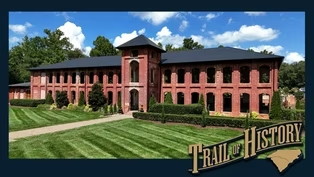
Small Towns, Big Stories Preview | Trail of History
Preview: Ep58 | 30s | Explore North Carolina small towns, hidden history, bourbon, mills & Main Streets. (30s)
Providing Support for PBS.org
Learn Moreabout PBS online sponsorship










Support for PBS provided by:
Trail of History is a local public television program presented by PBS Charlotte
Sponsored by Bragg Financial