Unspun
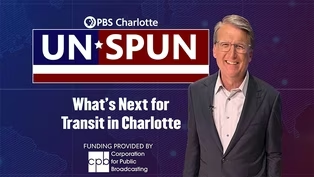
What’s Next for Transit in Charlotte | Unspun
Season 2 Episode 216 | 27m 4sVideo has Closed Captions
Charlotte transit’s future: what’s realistic, affordable, and publicly supported?
What is the future of transit in Charlotte—and what will voters support? As the region grows, leaders face tough questions about cost, priorities, and what type of system can realistically be built. Rising expenses and shifting needs are making it harder to turn big transit plans into reality. A closer look at what’s affordable, achievable, and possible for Charlotte’s future.
Problems playing video? | Closed Captioning Feedback
Problems playing video? | Closed Captioning Feedback
Unspun is a local public television program presented by PBS Charlotte
Unspun
What’s Next for Transit in Charlotte | Unspun
Season 2 Episode 216 | 27m 4sVideo has Closed Captions
What is the future of transit in Charlotte—and what will voters support? As the region grows, leaders face tough questions about cost, priorities, and what type of system can realistically be built. Rising expenses and shifting needs are making it harder to turn big transit plans into reality. A closer look at what’s affordable, achievable, and possible for Charlotte’s future.
Problems playing video? | Closed Captioning Feedback
How to Watch Unspun
Unspun is available to stream on pbs.org and the free PBS App, available on iPhone, Apple TV, Android TV, Android smartphones, Amazon Fire TV, Amazon Fire Tablet, Roku, Samsung Smart TV, LG TV, and Vizio.
Providing Support for PBS.org
Learn Moreabout PBS online sponsorship(upbeat music) - [Announcer] This is a production of PBS Charlotte.
- Tonight on Unspun, the Future of Charlotte Transit.
What's realistic, what's affordable?
And more importantly, what is the public willing to support?
Turning plans into reality far more complicated than you might think.
Costs have risen, priorities have shifted, and questions remain about how to build a system that actually works for a growing region.
We'll talk to a key voice in the debate.
In today's America, welcome to the Spin game.
Believe me, I know, I'm Pat McCrory.
When I was governor and mayor, I played the spin game.
I was played by the spin game.
But aren't we all done being spun?
Let's take the spin out of the world we're in here on Unspun.
(upbeat music) Good evening, I'm Pat McCrory.
Expanding Charlotte's transit system requires balancing ambition with cost and regional needs with political reality.
If anyone can make that happen, it's my guest tonight.
Ned Curran is the former president and CEO of the Bissell Companies.
For decades, he has been a key figure in Charlotte's Transit conversation.
Currently serving as treasurer of the Metropolitan Public Transit Authority, he brings a rare perspective for the business side, the building side, and the policy side of how major transportation projects actually get done.
Please welcome former board member and chairman for the North Carolina Department of Transportation, Ned Curran.
Ned, it's great to have you on Unspun.
- Great to be with you this morning, Governor, thank you.
- And congratulations on the transit referendum.
I guess the third, basically referendum we had in the history of Charlotte and Mecklenburg County.
Because we had one referendum, then we had kind of a recall referendum, and now we had a referendum for an expansion.
- And you were critical for both of the first two.
- [McCrory] Well, we both were.
- Wouldn't have happened without you.
- Well, we had a team effort both then and now.
What was the biggest challenge in the referendum and were there any surprises in the referendum, this most recent one?
- This was probably the largest, most extensive outreach to the community led by both the business community, community support groups, as well as transportation advocates.
And while there are voices that are skeptical today, we're still trying to earn their trust, bring them in.
But at the same time, everybody's facing congestion.
We all see it, we all feel it, and we all know how many people are coming here every day.
And we're starting to show up on lists of congestion and quality of life that we don't wanna be on.
And so communities that are doing something proactively for it continue to attract people, attract businesses and improve quality of life.
So we're trying to do something positively.
- I always sold transit as an alternative to congestion because people aren't really gonna see congestion improve as we grow by a thousand people a week.
But we've gotta have an alternative to the road system because there's no place else to build the roads unless you want to tear down neighborhoods or tear down businesses.
- Yeah, we see the friction that's involved with that and always has been.
But I think if we go back to the original case, going back to the nineties, under your leadership as mayor, it was about land use planning associated with it.
And when we first opened that line, you remember the ridership was off the charts relative to the projections.
And we put land use with it, which is why now when we look at the Blue Line, we see- - Explain the Blue Line.
- The Blue Line is the first transit line in Charlotte's history, runs out of center city.
The initial line ran to the south through south end.
- About to the 485 - To get to 485 to Pineville or just short.
- Just short of Pineville.
- But maybe we'll get there on this next run.
- It's a long story there.
- And now it runs out to the university with the expansion that was done.
And we've seen an incredible amount of density that has grown along those corridors.
And so when we think about the future of Charlotte, that's where we want a lot of the growth to occur because we only have limited capacity on roadways.
- Yeah, no doubt about it.
So let's get to the future and the current plans.
Based upon just new development of the board, the 25 member board?
- 27.
- 27 member board.
What is the next step in transit?
What is the next line gonna be?
Do we know now or what's that process?
- So first, the board is just getting established.
So it's doing the routine governance elements of building the foundation to make decisions, informed decisions.
So we're doing things like bylaws and the charters and policies, financial policies and those types of things.
And the staff of CATS will transition to us on January 1st.
So we're setting the table, if you will, to make all these fundamental.
- CATS is the Charlotte area transit system staff.
- Which are currently city of Charlotte employees.
- Right.
- And so as we think about those types of decisions that you're talking about, we are informed by the PAVE act, which was the legislation that allowed for the additional 1% sales tax.
And in that legislation, it specifies that the red line, the commuter rail line that'll run from Center City to Davidson and perhaps beyond into Iredell County and Mooresville at some point, that that line has to be constructed first.
And you can't advance other rail projects until you're at least 50% done that line.
- And that was very important.
Not only because I-77's a mess going toward there, there's a lot of growth going toward Lake Norm in Mooresville.
You got Lowe's headquarters up there.
This was the case when I was mayor 30 years ago.
- That's exactly right.
- But the political support's needed in that area, and they feel kinda left out because the original transit line is all within the city of Charlotte.
- That's correct.
And you remember the original five Carters and the plans, and there's just not enough money.
- Drew it on a napkin in a hotel many years ago.
- Just not enough money to go around to put that into action.
But now there will be.
And so we keep a promise that was made a long time ago.
Oftentimes in transportation, it takes decades to implement.
And in this case, it'll be a powerful option for people in a corridor that is impaired by a massive lake.
We think about grid systems to give us options to go from here to here.
When you have this massive lake, you're limited.
So 77 becomes very important.
Other roads become very important and the red line will become very important, this commuter rail line.
- Now, if my memory serves me, at least back when I was a young man, the red line was a hard line, not a light rail line.
Is that still gonna be the case?
Can you explain the difference between a light rail line and a hard line or, or I'm not even sure what term they're using.
- Well, it's commuter line, commuter rail and commuter rail is a different type of locomotive.
It's what you typically might see more with a freight type of a operation, less stops.
There's not as many frequent stops as light rail because it's a longer run.
And so to make it competitive with the option of taking public transportation in a bus on an express lane or to take your car, you want it to have a schedule that is comparable.
And so you can't have as many stops on that longer run.
So this plan has been around for decades, so people know pretty much where the stops are.
- In fact, we were trying to negotiate with the railroad company to free up that line and we were not having a lot of success.
- For decades, you and I tried it when you were governor.
- Exactly.
- And I was on the, your appointee to the board of Transportation.
But finally, and that was the breakthrough really when Norfolk Southern agreed to work with the city of Charlotte and say, "Okay, we can see a way to have both freight traffic and passenger traffic on that rail line."
And then that allowed the towns, the six towns to get together with the county and the city that formed the basis of the legislation.
- And where's that line gonna end coming into the city, downtown?
- Gateway Station, which is around Fifth Street.
- Which is another big challenge because that's been on the plans for decades too.
- It has.
And under your leadership at governor and in my time on the board, we approved the funding to enhance the station for the Amtrak station.
And the state now is putting great pressure on all of us, the city and the MPTA, the Metropolitan Public Transportation Authority to get moving on the gateway station.
And so I think we'll see some action on that within the next year.
- Okay, so the red lines part of the legislation go up there and it's desperately needed because of the land use issue more than anything, and the growth.
Where do you think the second, what are the second and third options that your board is gonna have to consider?
- So for now, we're following the plan that was adopted by the Metropolitan Transit Commission, which is kind of the predecessor organization to the MPTA.
- Me and Boyd Coble and a couple lawyers helped write that.
- That's exactly right, and now you're gonna- - We did it with ink pen, dipping it into the ink, that's how long with feathers and everything.
- So you've seen it from the beginning and you'll see its end because we'll take up where the MTC left off.
And the difference is the MTC was a policymaking board.
The city of Charlotte ran CATS.
And this authority, independent authority will do both.
And so it's a unique structure and it's an evolution, right?
It's an evolving of a transit system.
But the next emphasis is on the silver line, which is a new light rail line that would run roughly from the airport and eventually all the way down to Matthews.
The initial funding estimates are, you can run it from the airport to the gateway or gateway to the The BOplex Bojangles Coliseum, maybe try and get another stop, grow our way to get it ultimately to Matthews.
- The airport was the original objective when me and others helped start this thing, but the numbers didn't justify it.
But now, the airport growth and the density along Wilkinson Boulevard, Freedom Drive, that whole area West Boulevard is changing dramatically too.
- And part of what was important to the towns in the north was we wanna be able to get on a train and get to the airport.
And so this is why the gateway station becomes very important that they can take the commuter line, red line to the gateway, and then transition to the silver line and get to the airport.
And when you think about Amtrak's expansion in passenger service, folks from Salisbury, or are farther down the line, likewise can come into the Gateway station and then connect to the silver line and get to the airport.
- Or they might be able to even park further down 77, not have to deal with the traffic or the toll lanes.
- Exactly.
- Or the parking at the airport.
So you have many different options now to get to and from the most important economic thing in our town, and that's the airport.
- That's the airport.
and in a area that is growing and growing like we are, it's about options.
No one solution solves everything.
It's about giving people a different alternative to get from here to there.
They can look at Waze, look at Google map, say, what's the best way for me to get where I'm going at this time?
- In the remaining minute and a half, what's the greatest challenge do you have on this board?
And are there revisions gonna have to be made on how we govern this thing with 27 members, or are you still feeling the way out?
- I think we're still feeling the way out.
I mean, I think anybody steps back and says 27 people on a board is a lot to manage.
Virtually everybody that's been appointed to this board cares deeply, they're passionate, they're thoughtful, knowledgeable about the subject.
But I think when the time comes that we, the ambition is fully realized for a transportation, regional transportation authority, which eventually it will be, that might be an opportunity to revisit the 27, as you admit new members.
- In the remaining 25 seconds, what's your ultimate vision and goal?
- That we're successfully giving people greater options to move around.
And we've complimented land use with the investments we're making in transportation.
- And one other thing I wanna talk about is public safety.
I know this is a concern you and I have both had, and I know when Ron Tover and I first started this thing, we knew public safety had to be a major priority.
You've taken some steps to make that happen.
- No, no question.
- Especially after the tragedy.
- No question.
We've heard the public, we're part of the public, we all wanna feel safer on any option we have within the transit system, we'll do it.
- Ned, I can't tell you how much I appreciate what you've done for now 30 years in this community.
And not just for this community, but you were chairman of the State transportation board, which not only helped the entire state, but a lot of things were done for Charlotte too, that people don't recognize.
We didn't wanna brag about it, we would've caught some negative feedback from the eastern part of the state, but it's part of your leadership and I appreciate you willing to continue to step in this very, very complex issue that's needed for the next generation, many generations in the future.
- Thanks, sir.
- God bless you.
- I appreciate it.
- Thank you very much.
- Thank you.
(upbeat music) - All right, the top five countdown.
What are the top five lessons we learned with two decades of transit in the Charlotte region?
Let's start out with number five.
Number five, there is no guarantee of state and federal money.
In the past when we started transit, when I was mayor, 75% of the funds came from the federal government and the state government combined.
Those days may be over.
Look at the federal deficit, they could cut us off at any moment.
And the state deficit is starting to build too.
The days of state and federal money, we better adjust because those days may be long gone.
Number four, we need to check tickets.
Listen, if you offer something for free, it has no value.
And plus, it's part of the revenue source that pays for it.
If you use it, you gotta pay for it.
Number three, decisions based upon good data, not politics.
Some 20 years ago, everyone wanted the first transit line to be toward the airport or down Independence Boulevard or toward Huntersville.
Guess what?
The data leader, the data ridership did not look good.
So we went down the south end.
Everyone, why are you doing that?
Because the data showed it would work.
And guess what it is working along the south end and now to the university.
Number two, financial oversight by a qualified board is crucial.
There are now billions of dollars into the transit system.
Revenue coming in from the new sales tax, revenue coming in from the federal government.
You better have strong oversight of financial data sheets because if you don't, there could be abuse and there could be corruption and that could shut the whole thing down.
And number one, more important than anything, the number one thing I said when I helped start transit, public safety must be the number one priority.
If you don't have public safety, guess what?
People will not trust it and people will not ride it.
(punchy music) Time now for one on one, Tony Mecia, the editor of The Charlotte Ledger is joining me again.
Tony, great to have you back.
- Governor, great to be here.
It's an important topic, transit and transportation.
Everybody sees it, it affects everybody here.
As we're entering this new era of public transit with the transit tax passing, what challenges do you see?
- I think the number one is public safety.
We cannot have any more incidences on the buses or on the light rail train.
And in the future, the more transit commuter train going toward the North Mecklenburg area of our region.
If we do- - Is it just putting more police or is it beefing up?
- How do you solve it?
- Beefing up police, beefing up enforcement of tickets, beefing up security along the rail trail, everything.
Because as you know, in the history, I'll never forget when Underground Atlanta started going on 30, 40 years ago, it was a great success.
And then all of a sudden, crime came to Underground Atlanta.
It died.
But with this investment, we have billions of dollars of investment and we are very dependent upon this transit line giving us an alternative to the congestion traffic, which isn't gonna get any better.
If we're getting a thousand people a week now in the Charlotte region, do you think 85's gonna get less congestion?
No.
This will be an alternative to congestion, that's the way we should sell it.
And that's the way it needs to be because it'll always be a 20 minute ride going toward either UNCC or toward the outer beltway in Pineville.
- You were mayor when the first portion of the transit of the rail move forward, the Blue Line from uptown down toward Pineville.
How do you think that turned out?
I mean, like you said, if you look at it now, it didn't solve congestion 'cause 77 is as congested as it ever been.
But what do you see the legacy of it?
- Well, first of all, I never promised it would solve congestion in the referendum because I knew we were gonna continue to grow and I knew we wouldn't be able to widen 77 much more as we see in the controversy with I-77 now with the neighborhoods being disturbed or eliminated because of that.
So I promised an alternative and I did promise it'd be about a 20 minute ride forever.
And it is a 20 minute ride right now, approximately a 20 minute ride.
And it's gone beyond any of my expectations.
I was afraid it was gonna be a failure.
I'd worked over 10 years putting that thing in place.
So the first day of opening that up, I got there at five o'clock in the morning and was worried, oh my gosh, what am I gonna do if no one's there?
And then the lines started forming and it's transformed not only transit, but it's transformed the land use along the south corridor, which I got in trouble for one time calling the South Boulevard area, "the corridor of crap."
It wasn't a reflection on the people or the businesses there, it was just ugly and unseemly and no one went there.
It was light after light after light strip shopping malls, vacant buildings, and now look at it.
- I mean, south end, I mean you look at, you drive through there now, it is hard to believe what that was 10, 15 years ago.
- I'm in shock.
We predicted about 1.3 billion of new investment and it's probably well over 6 billion of new investment.
And then we predicted the same thing going up toward UNC Charlotte.
And there were a lot of stories to be told about how we got that in place with Jesse Helm, Sue Myrick, Elizabeth Dole, Mel Watt in Washington, and then in Raleigh, with Governor Easley and with Ed McMahan.
I mean, there are a lot of stories where this thing could have collapsed at any moment.
- So these transit lines, are they about moving people or are they about encouraging development?
- It's a combination of both.
We know we can't have, continue to have suburban sprawl because at the level we're doing now, because the worst traffic in the Charlotte region is not near downtown, it's out toward the lake in Mooresville.
I mean, if you've been to Mooresville lately at three o'clock in the afternoon?
You can't get anywhere.
Or if you've been to Waxhaw or if you've been to 85 in Gastonia, in Belmont, it's packed.
That's where it's needed more than anything.
- So this transit tax that passed, it increased, it'll be increasing the sales tax in Mecklenburg County and it generates somewhere around- - [McCrory] It's already started.
- 20, I think it starts this summer, around $20 billion of money for transit and transportation.
There's some for roads and some for transit.
The transit plan that they have, it's all kinds of things.
It's improving buses, it's extending street cars.
Ned Curran mentioned, rail lines, silver line.
Do you think they can, realistically, knowing what you know about transit, are they gonna be able to pay for everything that they think that they can pay for right now?
- I don't think we know yet because we don't know inflation.
And that's what hurt me a lot or hurt the transit when we started, the cost ended up much being much bigger than we ever anticipated.
In fact, the steel prices went up while we're building the south line and all of a sudden, we had to redesign the bridge going over Tyvola and Woodlawn because the price of steel, I mean we were broke way beyond anticipation of what was we projected, they called it the McCrory line at the time.
- There was a WBTV radio host, I think.
- Yeah, not as a compliment.
It was even in commercials.
Yeah, the McCrory line.
It's called the Blue Line now and it's working and I'm glad.
- Would you be happy if it were called the McCrory line?
- Blue Line works.
- Blue Line's fine.
- Blue Line works.
No one knows who the heck McCrory is.
- Okay.
What about, I know another of your points is following the data where wherever it goes.
Can you expand on that a little bit?
Because it seems like there's a natural tendency to wanna make sure so that everybody has buy-in, that everybody gets something.
Why is that a bad idea?
- 30 years ago when I evaluated whether to do this in Denver, I went to Miami, I went to Dallas and other cities.
The biggest lesson I learned, if you put the lines based upon the political power, those lines will fail if it's not based upon data.
And I really learned that in Miami, Florida.
Their first line was a total failure because they put it where the most powerful politician have to live, but no one else did.
And therefore, there was no ridership.
That was a lesson for me on that trip to Miami many, many years ago.
And that lesson should never be forgotten.
- Yeah, it's gonna be interesting to see how it all plays out.
It's gonna be overseen by this 27 member transit authority where the power of the city of Charlotte's been moved and will be invested in this authority.
What do you think that's gonna be like?
- I think that's gonna be tough.
I think within five years, we're gonna have to reexamine having a 27 member board.
I've never been on a board with that many people to be able to make good decisions, thoughtful decisions, and have the right match of qualifications needed.
We've got something going on right now though that you and I are gonna be involved in.
In fact, you and I are gonna be working with The Charlotte Ledger partnering with us for a special event called "Unspun Live."
And we would invite the great WTVI audience to join us here in the studio, right here in Charlotte off of Commonwealth for a conversation on Tuesday, May the 19th at 10:00 AM.
Space is limited, so we want you to register today at wtvi.org, wtvi.org.
And we got people who can come in the studio, watch all of this happening and give me feedback.
And I might let them give the media a little feedback like The Charlotte Ledger, you know how- - No, we'll steer it, we'll steer it towards you, they wanna see you.
- I'm gonna transfer the blame to the media for any problem.
- They wanna see you, but they can come in, people can come in, they don't have to yell at the TV anymore, they can come in here and they can yell at us or not yell, it's gonna be polite.
- We're gonna have WTVI is respectful.
This is where we bring respect back to conversations.
That's one of the reasons we do this show, Unspun, is have respectful conversation and respectful disagreement.
What issues do you think people wanna bring up here?
- Well, I know when we've done some of these before and let people come in on Unspun unscripted, people are asking all kinds of things that, last month it was the the Phil Berger race, what happened, money in politics.
But if people want to ask about crime or transportation or transit or data centers.
- So this is the time to come ask us directly about those issues that you care about because WTVI and Unspun care about it too.
Tony, thank you very much.
- Looking forward to it, thanks, governor.
- Take care now.
(upbeat music) Over three years ago, I was walking along the rail trail and struck up conversations with people riding the light rail line.
They had no idea who I was and frankly, they didn't care.
Most were young professionals who lived or worked along the line.
This was before the tragic incident that would happen years later.
To be clear, they were very complimentary of the system, but one thing stood out in the feedback, almost none of them were paying.
They told me tickets were rarely checked.
And when they were, people just held up old passes that were never really verified.
One person after another said the same thing.
"Well, I used to pay, but then I realized most people weren't.
So why should I?"
I listened, disappointed, but withheld my reaction.
Instead, I took that feedback directly to transit management.
Here comes the plot twist.
Instead of feeling outraged or even mildly concerned, their response seemed to be almost a blank stare.
And that's when my disappointment turned into frustration because a system I helped start was being undermined, allowing a paid service to essentially be free and easily abused.
The reality is simple.
When something feels or is free, it starts to lose its value.
Now, fast forward to today.
An official audit has confirmed what many already knew: more than half of light rail and bus riders weren't paying fares.
It's the worst kept secret in Charlotte.
It's shameful, let's call it for what it is, it's theft.
No different than walking into a store and walking out without paying.
But it's also a failure of oversight.
A system that looked the other way for too long and that raises a bigger questions about standards.
When people start justifying it by saying everyone else is doing it, that's a problem.
Not just for transit, but for the culture around it.
This should not be the Charlotte way.
The good news?
It's finally being addressed.
Better late than never, I suppose.
It's a reminder, systems only work when people trust them and when people respect them.
Well, that's the truth as I see it.
See you next time on Unspun.
(upbeat music) - [Announcer] A production of PBS Charlotte.
(bright music)
 New
NewWhat’s Next for Transit in Charlotte Preview | Unspun
Preview: S2 Ep216 | 30s | Charlotte transit’s future: what’s realistic, affordable, and publicly supported? (30s)
Providing Support for PBS.org
Learn Moreabout PBS online sponsorship
- News and Public Affairs

Top journalists deliver compelling original analysis of the hour's headlines.

- News and Public Affairs

FRONTLINE is investigative journalism that questions, explains and changes our world.











Support for PBS provided by:
Unspun is a local public television program presented by PBS Charlotte