Unspun
The Politics of National Security | Unspun
Season 2 Episode 212 | 26m 40sVideo has Closed Captions
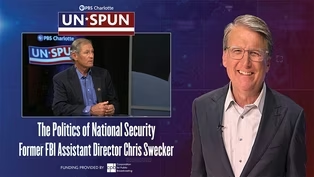
Pat McCrory talks national security with Chris Swecker about America’s security.
On this episode of Unspun, Pat McCrory asks whether national security still comes before politics. He’s joined by Chris Swecker, a longtime leader at the Federal Bureau of Investigation, to discuss the challenges facing the intelligence community, the intersection of politics and security, and what it means for the safety of the United States.
Problems playing video? | Closed Captioning Feedback
Problems playing video? | Closed Captioning Feedback
Unspun is a local public television program presented by PBS Charlotte
Unspun
The Politics of National Security | Unspun
Season 2 Episode 212 | 26m 40sVideo has Closed Captions
On this episode of Unspun, Pat McCrory asks whether national security still comes before politics. He’s joined by Chris Swecker, a longtime leader at the Federal Bureau of Investigation, to discuss the challenges facing the intelligence community, the intersection of politics and security, and what it means for the safety of the United States.
Problems playing video? | Closed Captioning Feedback
How to Watch Unspun
Unspun is available to stream on pbs.org and the free PBS App, available on iPhone, Apple TV, Android TV, Android smartphones, Amazon Fire TV, Amazon Fire Tablet, Roku, Samsung Smart TV, and Vizio.
Providing Support for PBS.org
Learn Moreabout PBS online sponsorship(bright music) - [Announcer] This is a production of PBS Charlotte.
(gentle music) - Tonight on "Unspun," when it comes to national security, the expectation has always been that protecting the country comes before politics.
But in today's political climate, many are asking a simple question.
"Is that still true?"
Next, I'm joined by former FBI leader, who has spent his career on the front lines of national security and homeland defense, and we'll unpack the top five homeland security risk.
(upbeat music) In today's America, welcome to the spin game.
Believe me, I know.
I'm Pat McCrory.
When I was governor and mayor, I played the spin game.
I was played by the spin game.
But aren't we all done being spun?
Let's take the spin out of the world we're in, here on "Unspun."
(upbeat music) Good evening, I'm Pat McCrory.
The Department of Homeland Security is one of the most powerful and complex agencies in the federal government.
It oversees border security, cyber defense, terrorism prevention, and critical infrastructure protection.
Responsibilities that touch almost every part of American life.
So when there's a sudden leadership change at the top, like the recent firing of our Homeland Security Director, it raises important questions about stability, strategy, and the direction of national security policy.
Both sides of the aisle criticized Secretary Noem.
Leadership including North Carolina Senator Thom Tillis, who recently delivered a very blunt assessment of her failures in a recent Congressional hearing on everything, from FEMA disbursements, to her handling of the immigration sweeps in Minnesota.
- We're beginning to get the American people to think that deporting people is wrong!
It's the exact opposite.
The way you're going about deporting them is wrong.
The fact that you can't admit to a mistake, which looks like, under investigation, it's gonna prove that Ms.
Good, and Mr.
Pretti probably should not have been shot in the face, and in the back.
Law enforcement needs to learn from that!
You don't protect them by not looking after the facts.
Not only should the FBI be investigating it, but every single law enforcement agency in that jurisdiction should be invited to it!
So our law enforcement officers do not have this pall cast upon them.
- Chris Swecker knows the world of Homeland Security from the inside.
The former Assistant Director of the FBI and former Head of the FBI Charlotte Field Office, has spent decades working on counter-terrorism, national security, and major criminal investigations.
Chris, thanks for joining us on "Unspun."
- Good to be here, Mr.
Governor.
- Well, recent news scares the heck out of me.
And that is the possibility of terrorist attack because of the Iran war by drones.
And the reason I'm worried about it is because over 20 years ago, when I was on Homeland Security Advisory Commission after 9/11, Secretary Chertoff said in my last meeting, "I'm worried about drones."
And I went, "Why?"
He said, "The technology is very simple.
And the enemy's gonna get it sooner or later."
Well, I guess now is sooner and later.
- Well, - Do you have the same concern about drones?
- I absolutely do, especially now, because I mean, we've degraded Iran's capabilities, conventional capabilities, which kind of pushes them into the asymmetrical terrorism, which is their roots.
And then when you're talking about drones, you're talking about, again, a very simple technological contraption, if you will.
That's what makes it so dangerous.
- [Pat] And cheap!
- Yeah, cheap.
And that's what makes it dangerous.
Because there isn't a whole lot to it.
And there are a lot of 'em out there in this country.
I mean, drones flying over the battlefield, you would expect, and I think you have countermeasures for that.
Drones flying in LA and all across our country.
I mean, I think we've shown in the past that we don't have the ability to detect a hostile drone from a commercial drone, or a delivery drone, or somebody's just doing a survey or a press drone.
So yeah, I don't know how you make that distinction.
We got our work cut out for 'em here.
- In fact, when I was governor, I didn't know this until I got elected governor, but all of a sudden, the new drone technology had really entered the atmosphere, especially in the private sector, and - - Right.
- We had to start writing policy for drone.
And if it were up to me, I wouldn't allow 'em.
Because of Secretary Chertoff warning to me many years before that.
But look at all the toy drones, look at all the agricultural drones, the photography developers use 'em, traveling tourism use 'em.
How can we tell a difference at a football game or another major event or- - Right.
- Coming from the Pacific Ocean into California, which is what the FBI has warned us about.
- Well, we talk about things flying below the radar.
Well, that's what these drones do.
I mean, they're, I don't think that the smaller drones can be picked up by radar.
And then I don't think that radar, even they do pick 'em up, can distinguish between a bad drone- - [Pat] Yeah.
- And a commercial drone, or a drone that's just, somebody's just using for as a hobby.
- Yeah.
Let me bring up another thing he warned me about long ago was cartels.
- Right.
- The Mexican cartels, and then we're gonna get into some other tough subjects.
He said, "I'm worried about the cartels.
They're killing judges and politicians in Mexico who are threatening their lives."
20 some years ago, he said, "They're gonna start threatening our elected officials and judges right across the border."
Is that a concern of yours?
Was it a concern of yours?
- It was, and it is.
I mean, we see now our attorney general is living in a military compound because of cartel threats.
And I spent eight years in Miami doing the Colombian drug cartels.
Then I went out to Houston to work the Mexican cartels when things shifted to the southwest border.
And we saw them growing more and more powerful.
And they're powerful because they have either compromised or intimidated the government structure in Mexico.
I mean, they have always been wired into the government.
In fact, they're just, there are so many corrupt government officials that you could almost call it a narco state.
And we have President Sheinbaum right now, finally taking some action, because she sees what's happening in Venezuela.
And she knows that we have a president that'll take action.
And so you see the capture, or the killing of El Mencho, one of the leaders of the Nueva Generacion cartel in Mexico, one of the most powerful cartels.
But make no mistake, they're the most powerful criminal organizations in the United States.
And they present a national security threat to us.
- Back when I was mayor in another century, you and I worked together.
- Yes.
- You warned me about cartels in Charlotte.
We didn't advertise that.
- Right.
- But I remember you saying, "Mayor, we got some cartel activity in the region."
- Well, I was primed to see it, because I was fresh out of Miami and Houston.
And you could see the trends, and we were at the hub of several major interstates, and it's natural that the cartels would set up shop here, which they did, and are, they're still here.
And then you have the sort of Latino gangs that have sprung up around that, Tren de Aragua, MS-13.
They all work together.
I mean, they sort of collaborated at times.
- [Pat] Yeah.
- And it presents a pretty serious threat to law enforcement because they get the same weaponry, probably better weaponry.
They have drones, they have military vehicles, they have anti-tank weapons.
You go to any frontier town in Mexico and it's a war zone.
- Yeah.
All right, we're gonna get in a tough subject that Thom Tillis recently did not hold back on.
There was no unspun with Thom Tillis talking about Secretary Noem.
I personally think she was over her head from the beginning.
- [Chris] Yeah.
- I mean, she was governor of a state that has less people than Charlotte.
- [Chris] Right.
- And, - More cows than people.
- And she was doing videos and so forth.
What was your initial reaction?
Did you hear behind the scenes?
What were you hearing behind the scenes from the inside when she was dealing with Minnesota?
- Yeah.
- Dealing with, doing videos, dealing with possible boyfriends, I don't know.
- Yeah, I echo, and what I've heard echoes what your opinion, and mine as well, she was over her head.
I liked her as a governor.
- [Pat] Yeah.
- She's governor.
- [Pat] Nice person.
- Yeah.
- I'd met her.
- Very visible, very proactive in bringing business and making it a welcoming place for new businesses and really successful in that area.
But in homeland security and law enforcement, I don't think she had an idea.
She sort of defaulted to what she did well, which is PR.
And hence some of the issues around the big advertising campaign.
I didn't like to see her riding with the cowboy hat and the red jacket and the hat and everything.
I just, it didn't go over, it didn't fit with her.
She doesn't present the image, or have the skill set to deal with things that you and I are talking about at this table.
- I couldn't believe it, spent millions of dollars on that.
- Yeah.
- But talking about PR, and violence in Minnesota, you and I have had to work together on riots, - Right.
- Here in Charlotte.
- Right.
- I remember us having a great relationship, but the two controversial Minnesota shootings, where we had death.
After our shootings, there were immediate outside investigation.
The person would be taken off the street.
Even if it was clear to be a justified shooting, we would go, "No, you're off the street.
We're gonna investigate it.
We're gonna do a communication job."
What is your thought about the federal government holding back on getting the local government involved in that investigation?
- Historically, state and local and federals have worked pretty well together.
- [Pat] Yeah.
- Over the years.
And like in a police shooting, often the FBI will come in, and do a civil rights investigation, just to run things out to the nth degree.
And, if it's a bad shooting, then they could go federal with the charges under civil rights statutes.
But they work together.
And they're sensitive because you have someone who is involved in a shooting, they have rights too, just like anyone else.
- [Pat] Right.
- And yet you can, if you do it wrong, and you compel them to make a statement, that statement's never gonna get used in court because they, so there's all kinds of rules that have sprung up around that.
Say locals do it one way, the feds do it another way.
So they have to work together.
And that actually didn't happen up there.
- And this is where from President Trump, to the governor, to the mayor, I couldn't believe the public statements they were making.
- Yeah.
- After shootings in Charlotte, where again, we worked together, the last thing you did was show cards that could be used in a jury trial.
- [Chris] Right, right.
- Either for, or against somebody.
- [Chris] That's right.
- 'Cause you sway the jury if a mayor or governor or the president tweets something or says something.
- Yeah, when you see the FBI director speaking out and the president speaking out, it's literally improper.
I mean, as an attorney, if you are an attorney, it's almost an ethics violation.
I shouldn't say almost.
It is.
If it's something that's going to trial, and you're making extra judicial statements about the guilt of someone before trial, especially if you're a prosecutor, you're supposed to be neutral.
You're supposed to be an objective fact finder.
And you're supposed to not be predisposed as to someone's guilt before all the evidence is in.
And then when you push that out to the public, as you say, you could taint a future jury pool, and cause a change of venue, or a mistrial.
- In fact, I've had to testify as mayor.
I was called to a trial.
And my public comments thankfully weren't bad.
- Right.
- But it shows how careful you have to be.
And it's only fair to the public safety official and to the victim and their families.
- That's right.
And I get on Kash Patel about his pushing out things prematurely to the public, and the statements that he makes.
And even the president does that.
And they should know better.
- And the mayor and governor did also.
- Right.
- And they were just... - That's, I mean, I'd be screaming at the TV, and throwing stuff at it when they were doing that.
- So we had immigration come to Charlotte, then they went to Minnesota.
It's a fine line right now.
We're walking in it.
- It is.
- So what do you recommend for Homeland Security and the new Homeland Security Director?
- Yeah, I mean, the public buys the, I think the general public buys the idea of criminal aliens, getting them off the streets.
But when they perceive that they're just running up numbers by going to the Lowe's and the Home Depot's parking lots.
Look, we're both conservatives.
We can talk like this.
They don't need that optic.
There are plenty of bad guys out there, really bad guys out there.
And I think, when you're pushing daily operations, and you're doing them so quickly, and you're out on the street all the time, you don't have time to plan very well.
And so things go south pretty quickly if you're not planning and things to go bad.
And then you got people out there interfering with what you're doing at the same time.
So I think DHS has to take a step back and start getting into more deliberate operations, as opposed to the jump out stuff that they're doing now.
- And the officers out there, whether federal, state, or local, being cussed at and sworn at, and people throwing things.
- Right.
- Which I've had to deal with with my National Guard.
- Yeah.
- It's tough out there.
But if you add even more fuel to the fire, whoo!
So... - Yeah, I think they were telegraphing what they were doing.
- Yeah.
- So much, they were out there and looking like a SWAT team, a Delta Force out there daily on the streets, and everybody knew what they were doing.
I think a little more discretion, plain-clothes stuff, - Yeah.
- Would go a long ways.
- So in the remaining minute, what's happening that we don't know with the Iran crisis, and Homeland Security, with the immigration issue, with the controversy that we're seeing with Homeland Security.
Is there something that we don't know that's happening that, - Well, - [Pat] That we think is happening, or don't know is happening?
- I mean, we had four years of open borders.
And I don't think you can overstate how catastrophic that was to this country.
We had 70,000 special interest aliens getting across, these are people by definition are hostile to this country, yet we let 'em in.
Two million got aways.
That's one, I mean, two million.
One's too many.
'Cause we don't know where they are.
So we have literally, a crime wave, and an intelligence crisis at the same time.
- The way I put that is, if you let airport foreign travelers come in off the plane and just walk through.
- Exactly.
- It's the same thing.
- That's exactly, we threw the door wide open.
- Yeah.
- On the southern border.
- Yeah.
- And we, - No passports ready.
- We just invited them in.
And what terrorist organization wouldn't take advantage of that?
And what criminal organization would not take advantage of that?
- Yeah.
So is that your biggest concern right now?
- Absolutely.
I mean, I would've said, hey, before the open borders, I would've said, "Hey, we have a handle on where the sleeper cells are.
We have a handle on where the criminal organizations are."
Now, all bets are off.
We're playing catch up.
- Appreciate your not holding back.
Thank you very much for your leadership in the past with us in Charlotte, North Carolina, and in the future.
- Well, and your leadership as well.
- [Pat] Thank you very much.
- Thanks.
(upbeat music) - All right, it's time for top five "Unspun Countdown."
Tonight's very interesting.
Don't miss this now.
The top five homeland security threats.
This comes from Pat McCrory and his extensive experience on Homeland Security Advisory Commission, and as mayor and governor.
Top five, we don't talk about these much, but you gotta take it very seriously.
Top five.
Terrorist infiltration into the military.
Hey, be in a state with a lot of military bases?
One terrorist that gets into our military, or is trained as a terrorist in our military, without the military knowing about it?
That is danger to come, especially in North Carolina.
Number four.
Attacks on major infrastructure.
Especially electric, utilities, like communications and water.
Very, very vulnerable.
I don't wanna say any more than that.
Number three.
Lone wolf terrorism.
These are tough to track down because they can come outta nowhere.
And we've seen this in past history, and sadly, we'll probably see it again.
Number two.
Attacks on our financial systems.
We saw how the whole financial system was impacted by 9/11.
It can happen again.
Our financial systems communications is very, very fragile.
And number one.
Attacks on US political figures, especially judges.
(upbeat music) Time now for "Unspun One-on-One."
Joining me tonight is Tony Mecia, the Editor of the Charlotte Ledger.
Tony, it's great to have you back.
- Thanks.
Great to be here, governor, thanks.
- A lot's going on in Charlotte, the state and the nation, and internationally.
- It certainly is.
I enjoyed your conversation that last segment.
A lot of times we think of these national security issues.
You see a lot of, you see attacks on New York, D.C.
How much do we have to worry about this here in North Carolina?
- Well, it goes back 20-some years, ever since 9/11.
I think we have to be worried here in North Carolina.
I was extremely worried.
In fact, the former FBI director, Chris and I worked a lot together when I was mayor.
I mean, as I said in the show, he advised me that there are potential cells right around Charlotte that we ought to be very concerned about.
So at that time, remember how paranoid we were after 9/11.
We were looking for people taking pictures of buildings or roadblocks or stores that might be selling explosives.
I mean, so if that was happening then, it's happening now.
And as I'll talk about at the end of the show, patience is something I was told on Homeland Security by Secretary Chertoff, that they have patience.
They will wait a decade or two to make the next attack.
So you can never let up.
- Yeah, I remember after 9/11, it was such an eye-opening thing, not just the terrorists were able to do that, where they did.
But even around here, even around Charlotte, I remember, they evacuated the big towers uptown.
There was a guy taking photos and they hauled him in and it was really, it was just the state of what's gonna happen, are there other possibilities of how they can get us?
What sort of things are you most concerned about?
You talked about drones that last segment, - I talked about drones, I talked about protecting our synagogues.
That was on 9/11.
I was in the mayor's office when the second plane hit on 9/11.
And the first thing we did was send security out to the Jewish synagogues and some of the Muslim synagogues.
That was a major concern for security.
And again, we're not used to attacks.
So just one attack could have a major impact on the quality of life and our financial environment here in the United States, unlike the Middle East is used to it.
But yeah, it could get very serious with the Iran war at this point in time.
- I think for those of us that have not been elected officials, we look at elected officials and we see, okay, they're probably getting these confidential briefings all the time.
[Pat] Yeah.
- What's it like being in that seat?
What kind of information do elected officials know that the rest of us don't?
- In some ways, a little overestimated.
I had top secret clearance as a Homeland Security Director, and as governor.
And so I'd go in these meetings, they'd shut the blinds, the steel blinds, take our cell phones, and I'd go, "Oh my gosh, we're really gonna hear something."
And mostly what we heard, I'd already heard on cable TV a week before.
And I remember going, "That's it?"
So even if you have the secret clearance, they don't tell you a lot.
It's not like I never saw the thing like "24," the old TV show, which was famous when I was mayor.
I was going, "Is this it?"
I mean, I was really worried.
And I was Chairman of the Communication Committee on Homeland Security.
In other words, a lot of the issues of homeland security are not in the public sector, they're in the private sector.
If the market gets hit, the financial market gets hit.
If Verizon gets hit, cell phone towers gets hit.
That's not the government.
If other things are infiltrated in the private sector, the dilemma is how long is that information held onto, and the public is told?
Even getting through a major bureaucracy, if one person at this level in the governor's sphere of influence goes, "Hey, our IT system was just infiltrated."
It might take five hours, six hours, to finally get up to the governor.
And then the governor has to decide, who else do we communicate to, 'cause you don't wanna cause panic.
- Well, I can't believe that actually being in the government is not like TV.
It's hard for me to imagine that Hollywood actually takes some liberties with these things.
But what should we know as citizens about whether we're safe?
Like are law enforcement, I know they work hard.
Are they doing a good job?
Are they on top of things?
- Overall, they're on top, they're doing a good job.
The dilemma is always gonna be a breakdown in communication, which occurred on 9/11.
And that's the biggest danger.
The policy's out there, but people holding onto information, including civilians, could be the problem that causes a major catastrophe.
- Yeah, I mean, we'll just have to see, keep our fingers crossed on this.
- And the media plays a role in this too.
The media, how much they hype it up, how much they exaggerate, or don't exaggerate, can play a role in what happens too.
- Well there's this element, you don't wanna cause panic, right?
You don't wanna cause unnecessary fear, but you do want people to be aware.
- Yeah, but as you know, in media, and especially on cable TV, it's nice to do a little teaser.
And right now with drones possibly coming into California, which was an FBI threat, we really don't know how detailed that is.
So how much should it be mentioned and how much should you stay quiet about it?
And my big issue is how much drone defense do we really have in the United States?
My thought is not much.
- Yeah, I don't know.
It could could come from all over.
- [Pat] Yeah.
- Whether it's drones, I was watching a TV show, and again, not reality, but chemical weapons, there's all kinds of different threats.
- Tony, you and I are gonna be together at the Friday of, at the end of this month.
Tony and the Charlotte Ledger are partnering with us for "Unspun Unscripted," a free monthly live video chat, where you get to ask me and Tony questions and get straight answers to your questions.
No talking points in advance.
Tony and his team will moderate the event, and it happens on the last Friday of each month at 10:00 AM in the morning.
Register now at wtvi.org/unscripted.
It's great to have this relationship.
- Yeah, with- - Your great, I love the Charlotte Ledger.
Y'all are doing a great job.
- Well, appreciate the plug.
We did one of these last month.
I thought it was a smashing success.
We had a great conversation for an hour, took questions, who knows what it's gonna be like in a week or two?
But we'll see what we cover.
- I'll see you again.
- All right, thanks.
- Look forward to it.
Thank you so much.
(upbeat music) In a time when national security is back in the headlines, it's worth remembering a few hard truths about what it actually takes to protect a free country.
The truth is far more complicated than we'd like to think.
Let me explain.
In 2004, I was honored to be appointed by the first Homeland Security Director, Tom Ridge, to the 15-member Homeland Security Advisory Commission.
And at that time, I was the only mayor of the United States serving on that board.
During my four years on that council, I came to two major conclusions.
First, a free country is, by its very nature, a vulnerable country when it comes to terrorism.
There is no way to put fences around every public space, our parks, government buildings, entertainment events, or even our schools.
And even if we could, no one would want to live that way.
There will always be gaps in security.
And those who want to do us harm will always look for, and eventually find those holes, those gaps.
Unless, of course, public sentiment changes about becoming a nation living behind barbed wire fences and security checkpoints everywhere we go.
The second lesson I learned is about the people who want to destroy our country's way of life.
They are very patient.
In fact, patience may be a terrorist's greatest strength.
They're willing to wait weeks, months, years, and even decades between attacks.
But our culture is very different.
We have little patience.
We want wars to last weeks, not decades.
And after an attack, we want to return to normal life quickly as possible.
In many ways, our 24-hour news cycle is a weakness, because our enemy understands that cultural reality.
So as a country, we must continue to walk a very fine line, protecting ourselves from real threats without surrendering the freedom of movement and open society that define who we are.
We can't afford to live in fear, but we also can't afford to let our guard down.
And that balance may be one of the greatest tests of a free society.
Well, that's the truth as I see it.
See you next time on "Unspun."
Good night.
(upbeat music) (upbeat music continues) - [Announcer] A production of PBS Charlotte.
The Politics of National Security Preview | Unspun
Preview: S2 Ep212 | 30s | Pat McCrory talks national security with Chris Swecker about America’s security. (30s)
Providing Support for PBS.org
Learn Moreabout PBS online sponsorship
- News and Public Affairs

Top journalists deliver compelling original analysis of the hour's headlines.

- News and Public Affairs

FRONTLINE is investigative journalism that questions, explains and changes our world.












Support for PBS provided by:
Unspun is a local public television program presented by PBS Charlotte