Unspun
The Growing Fight Against Fraud in North Carolina | Unspun
Season 2 Episode 215 | 27m 21sVideo has Closed Captions
NC fights fraud and rising costs as insurance rates and drug prices climb.
Fraud is evolving—and becoming harder to detect as financial pressures grow. In North Carolina, Insurance Commissioner Mike Causey is leading efforts to investigate fraud and protect consumers. He’s also tackling rising drug costs and opposing proposed rate hikes that could bring double-digit increases for homeowners statewide.
Problems playing video? | Closed Captioning Feedback
Problems playing video? | Closed Captioning Feedback
Unspun is a local public television program presented by PBS Charlotte
Unspun
The Growing Fight Against Fraud in North Carolina | Unspun
Season 2 Episode 215 | 27m 21sVideo has Closed Captions
Fraud is evolving—and becoming harder to detect as financial pressures grow. In North Carolina, Insurance Commissioner Mike Causey is leading efforts to investigate fraud and protect consumers. He’s also tackling rising drug costs and opposing proposed rate hikes that could bring double-digit increases for homeowners statewide.
Problems playing video? | Closed Captioning Feedback
How to Watch Unspun
Unspun is available to stream on pbs.org and the free PBS App, available on iPhone, Apple TV, Android TV, Android smartphones, Amazon Fire TV, Amazon Fire Tablet, Roku, Samsung Smart TV, and Vizio.
Providing Support for PBS.org
Learn Moreabout PBS online sponsorship- [Announcer] This is a production of PBS Charlotte.
Tonight on "Unspun," the word fraud has become a buzzword in policy and politics.
From insurance scams to healthcare costs, state leaders are under pressure to crack down while also balancing concerns over rising rates and consumer protection.
We'll look at how it's playing out in the North Carolina Insurance Commissioner's office, and where's the line between smart investment and something that starts to look a lot like fraud.
In today's America.
Welcome to the spin game.
Believe me, I know, I'm Pat McCrory.
When I was governor and mayor, I played the spin game.
I was played by the spin game.
But aren't we all done being spun?
Let's take the spin out of the world we're in here on "Unspun."
Good evening, I'm Pat McCrory.
You know, fraud isn't new, but the urgency around it is growing as consumers feel a strain in their wallet and cases become more complex and harder to detect.
Here in North Carolina, the Insurance Commissioner's office plays a key role in investigating fraud and protecting policy holders, but that's only part of the job.
Commissioner Mike Causey is also taking on broader issues, including working with the State Department of Justice on efforts to push for fair drug prices and pushing back against proposed insurance rate hikes that could mean double digit increases for homeowners across the state.
Joining me now, commissioner Mike Causey.
Mike, it's great to have you in Charlotte.
- Thank you.
- My old friend.
- Good to be with you.
- Yeah.
Yeah, no doubt about it.
Listen, before we get into fraud, because that's the major topic of the show, I do want to talk about an issue that I had to deal with as governor and that is the controversy of rate, insurance rate increases.
What can you do about as the insurance commissioner and what is being done?
- Well, rate increases are a fact of life, just like inflation.
Every time we go to the grocery store, people complain about that.
The high gasoline prices and diesel.
I saw I was in Eastern North Carolina yesterday and saw diesel fuel at $6 a gallon.
So that's really tough on farmers, truckers and so forth.
But North Carolina is unique.
We're different from every other state in that we have the North Carolina Rate Bureau created by the General Assembly back in 1977.
So that's the law that we operate under.
So no matter who the commissioner is, when the insurance companies want to increase rates, they're required by state law to submit what's called a rate filing with the Department of Insurance.
And a rate filing, if you've ever seen one, it's not two or three pages, it's 2000 or 3000 pages that supposedly has to document the amount of money that the companies pay out in claims or have paid out in claims, the amount of premium dollars they take in, executive compensation.
A whole host of different factors.
And just as I said, hundreds and hundreds of pages that takes months for a team of attorneys and actuaries to go through.
So we've seen during my nine years, almost 10 years as commissioner, I've seen a lot of rate hike requests.
And I will say this, Pat, the commissioner only has two choices.
You can say yes or you can say no.
And I've always said no to every single rate hike request that's come before me.
- But it's not all in your hands.
- It's not all in my hands.
And what we do, there's a process.
We have to follow the process.
We schedule a public hearing on most cases and we have people to come to Raleigh or they can go online and make those comments.
And on the last homeowners rate hike request, I received over 25,000 comments.
And everybody says the same thing, please say no, don't raise my rates.
- This is a problem in every state.
But another problem in every state is a problem you're really focusing on, and that is fraud.
Can you describe what type of fraud you're going after?
- Insurance fraud is rampant and it's all over.
It's in every type of insurance, whether it's workers' comp, medical.
The biggest dollar fraud is in medical insurance fraud.
- Describe a medical insurance fraud.
Is this where a doctor is- - It's all party.
There's people that file fake claims.
We had a lady in Eastern North Carolina, apparently she was very knowledgeable about medical codes and medical procedures.
- Right.
- And she filed a cancer claim and got the claim paid and she did not have cancer.
- Wow.
- Now that's pretty good.
- And you're talking a lot of money.
- In that case it was, could have been a large amount, but that was a $34,000 claim before it was discovered.
And she was found guilty and had to repay that.
- And explain how that impacts the taxpayer.
- We're paying for it as policy holders.
For every $1 you pay in insurance premiums, over 20 cents is going just to cover the fraud.
So the more fraud that's allowed to occur, the more pressure on our insurance premiums that we need to pay more.
- Yeah.
- So we ask people, you don't have to know it's fraud.
If you suspect it might be fraud, report it to the department of insurance, ncdoi.gov and we'll get somebody to check into it.
And our criminal investigators looked into seven and a half thousand tips last year.
- Wow, wow.
Another type of fraud you mentioned was worker's comp, which is something I had to deal with as governor because it was really impacting my operating budget.
And the millions upon millions of dollars.
We had government employees on workers' comp and they were snow skiing.
- Right.
- Or they were playing tennis and we had investigators going after 'em and you know, they were rigging the system.
- Well, it's amazing.
I guess if you've got some good attorneys that worked with you on that, you could fool a lot of folks.
But there's so many people that do get away with that.
Now that's not to say that if it's a legitimate claim, it needs to be paid.
- Absolutely.
People who are paving roads might hurt their back working for POT and they're really hurt or they get hit by a car.
- We see that far too often where people are working in their yard, shoveling dirt, mowing grass, but they say they can't do any even desk work.
So if it's fraud, we need to get on it.
- I think we were paying, I don't have the number with me, but it was over a hundred million dollars.
- That was for the city?
- For the state at the time.
- Okay.
- It was a lot of money.
I was looking at it line by line and how much workers' comp was costing us.
And so what can you do about workers' comp?
What do you do as insurance commissioner about people that are maybe frauding the system in workers' comp?
- Well, as you know, workers' comp is under the governor and is housed under the Department of Insurance.
But all the workers' comp, the industrial commission, those attorneys are appointed still by the governor.
- And I appointed some people who really looked for it.
My industrial commission, I kind of wiped out the old industrial commission.
And it was being pretty strict on workers' comp.
- And as a result, the rate that the employers pay for workers' comp has come down dramatically since you were governor.
So that's a good thing.
- Explain how workers' comp then, if people fraudulent collect workers' comp, state employees, why does that cost the state?
- Well, anytime you've got fraudulent claims, it puts pressure on the premiums.
So if we have unchecked fraud, then the future premium payments are going to go up and up.
So that's why we need to get tough on fraud.
And whether it's automobile insurance, homeowners, or any type of insurance, there's so much of it out there, we're just scratching the surface.
- And this is not just true with state government employees where some take advantage of.
This is true in every private sector.
And some people won't come to North Carolina if they see workers' comp being abused or the cost are too great for people to work in companies to pay that.
- And that's true.
And we're fortunate we have a really good business climate.
We're one of the tops in the nation.
But the thing about the fraud aspect is that you don't want to let people get away with it and drive your insurance rates up continuously.
And one of the biggest frauds is in Medicare and Medicaid.
And people don't realize that here in the state, at the Department of Insurance, we have sworn federal officers, we go after Medicare fraud and work with the Health and Human Services on Medicaid fraud.
But we also do social security fraud investigations and make arrests.
And we have an FBI white collar crime task force working with the FBI on white collar crime, financial crimes.
- Describe a Medicare or Medicaid fraud.
What typically happens?
Real quick just give me a synopsis of how does it happen?
- Over half the claim submitted have some element of fraud in them.
- Over half?
- Over half.
- [Pat] And what's the fraud?
- Well, many times it is the medical codes and sometimes it's the medical providers and they realize that if they can change that code to this particular code, they can get a higher reimbursement.
- So versus a bad elbow, they might put a bad elbow and a bad shoulder.
- Right.
- Different codes.
- Different codes.
And many times when we have consumers that have complaints that the hospital saying they owe money and the policy holder says, well, the insurance was supposed to pay this.
And we get the checking into it, we find out, wait a minute, this was miscoded either on accident or on purpose by somebody at the medical facility or the hospital.
And once those codes get straight, the insurance company says, oh, that's covered.
We'll pay for it.
- So is it done on purpose?
Obviously you have players out there in the medical community.
- Sometimes it's a legitimate mistake.
- Yeah.
- Sometimes it is fraud that's done on purpose.
- Wow.
And what about in other areas like Medicaid?
The same type of fraud?
- You have people that are embellishing the claims and they're claiming the sickness that they don't have.
Similar to the workers' comp situations.
- Wow.
Other types of fraud we should be on the lookout for in North Carolina.
- Staged accidents.
You have people driving down the road with no driver's license, no insurance, and sometimes stolen vehicles.
And people are making a career to hit the brakes in front of you so you'll deliberately run into their vehicle.
- And they're charged for following too closely.
- And you get the blame and you'll have people that will see you coming down a ramp and they'll signal you to come on.
And then when you come down, they'll speed up.
So you'll run into them and then they'll say it's your fault.
- These are pros.
- They're pros.
And you'll have an accident, maybe two people in the vehicle and all of a sudden, there's six people show up that we're all in the vehicle.
- We've seen that with buses in Charlotte.
- Right.
- An accident on the bus and all of a sudden we have people getting on the bus saying, I was on the bus.
But we've got cameras now that can see that.
Are cameras changing the game in fraud in such accidents like that?
- Cameras are really helpful because in fraud investigations, you have to prove there was fraud.
- In the remaining minute, what is your greatest challenge and what should the consumer be watching out for?
- Well the consumer needs to be watching out for agents that are not licensed.
Every insurance agent - Insurance agents?
- Has to be agent.
Has to be licensed through the department of insurance.
And there are, most insurance agents are honest, hardworking folks, but there are some out there that are trying to scam the system.
They will take your premium dollars and not turn it into the insurance company.
And you don't have insurance but you think you have insurance and if people experience this type of fraud, we need to know so our criminal investigators can look into it and go after those folks - And put 'em in jail where they belong or in prison where they belong.
- And that's right.
We had last year over 400 arrests for this type of fraud.
And we have legal prosecutors that work with us and they were able to convict 200 last year and the others are pending in court right now.
- 400.
Commissioner, it's an honor to have you on "Unspun" and back in Charlotte too.
- Thank you, Governor.
- Thank you very much.
- Good to see you.
(upbeat music) - All right, Unspun Countdown.
The top five reasons politicians talk about fraud.
Let's start out with number five.
Number five, other cost cutting decisions are very difficult.
You don't want to talk about cutting social security or Medicaid or Medicare.
Are you kidding me?
You lose votes doing that.
But if you talk about fraud, that's very popular to talk about because it's there and we know it's there and we need to investigate it.
Number four, the word fraud has many definitions.
Well, there's private sector fraud, there's public sector fraud, there's insurance fraud, there's Medicare fraud, there's fraud everywhere.
So it's a very broad definition as long as it doesn't hit the person you're talking to.
Number three, everyone knows or believes there's fraud.
That's why politicians talk about it.
They know it exists.
Consumer believes it exists because it does.
I mean, the cases we heard from the insurance commissioner.
Over a hundred insurance agents committing fraud in one year that were caught.
An amazing number.
Number two, it is always the other party that is investigated.
So it's the Democrats.
When Democrat people are in charge, they go, "It's the Republicans committing fraud."
When Republicans are in charge, they say, "It's the Democrats committing fraud."
Guess what?
Everyone's involved and we to catch them regardless of the political affiliation and charge.
And number one, talking about fraud is a very trustworthy message.
When a politician says, I'm gonna cut down on fraud, they immediately trust you.
And that's rare in politics.
(dramatic music) We welcome back Anna Beavon Graveley to our one-on-one segment this week.
She is founder of Restless Politico and co-host of the YouTube podcast, "SAT Chats," a podcast for Bitcoin beginners, a podcasts that I've been on.
- You have - And I had a great time.
And it's great to have you back in Charlotte.
- I'm so happy to be here.
- So what tough questions have you got for me today that you did last time you were on the show?
- Well, so I had the privilege of being able to watch your review with Commissioner Causey.
And one thing that I am wondering is, is fraud actually getting worse or are we just paying attention to it more because we're seeing more tiny cuts through inflation to our wallets?
And so any little bit of of additional cost or spending or someone taking something that isn't theirs.
- I should have asked that question to Mike Causey and you should have done the interview for me.
- Well, now I get to ask you.
- I would say more investigations are being done today because the deficit is getting bigger and bigger and bigger.
And the word fraud is the thing to talk about because no politician wants to make the difficult cuts or increase taxes.
So what have we got to rely on?
Let's catch fraud.
And therefore, I think they're going after it more.
But wasn't it amazing to hear that over a hundred agents, insurance agents are working without a license that were caught in committing fraud?
I mean, that's a lot of people.
- Yeah, he also said that there were 7,500 tips in just last year alone.
- Yeah.
- Which is wild to me.
And so that leads me sort of to my next question of looking at what he said about being a not the end all, be all of whether or not there can be a rate hike.
He can't really do much to stop it.
He can say no, make him go through a longer process.
Are we as voters or as North Carolinians expecting too much from our commissioner?
- Yes.
- Okay.
- I think the commissioner gets blamed for a lot of things that the commissioner doesn't have control about.
Very similar to a governor.
They think the governor controls education when in fact, the governor has very little power over education at the university level and K-12.
Yeah.
And and the fact of the matter is this is a problem in all states.
And you've got a problem.
If you're too tough on the insurance companies, the insurance companies will leave your state like they're doing in California.
Plus there's another item that we don't talk about.
The insurance industry gives a lot of money to politicians.
- Mm.
- A lot of super PAC money comes from the insurance industry to both Republicans and Democrats.
And you notice even at the presidential level, President Trump recently is attacking the insurance industry.
So you wonder is the insurance industry gonna give their money to the Democrats this next election or to the Republicans because it's a very large influential political lobbying firm like banking, like crypto, like other things that are across Washington and Raleigh politics.
- So little civics 101 here.
- Okay.
- Governors in other states have different powers.
- Yeah.
- Do commissioners in other states have different powers?
- I think they do.
I don't know the details, but most likely, like with the governor, the commissioner of North Carolina doesn't have as much power as they think.
But they get all the blame.
So the biggest political item for an insurance commissioner's reelection is insurance rates.
Plus there's a debate.
The people at the beach pay higher insurance rates and they want it spread out across the state.
The people in Charlotte are going, why should we subsidize people at the beach?
And there's usually a middle ground there because you want people to at the beach because it's important for travel and tourism and real estate to not be pushed outta their homes, but at the same time, why should other people subsidize that?
So it's a big issue.
And another big issue is with the recent hurricanes coming to North Carolina, including Asheville getting a hurricane, the insurance rates are gonna go up.
- So one thing that I thought was interesting is North Carolina gets more rain than Seattle and we don't ever think about that.
And there are, the insurance providers are shrinking and the number that exist.
- [Pat] Yeah.
- So that's gonna lead, from my perspective, anytime you have a small pool less competition, you're gonna lead to higher prices without any competition.
- [Pat] Right.
- Is that something that you see coming down the pipe?
- Absolutely, especially with the hurricanes.
- Yeah.
- And the mountain hurricanes, the hurricanes with Asheville, we didn't have seen that in our lifetime.
And I can't imagine with all these insurance claims, when you submit an insurance claim, wait for your rates to go up the next time you reapply.
It's gonna go up, no doubt about it.
And look at the damage in Asheville and the hundreds of millions of dollars.
Certain insurance companies can't afford that.
Look at the fires in California.
They might not come back to California because of that.
And some people will just go, it's not worth getting insurance.
But that's only the people that can afford to pay the houses in cash.
If you borrow money, you have to get insurance.
- Right.
- So it impacts affordable housing.
- Okay, so what would be the sweet spot lane for voters and citizens to expect from our commissioner?
- I think he's smart right now.
Mike Causey he's smart, going after the fraud, going after Medicaid, Medicare insurance fraud.
And it's his job to publicize as much as possible and then tell the insurance companies, look at all the fraud I uncovered.
So therefore, your cost of fraud should be included as much in the state of North Carolina because we're given it a high priority.
And he gave us a huge number on how much insurance fraud is costing the rate payer.
So if he goes after more fraud, then the insurance company should lower their rate.
- Yeah, sometimes when I think when we talk about fraud, it sort of feels like a nebulous word that catches all.
- [Announcer] Right.
- And so one thing- - That's why politicians love it.
- I know, I know.
- Catches it all.
Everyone's against fraud.
- Absolutely.
It really hits that law and order bucket.
- Absolutely.
- Yes.
So what is one thing that you think that the commissioner should do or could do to help make it real for people?
Because like right now, I don't really experience fraud every day in my life.
- Actually, you do.
- Okay, hit me.
That's the insurance commissioner's job.
Because every time someone commits Medicare or Medicaid fraud, it impacts our cost.
'Cause taxpayers are subsidizing both Medicare and Medicaid and therefore, it is costing you.
Your insurance rates are higher because of insurance fraud.
And I think the commissioner, coming on this show has to explain that and I think it's a smart move to explain that we each have a role in fraud.
- Yeah.
- And if we know a neighbor's doing it, instead of going, hey, that's pretty cool, I ought to do it too.
Go, hell no, you're costing us money and call 'em out on not only 'cause it's a bad moral thing to do, because it costs all of us money.
It's like shoplifting.
Shoplifting the cost to everybody.
- Yeah.
Okay, so looking at all of these avenues of fraud, what the commissioner has shared earlier, what would be one thing that you would say have voters look at to say this is he's doing a great job?
- I would say to the governor and to the insurance commissioner look at the industrial commission, which reviews workman's comp fraud.
- Okay.
- 'Cause if state employees or other people involved in workers' comp faking an injury and not showing up to work, but still getting paid, that costs us all money.
But you've gotta have an industrial commission that really enforces that.
And the dilemma is a lot of lawyers get paid by putting claims in and they give a lot of money.
Trial lawyers give a lot of money, and they become a very powerful lobby, which means the politicians might not go after fraud like you think.
You asked the best questions.
We want you back in Charlotte.
Glad to have you.
- Thanks.
- Thanks a lot, Anna.
Is fraud real?
Absolutely.
I saw it firsthand as both mayor and governor.
Individuals and companies, both foreign and domestic finding ways to game the system.
We've seen people collect unemployment while never seriously looking for a job.
Governed employees claiming workers' compensation, then getting caught doing things like snow scheme.
During COVID, millions of dollars went out the door to companies that existed only on paper.
And the fraud doesn't stop at our borders.
Foreign operatives from countries like Russia and China have infiltrated bidding systems for major infrastructure projects, including roads and transit.
And when that happens, it undermines fair competition and ultimately puts taxpayer dollars at risk.
Those are real problems and they need to be stopped.
But here's the harder question.
What about the legal giveaways that happen in plain sight, that I've been involved in as mayor and governor?
Millions in tax breaks to attract new businesses or use public tax dollars to subsidize sports stadiums for professional teams that then sell their teams for billions with no direct return to taxpayers?
It's all legal, it's all approved out in the public and it's all justified as being in the public's best interest.
But as deficits grow into the billions, future politicians may need to expand the definition of fraud, or at least at the very least, be forced to ask an even tougher question.
Where's the line between smart investment and something that starts to look like fraud?
There's a fine line and it's not always clear, but it's a conversation worth having.
Well, that's the truth as I see it.
See you next time on "Unspun."
(gentle music) - [Announcer] A production of PBS Charlotte.
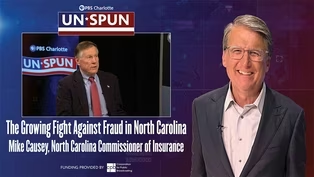
The Growing Fight Against Fraud in North Carolina Preview | Unspun
Preview: S2 Ep215 | 30s | NC fights fraud and rising costs as insurance rates and drug prices climb. (30s)
Providing Support for PBS.org
Learn Moreabout PBS online sponsorship
- News and Public Affairs

Top journalists deliver compelling original analysis of the hour's headlines.

- News and Public Affairs

FRONTLINE is investigative journalism that questions, explains and changes our world.











Support for PBS provided by:
Unspun is a local public television program presented by PBS Charlotte