Unspun
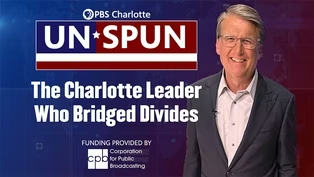
The Charlotte Leader Who Bridged Divides | Unspun
Season 2 Episode 222 | 26m 31sVideo has Closed Captions
Mac Everett helped transform Charlotte through banking, civic leadership, and unity.
As a senior banking executive, Mac Everett helped transform Charlotte into a national banking center. But his influence extended far beyond business. Time and again, Everett brought people together to address the city's biggest challenges—from race relations and community fundraising efforts to winning support for Charlotte's transit system. His leadership helped shape the city that exists today.
Problems playing video? | Closed Captioning Feedback
Problems playing video? | Closed Captioning Feedback
Unspun is a local public television program presented by PBS Charlotte
Unspun
The Charlotte Leader Who Bridged Divides | Unspun
Season 2 Episode 222 | 26m 31sVideo has Closed Captions
As a senior banking executive, Mac Everett helped transform Charlotte into a national banking center. But his influence extended far beyond business. Time and again, Everett brought people together to address the city's biggest challenges—from race relations and community fundraising efforts to winning support for Charlotte's transit system. His leadership helped shape the city that exists today.
Problems playing video? | Closed Captioning Feedback
Where to Watch Unspun
Unspun is available to stream on pbs.org and the PBS app.
Providing Support for PBS.org
Learn Moreabout PBS online sponsorship(bright music) - [Presenter] This is a production of PBS Charlotte.
(bright music fades) - Tonight on "Unspun."
Charlotte didn't become a major American city by accident.
It took business leaders, elected officials, and community voices finding a way, even when they didn't always agree.
In a time when compromise often feels like a dirty word in politics, what can we learn from leaders who believe consensus wasn't weakness?
It was how you got things done.
(dramatic music) In today's America, welcome to the spin game.
Believe me, I know.
I'm Pat McCrory.
When I was governor and mayor, I played the spin game, I was played by the spin game.
But aren't we all done being spun?
Let's take the spin out of the world we're in here on "Unspun."
(dramatic music continues) Good evening, I'm Pat McCrory.
Tonight, our Pioneers in Politics and Business series continues with someone who spent decades helping build consensus during some of Charlotte's most important moments.
As a senior banker executive, Mac Everett helped transform Charlotte into a national banking center.
But his role in this city went well beyond business.
When Charlotte faced big civic challenges, Mac Everett was often the person asked to bring different sides together, whether it was race relations or a United Way fundraising campaign.
He even helped with public support for Charlotte's transit plan, a decision that helped still shape the city today.
Mac, it's great to have you on "Unspun."
And congratulations on being a pioneer in politics and business.
- Well, thank you, Pat, very much.
It's always great to be with you.
- First, I wanna find out, how did you get to Charlotte?
- It's not a very interesting story.
Andy and I were in Atlanta.
We've been there for nine years with the Trust Company of Georgia- - Andy your wife.
- Andy my wife.
- Your wonderful wife.
- My wonderful wife.
We'd been there nine years with the Trust Company of Georgia, which became SunTrust, which merged with BB&T to become Truist- - [Pat] I think you went to the University of Georgia, right?
- Both of us went to the University of Georgia.
I had a call from a friend, Neill McBryde, who was a lawyer here at Robinson Bradshaw, and said that, "First Union would like to talk to you about coming here to work."
And so through Ed Crutchfield and John Georgius, we had conversations, and we ended up coming in 1978 to Charlotte.
- Wow, that's the year I came to Charlotte.
Same year, right out of Catawba County.
- Great year for Charlotte, huh?
- No doubt about it.
You know, when we moved to Charlotte, Charlotte was just coming out of some very difficult race relations, due to desegregation, integration of schools, and things of this nature.
But when I first got to know you, really, was during some race issues when I was mayor.
And we had some major police shootings.
In fact, in over a 6-week period, 1996, '97 time period, we had some very controversial shootings.
And the city was about to explode.
And I remember calling you up and goin', after the last shooting, and goin', "We need the private sector's help and the religious community's help."
Tell me your role in that.
- Well, actually, there was a group that you and then-county commission chair Parks Helms- - Who was a great guy.
- Brought together.
- Yeah.
- Headed by a wonderful lady- - Chairman Parks Helms of the county commission.
- Right, Emily Zimmern.
Wonderful lady.
And James Ferguson, the lawyer in town- - [Pat] Civil rights leader.
- Correct.
Came together to chair this small group.
Claude Alexander, Ralph McMillan, and others.
- [Pat] Former city council member Ralph McMillan.
- Yeah, there were probably six or eight of us.
- [Pat] Right.
- And Michael Marsh, kinda, at the time, was sort of facilitating, bringing everybody together.
Diane English was a part of all that.
- Wonderful.
- And we came together.
And through several meetings, decided we needed to have a community event, which we did in December of 1997, and brought 600 people together in the convention center.
We broke down into groups.
We looked at different issues throughout the city of Charlotte.
And when we came back together, Pat, and reported on those issues, we looked at each other and said, "We can't stop now."
So what was then the Community Building Task Force became the Community Building Initiative, which exists today to address those issues in our community.
- And really, since then, we haven't had, well, we almost had some issues when I was governor during the riot, but that really didn't have as much to do with race.
But similar issues of bringing the community together.
And I think that same group helped us during the riot when I was governor in 2016.
- Yeah, well, it's helped us in a lot of cases, I think, Pat.
I think it's a story about process.
Not the answer to a problem, but bringing people together to figure out where we go from here.
- And to have communications before the events, not just after the events.
- Exactly.
And build the relationships, Pat, throughout our community that allow us, when something happens, allows us to come together quickly.
- Now, another time I called on you was I made you, when transit, when I got elected mayor in 1995, end of '95, I looked at an old 25-year transit plan that Richard Vinroot and Harvey Gantt and other previous mayors had worked on, and Parks Helms too, and I looked at it, I didn't run on it, and I said, "You know, this makes sense," but I didn't run on this issue.
And it's kinda shelved.
It had cobwebs on it.
It was the Committee of 100 report.
(Mac chuckles) So I decided, after meeting with Bill Lee, by the way, Chairman and CEO of Duke- - One of my favorites.
- One of the great guys.
I asked him about it.
And he said, "You can wait until the pain arrives and do it then, and it'll be an easy sell, or you can do it now.
But the pain hasn't arrived, and it's gonna be a hard sell."
So I formed a Committee of 10, put you on it.
And you served on it to come up with a pragmatic plan to implement transit, where's the money gonna come from.
And then Rick Ray, who was chairman, called me up at a moment's notice.
He sold Raycom, had to move to Florida.
Who did I call?
The troubleshooter, Mac Everett.
- [Mac] The ditch digger.
(Mac and Pat chuckle) - I call you the troubleshooter, and I said, "Will you head up the Committee of 10?
This is crucial for Charlotte's future."
Tell me about your experience with that and the final proposal.
- Well, again, it was a group of people coming together with different interests, actually.
And I think that was what was so successful about it, Pat.
And it's an easy answer when you look back at it, but it was not an easy answer then.
And, of course, the media was all over us, and for and against us, as was the community.
- They weren't allowed to have secret meetings.
This was all done in public.
- Well, I'm gonna share a secret with you, Pat.
- Uh-oh, uh-oh.
- Yeah, yeah.
We did not adjourn meetings, we recessed meetings.
So that a recess meeting, we could come back together without posting the time- - [Pat] The things you didn't tell me as mayor.
- Well, you shouldn't know that.
(Mac and Pat chuckle) But it all worked out well, obviously.
And, gosh, you look back at things like that and say, "Wow, why did we wait so long to do that?"
Kirby Smart is a head football coach at the University of Georgia.
And Kirby has a saying.
He says, "If you run away from hard in life, you run into more hard."
- [Pat] Wow, wow.
- And that's what we finally did with that transit- - Well, y'all came back to me and said, "We need a half-cent sales tax.
But we need to go to the legislature to ask us to have a referendum."
And I remember goin', "There's no way in heck."
And I got Ed McMahan and Lyons Gray from Winston, took 'em out to Raleigh.
I took three bottles of wine (Mac and Pat chuckle) to convince Ed McMahan to be the mover and shaker in Raleigh and give us permissions.
But I remember, also, you and others would go to Raleigh to help lobby for that, finally showing Charlotte's voice in Raleigh.
- Yeah, yeah.
- And- - There's several instances of that.
And I don't wanna get off the transit, but I remember when First Union and Wachovia were coming together, SunTrust actually wanted to be a bidder for one of the banks.
And I went to Raleigh with Russell Robinson.
- [Pat] Wow.
- And, in three days, Russell had the group- - Who was a lawyer with Robinson- - Robinson Bradshaw, and just one of the great guys and recognized as one of the great corporate minds anywhere.
- Right.
- And the Eastern North Carolina guys, Basnight and Moran, and those guys, in three days, Russell had legislation passed that wouldn't allow an out-of-state bank to get into the process.
- And that changed Charlotte forever.
I mean, that allowed also Texas and Florida to come into play in North Carolina.
Changed our city forever.
That one piece of legislation probably transformed Charlotte more than anything else.
It took a couple of people to do it.
- Yeah.
- No doubt about it.
So transit got initiated.
We went through a referendum.
We went through another referendum, a recall referendum.
And that committee and others stayed on, focused to get this thing done.
And who would've imagined what it's become because of the committee- - It's just unbelievable.
What's happened along the light rail, Pat, and the development there.
- Well, the goal of that, I remember telling you the goal, simplify this thing and do what we can, don't ask for what we can't do.
- Yeah, yeah.
- So the next big thing that, I mean, this was all in the '90s.
It was just amazing that I was I inheriting, and, some, maybe created, was the Hornets in the arena.
And we were going through a situation where George Shinn, the owner of the Hornets, wanted a new arena.
And he was getting offers from other cities to go to New Orleans, offered him 100 million or so dollars, which was big bucks in those days.
And I remember you picking me up in a First Union jet in Knoxville, Tennessee because I was meeting with President Bush.
I was on the Homeland Security Committee after 9/11.
And y'all came, picked me up in the jet to go to Teterboro and then to the NBA headquarters, or the Plaza Hotel.
- [Mac] Yeah, it was NBA headquarters.
- And tell us about your recollection of that meeting, trying to keep the Hornets.
- Well, it was the relocation committee, which Stern, David Stern, chaired, but was made up of- - My buddy, David Stern.
- Your buddy, yeah.
- He didn't like me, and I had a tough time with it.
- Right, right.
But it was made up of other owners, NBA owners.
And George Shinn had applied to move to New Orleans, and we were there to try to keep the Hornets here.
But, frankly, we're not unhappy when they left.
But David Stern, at the end of the meeting, I'll never forget, he called me over and he said, "Look, we are not gonna stop the Hornets from leaving Charlotte, but we will get another NBA franchise for you."
And that was the beginning of what was the Bobcats and Bob Johnson coming to town.
- Well, we had you and maybe Pam Syfert, the city manager- - Nelson Schwab.
- Nelson Schwab was a big player.
- Yeah.
Jim Hansen was a big player, obviously.
He was not with us on that trip, but- - He helped with Johnson & Wales later on.
- Oh, yeah.
- But I remember, we went to the wrong place, first of all.
And then we went to another place, got out of the car and ESPN was waiting for us.
And then I go up to the elevators, and David Stern, first thing he says to me is, "You're late."
- [Mac] Yeah.
(Mac and Pat chuckle) - He was the hardball guy.
- Yeah, no, he was.
Yeah, he was nice to a couple of us and a little hard on a couple others.
- Yeah, it was a tough relation, I knew he was a hardball lawyer.
and so I had to be hardball back to him.
I was the bad cop for Charlotte.
But I had to represent the taxpayers too, so... - [Mac] Yeah, for sure.
For sure.
- So then we go to the next box.
Since Stern told you and others, "We still plan to come back," tell us your role in then getting the Hornets back.
'Cause I remember several meetings with you and your boss, Ken Thompson.
- Yeah, right.
And, again, Nelson Schwab and Jim Hansen and I kinda took that on.
- Jim Hansen with Bank of America.
- Bank of America.
- Executive vice president.
- Yeah.
The NBA announced they would bring another franchise here.
We had to find the owners.
And there were several ownership groups that were interested.
And we landed on Bob Johnson.
Bob was from Washington, had started BET Network and sold it for a lot of money.
And I'll never forget going to Bob and asking him to write a check for $300 million for the franchise, which he did.
And we were very pleased with it.
He came to North Carolina to speak at the North Carolina Chamber meeting, when I was chairing that group, and he started his speech by saying, "Can you imagine three white guys coming into my house, asking me to write a $300 million check?"
(Mac and Pat laugh) But he did.
And to his credit, of course, brought Michael Jordan along with him as a minority owner and a number of Charlotte business people.
- I had actually a good relationship with him.
- Yeah.
- Pam Syfert and I went to his headquarters, which was an interesting meeting.
I remember he gave me a leather jacket with BET on it, and I ended up giving it to a kid I mentored.
But that was an important thing for the NBA, though, to have the first minority owner of an NBA team.
- Yeah, it was.
- And I think that helped at that time.
Although Larry Bird and some others- - Larry Bird was- - He came to my office.
- Exactly, yep, yep.
That's exactly right.
- But then the big issue was how do we get a new arena after the referendum failed?
For an arena, baseball stadium, arts facility.
It failed.
And then I remember going to your office with Ken Thompson and goin', "Mayor, we have to build a new arena."
- Yeah, yeah, yeah.
Well, I think, of course, we built the arena on Tyvola, thanks to Johnny Harris and his leadership out there, which was great.
And the reason we went out there, we were looking at downtown at that point in time, but we went out there because it was free land, basically.
- Right.
- And, in retrospect, it was a great thing to do.
Because I'm not sure we would have the downtown arena where we have it today, had we not been out there and said, "We gotta go downtown."
- [Pat] Yeah.
- So I think it all works out in the long run.
- And you and others worked with Pam Syfert, our great city manager- - Wonderful city manager.
- Who's underrated in the city, doesn't get the credit she deserves.
- Agreed.
- She helped assemble land- - Yep.
- Some owned by the Bell Corporation- - That's correct.
- Because they were breaking up at the time, and their warehouses were there.
- That's right.
- Warehouses and parking lots.
- Well, and their corporate offices were actually over on Fifth Street at that time, yeah.
- [Pat] Exactly, that's now the arena.
- Yeah.
- So you had a big role in that with, again, this team effort of about probably 5 to 10 people, made it happen.
- Well, it got to be a bigger group than that.
- Oh, I agree.
- And a lot of people involved in gettin' it done.
But remember we called things The Charlotte Way?
- [Pat] Yeah.
- And that was The Charlotte Way.
- And the troubleshooter, Mac Everett, was called to help.
- The ditch digger.
(Pat chuckles) Bill Lee, John Bell, Bob Brown, Cliff Cameron, my great mentors, they had these wonderful ideas.
- Cliff Cameron.
- They just needed- - I think you're the twin- - They needed a ditch digger.
- No doubt about it.
All right, golf tournament.
- [Mac] Yeah.
- Quick.
I wanna get all these in that you were involved in.
We had had previous golf tournaments, a senior golf tournament and a PGA a long time ago- - [Mac] Kemper Open in the '70s.
- Kemper Open.
You were active at Quail and worked with Johnny and others.
You were with First Union.
I say First Union, which became Wachovia, which became Wells Fargo.
Tell me in a minute here, how did you and others make this wonderful golf tournament come back to Charlotte?
- Well, it was a great opportunity to brand the new company, the new Wachovia, which it was the combination of First Union and the old Wachovia.
So that was the start of it.
- [Pat] So it was a branding after the recession of 2008?
- Exactly.
- [Pat] Right.
- Well, no, it was before that.
- I'm sorry.
- Our first golf tournament was 2003.
- I keep forgetting all the different time period.
- But, you know, we had an opportunity to build something new.
- [Pat] Yeah.
- And, again, Johnny was a great leader, and Johnny Harris was a great leader in this.
And there were others involved.
And Ken Thompson, obviously.
But they asked me to chair the event, and I did for 16 years.
But, Pat, it is so much easier to start something with a vision than it is to change something.
And so we took that opportunity with the first new spring date on the PGA tour in 30 years to build what became the Wachovia Championship, Quail Hollow Championship, Wells Fargo Championship, and then the Truist Championship.
- And then a PGA Championship and a Presidents Cup.
- Yeah, yeah, and we are so fortunate to have Truist as our title sponsor now.
They're so community-driven, and that's exactly what we need.
- Which is a huge move for Charlotte when they made Charlotte its headquarters.
- Absolutely, yes.
- The movement continues.
- Yeah.
- No doubt about it.
Okay, I'm not gonna get into United Way, but you helped save United Way too.
But I do wanna have time to talk about the future, but one more thing, Good Fellows.
- [Mac] Yeah.
- Will you explain Good Fellows to the audience?
And I'm honored to be on the executive board, but charity and giving back as a major part of this community.
- A 110-year-old organization.
The Good Fellows Club started here in Charlotte 110 years ago.
Every year since then we'd come together at a Christmas event, prior to Christmas, to raise money for people in our community who are hardworking people, but hit some kinda bump in the road, whether it's a medical expense or whatever it might, losing a job, whatever it might be, and to help them get over that one-time expense of rent or, you know, what that challenge is.
- [Pat] Right.
- And it just goes on and on and on, and gets better and better and better, it helps more and more people in this community and goes unnoticed by so many people.
- It's a camaraderie that, like, I've never, I've been going since 1982, I think.
- Yeah, I've been going over 40 years.
You know, Pat, it's the beginning of Christmas for me.
- Yeah, I love it.
- Every year.
- And all these men coming together, and there's a women's- - The Good Friends.
- The Good Friends.
And the women are doing great.
- Awesome.
- It's kinda interesting.
We're segregated, but we all agree with that segregation for that one day where there's camaraderie among the women and camaraderie among the men.
And the Good Fellows comes to the- - Good Friends- - And the leaders come to each one- - Yeah, and we talked about bringing the two organizations together at one time and mutually decided that Charlotte's better off with the two separate organizations.
- I'm honored to be on their executive committee now.
And how many years were you- - Well, I've been to over 40 meetings, and I've been on the board for, I don't know, I'm emeritus now, which is a great word, Pat.
- The only mistake you made, you started letting me tell the jokes during the meeting, which we're gonna have to change sooner or later.
I wanna talk about the future.
Let's just don't talk about the past.
Tell me some of the challenges, based on your experience, that you think Charlotte, North Carolina has for the future.
- Pat, you remember there's one more quick pass.
When Ed and Charlie Shelton moved to Charlotte, and Ed went to the Chamber of Commerce, and we started something called Advantage Carolina, and we came out with a number of projects that needed to be done.
Some of those projects took 20, 25 years to do.
We need to start those projects today for Charlotte, for the future of Charlotte.
And we've got wonderful young leadership in Charlotte.
But what we don't do well is we have the challenges and the leaders, we don't connect them very well and we need to do a better job of that.
So that's one thing.
The political environment certainly bothers me today a little bit.
We used to have a group in the middle, regardless of the political body, that would always sit down and talk.
And then- - [Pat] We had a two-party town.
- Yeah, right, right.
So that is somethin'.
One thing keeps gettin' with me, though, is, for years, the Charlotte Chamber of Commerce was an advocate of small business and a supporter of bringing together a place for small business in Charlotte.
When the chamber and the regional partnership merged, that became more just economic development organization and I think we left small businesses behind.
There's a for-profit chamber now today that does some of it.
But I really worry about that because, forever, we've said that small business, these great announcements are wonderful, but small business, that's the real core of Charlotte.
- You've also been very active in communicating, since you were a member of the Committee of 10 on transit, which I appointed, infrastructure.
I mean, we're growin', you know, 500 people to 800 people a week in Charlotte.
Infrastructure.
- Well, infrastructure, and I don't mean just roads, I'm thinking water, power, all those kinds of things, beginning to be taxed, sewer.
And it's not just Charlotte proper, but if you look at Pineville and Matthews, people can't afford Charlotte, a lot of people, anymore, so they're movin' out to those places and putting tremendous pressure on the infrastructure in these small little communities that surround Charlotte.
Not unlike Atlanta, you know, as people moved out to Sandy Springs and places like that.
So we really need to pay attention to the infrastructure of the Charlotte region.
And what that says to me is we need to bring people from the region together to solve that.
- You had a quote you told me one time from a business leader where differentiating the city and the region and why it was so important.
I remember you told me- - Oh, oh, well, the regional partnership actually started as something called the Charlotte Regional Business Alliance council.
And Pete Sloan, old Pete Sloan, one of the great- - Lance crackers.
- Lance crackers, CEO.
I asked Pete to chair that, which he did.
And we were meeting business leaders from 15 counties on the 42nd floor of then the First Union tower, the jukebox building.
And Pete opened the meeting by saying, "Folks, if you go in and flush that toilet, it's not gonna stop at the Mecklenburg County line."
And he made a great point.
You know, what happens here impacts everybody.
And I think people have begun to now appreciate that Charlotte is the core of a big region, not a separate city.
Whereas, before you didn't wanna go out into the region with the name Charlotte.
You wanted to do something else.
But today, I think people say, "Yes, that's the engine."
- Even the regional people go, "I'm from Charlotte," even though they live in Lincoln County or Stanley County.
- Right.
- They're really from Charlotte region now.
- And it's no longer Charlotte, North Carolina, it's just Charlotte.
- No doubt about it.
No doubt.
One word to describe the future of Charlotte, what do you think's Charlotte's future?
- Well, I'm very optimistic.
'Cause I'm an optimistic person, I don't think- - [Pat] No doubt.
- You need to live a day without being positive about things.
So I'm very positive about it.
Think about that, Pat, when we get sick sometimes, we get real sick before we go to the doctor.
- [Pat] Yeah.
- And I think we probably aren't sick enough yet.
But once we get there, we'll rebound and do some things.
- Once the pain arrives, we move.
- Yeah, yeah.
- But we need to anticipate the pain now.
- Yeah, well, and plan- - Mac Everett, I'm disappointed you didn't put an application in for mayor.
(Mac chuckles) You would've been a good one, so... You've been a great leader in many other ways.
- Thank you, Pat, very much.
- [Pat] Thanks for bein' here.
Congratulations for being a pioneer in business and politics.
- Well, thank you for your friendship.
- [Pat] Thank you very much, Mac.
(dramatic music) - When Charlotte voters initially rejected a referendum that would've helped fund a new arena, arts facilities, and a baseball stadium, a major question immediately emerged, what do we do with a Charlotte Coliseum on Tyvola Road?
The Hornets had already moved to New Orleans.
They had been the primary tenant paying the rent and filling the seats.
Suddenly, one of the crown jewels of our city had become a money-losing white elephant.
Sure it could host concerts in the occasional college basketball tournament, but that wasn't enough to help keep the books in the black.
So working with leaders in the private sector, including Mac Everett and then Wachovia CEO Ken Thompson, we began looking for a solution.
And that solution started with a simple but ambitious idea, bring the NBA back to Charlotte.
We reached out to the league and there was interest.
The problem was our existing arena no longer fit what the NBA wanted.
It was too large for modern professional basketball.
It lacked luxury suites.
The upper deck seats felt miles away from the court.
And perhaps, more importantly, it wasn't downtown, meaning restaurants, hotels, and other businesses saw little benefit from game nights.
So Charlotte did what Charlotte has often done at its best.
We adapted.
We developed a strategy that matched the new realities of professional sports without asking taxpayers for additional taxes.
We sold the Tyvola property for redevelopment.
We assembled land downtown that was largely warehouses and surface parking lots, and we made the case that Charlotte deserved another shot at major league basketball.
It took a team to recruit a team, business leaders, civic leaders, elected officials, people willing to think long term instead of simply managing the crisis of the moment.
And it worked.
The Bobcats arrived.
Eventually, they became the Hornets once again.
And the arena helped transform uptown into a year-round destination, hosting not only NBA games, but major concerts, ACC tournaments, and countless events that brought people and investment into the heart of our city.
It's a reminder that sometimes a setback forces you to rethink the future.
In this case, losing a team ultimately led to building something bigger than basketball.
Now, if the Hornets could just start winning playoff games.
Apparently, even the best strategic plans have their limits.
Well, that's the truth as I see it.
I'll see you next time on "Unspun."
(bright music) - [Presenter] A production of PBS Charlotte.
(bright music fades)
The Charlotte Leader Who Bridged Divides Preview | Unspun
Preview: S2 Ep222 | 30s | Mac Everett helped transform Charlotte through banking, civic leadership, and unity. (30s)
Providing Support for PBS.org
Learn Moreabout PBS online sponsorship New Episode
- News and Public Affairs

Top journalists deliver compelling original analysis of the hour's headlines.

- News and Public Affairs

Today's top journalists discuss Washington's current political events and public affairs.
 New Episode

 New Episode




 New Episode
 New Episode
Support for PBS provided by:
Unspun is a local public television program presented by PBS Charlotte