Unspun
Pioneers of Business: Ed McMahan | Unspun
Season 2 Episode 218 | 27m 12sVideo has Closed Captions
Ed McMahan reflects on shaping Charlotte—and what’s next for the city.
For decades, Ed McMahan has helped shape Charlotte’s growth—from supporting light rail to major projects like Johnson & Wales University. Now, he reflects on how the city has evolved and where it’s headed next, offering insight into the future of one of America’s fastest-growing regions.
Problems playing video? | Closed Captioning Feedback
Problems playing video? | Closed Captioning Feedback
Unspun is a local public television program presented by PBS Charlotte
Unspun
Pioneers of Business: Ed McMahan | Unspun
Season 2 Episode 218 | 27m 12sVideo has Closed Captions
For decades, Ed McMahan has helped shape Charlotte’s growth—from supporting light rail to major projects like Johnson & Wales University. Now, he reflects on how the city has evolved and where it’s headed next, offering insight into the future of one of America’s fastest-growing regions.
Problems playing video? | Closed Captioning Feedback
How to Watch Unspun
Unspun is available to stream on pbs.org and the free PBS App, available on iPhone, Apple TV, Android TV, Android smartphones, Amazon Fire TV, Amazon Fire Tablet, Roku, Samsung Smart TV, LG TV, and Vizio.
Providing Support for PBS.org
Learn Moreabout PBS online sponsorship- [Announcer] This is a production of PBS Charlotte.
- Tonight on "Unspun," we'll sit down with a man who didn't just watch Charlotte grow, he helped build it.
From major economic development wins to the decisions that shaped how this city moves and competes, some of Charlotte's most important moments can be traced back to a handful of key leaders, and Ed McMahan is one of them.
In today's America, welcome to the spin game.
Believe me, I know.
I'm Pat McCrory.
When I was governor and mayor, I played the spin game.
I was played by the spin game.
But aren't we all done being spun?
Let's take the spin out of the world we're in, here on "Unspun."
Good evening, I'm Pat McCrory.
For decades, Ed McMahan has played a key role in shaping both policy and growth in this region, from helping lay the foundation for Charlotte's light rail system to supporting major economic development projects all over the city and state that helped to elevate Charlotte's national profile, like Johnson and Wales.
So what does he see when he looks at Charlotte today and where does he think we are headed next?
Tonight we continue our Pioneers in Politics and Business series with a former member of the North Carolina General Assembly and a longtime leader of Little Associates.
Welcome Ed McMahan.
- Thank you, Governor.
Nice to be with you.
- Ed, you're one of the best kept secrets in Charlotte about how much impact you've had on, not only Charlotte, but the state of North Carolina, and especially your old school UNC Chapel Hill.
So it's such an honor to have you on the show.
Have people learned about how Charlotte, North Carolina got to where it is today?
And it didn't happen by accident.
It happened because of people like you.
- Thank you.
- So I look forward to finding out more about how we got here today.
But first of all, how did you get to Charlotte, North Carolina?
- Well, nice to be with you, Governor.
I appreciate the opportunity to be here.
Actually, I came to Charlotte from Columbia, South Carolina.
I was working with a bank in Columbia, CNS National in mortgage finance, and I financed a building on Park Road, 4000 Park Road.
And the owner of that building asked me if I would like to come and join him and start a development company.
So I did do that.
I actually was supposed to be moving to Charleston to go to the corporate headquarters of CNS, build a house there, and actually had a house there and a house in Columbia and bought one in Charlotte.
So I had three houses, and decided to come to Charlotte and join him and start a new company.
- And then during your business career, you ended up going to a big architectural firm and leading that firm.
- Well, that was the firm I joined.
Actually, when I came to Charlotte, it was Little & Associates.
And I joined him and he wanted to start a development arm.
And I came to start that development arm.
And then a couple of years later, of course, he was kind enough to bring me into the architectural group too.
And we ended up 50/50 partners for about 40, 45 years.
- And Little & Associates had a major impact on Charlotte and building throughout North Carolina.
Give us some of the examples that you were involved with in the private sector.
- Well, one in particular in the public sector would be the downtown jail project, which was by far the largest project we had ever done.
And we joined eventually with a company out of New York.
And that's one of our landmark buildings here, along with many, many more.
Our firm, when I joined it was 15 people, and when I left there, I retired 10 years ago, actually 15 years ago, we had 350 people.
We had five offices across the country.
A lot of our growth actually occurred by way of the banking industry.
And as First Union and Bank of America, and the banks went national, we went national with them.
So we opened offices in those cities, Philadelphia, Los Angeles, with Bank of America, San Francisco, other areas, Dallas.
We opened offices in order to handle the acquisitions that our banks here, First Union and Bank of America were making of other banks.
So as they grew, we grew.
And now we've probably got 450 people.
- [Pat] Wow.
- In offices around the country.
- And back then when you moved to Charlotte, Charlotte was Charlotte, North Carolina.
Now it's Charlotte.
What a change.
- I had not really thought very much about that.
That's amazing.
- Now I gotta ask you this.
In the middle of your business career, a very successful business career, you decided to get into politics.
What made you do that?
- Well, Governor, quite honestly, if you're in the development business in the late '70s and early '80s in Charlotte, you just never could, I always was interested in politics all the way through schools and Carolina and so forth.
I participated in either student government or president of various organizations.
Tried to anyway.
But anyway, when it came to Charlotte, it became a situation that you couldn't develop in Charlotte.
And I was a developer and we tried to do some projects.
And the people that were leading Charlotte at that time were more of an anti-growth type mentality.
So myself and a couple other guys that are very well known in this city, John Crosland and Allen Tate, the three of us sort of joined together and decided that we would try to do what we could to change the attitude in Charlotte.
Because, I'll give you an example, Governor.
We built a building out on Highway 51 that's now occupied by Charlotte Catholic School.
That was a building built in the late '70s for a major corporation out of Philadelphia, Catalytic Corporation.
We developed that.
- That's Charlotte High School.
Catholic High School.
- Yeah, Catholic High School, those 30 acres of land.
And we tried to get the city to discuss with us the widening of Highway 51.
And we were told by the mayor then and the chair of the county commission, that Highway 51 will never be widened.
We want growth to go north in Charlotte up to the lake.
We have no interest in it going south.
And now of course, you can just look at what's happened.
It's been amazing.
- Highway 51 was a country road.
- Absolutely.
Two lanes, very narrow two lanes.
- And Park Road getting out there was a farm road, near South Meck.
- And Carmel was a two-lane road.
But anyway, we developed that project and it later became Charlotte Catholic.
- That's a fascinating story.
I didn't know that.
That's the first time- - That was one of our projects there.
But we first started the development company in the late '70s.
- And it's been converted into a major influential high school.
- We did the conversion, our firm did the conversion into the high schools.
- I did not know that.
I did not know that.
- There were other examples in Charlotte that it just was an attitude that we needed to combat.
The roads were not being built.
There's just a lot of things happened in the late '70s, early '80s that required, it really meant that Charlotte took some time.
And I think even today we're still seeing some of the results of that because I think our road system is really a combination of that in Raleigh, the anti-Charlotte attitude in Raleigh as far as highways back at that point in time.
That's really why we are still so far behind.
- So you ran for state legislature in the House of Representatives.
What was your major challenge going from Charlotte to Raleigh?
And were we known?
I know, in fact I was on city council during that time.
We were known as the great state of Mecklenburg.
And it wasn't meant as a compliment, I don't think, was it?
- No, it certainly was not.
And I got elected in '94 in a primary election and then started serving of course in '95.
And I had no idea, to be honest with you.
I didn't know a lot about Raleigh.
I knew that I wasn't going to go to Washington.
I knew I really wanted to do work in North Carolina.
So I went to Raleigh and it was just amazing the attitude that I found there.
I did not realize it was anything as strong as it was about anti-Charlotte.
And so we had a wonderful delegation from Charlotte.
I think there were 14 of us.
And we had the Fountain Odoms and the Ruth Easterlings and the Becky Carneys, and Becky's still there I think.
- Still there, yeah.
- And it really goes on in a great group of people.
And we worked together.
I mean, we really worked hard together and no negative attitude at all between our delegation.
We really did what we thought was best for Charlotte.
And the attitude in Raleigh was pretty difficult.
- Well, when I was elected mayor in '95, I was beginning to implement the transit system from scratch basically.
And I approached you and Lyons Gray and Boyd Cauble, who was my assistant, city staff, we took you out to an Italian restaurant in Raleigh.
So I was kind of new and you'd only been in the legislature probably two or three years.
And I said, "Can you carry the water for us for Charlotte Mecklenburg on a new transit line?"
And if I recall right, after the initial bottle of wine, you said, "There's no way in heck that we'll ever get permission for a referendum for a half-cent sales tax or matching funds also."
And I think it took about three bottles of wine.
But finally you and Lyons Gray said, "We will help you."
Is that how you recall that conversation?
- Yes, I certainly do.
I remember that night quite well.
And Lyons was a dear friend.
He was from Winston-Salem.
That's the Gray family, the very prominent family.
He chaired the finance committee.
- Ended up being a cabinet member for me when I was governor, years later.
- That's right.
I forgot that.
- Yeah.
- He's a wonderful man.
He understood what we were talking about.
And I remember Fountain Odom as who we thought was sort of chair of the delegation who should be handling this legislation.
- You told me that, I remember.
- Yeah.
Fountain, we didn't know, but Fountain, for some reason, he thought that we Republicans, and there weren't many of us of course, but we Republicans would do what we could to defeat it.
And he did not want to have a bill that they were proposing a tax increase that would result in a defeat and appear that it was the Democrats leading it.
- That's how I recall it too.
- You remember that?
- Oh yeah.
- So we and our delegation talked about what could we do?
And everybody was shaking their head, we just can't get a half-cent sales tax for transit.
The people across the state didn't like it.
A lot of people in Charlotte didn't want the half-cent sales tax.
And he provided the leadership and were kind enough and thoughtful enough of Charlotte to come to Raleigh and meet with us.
And I just felt so strongly about how we needed that and needed it very badly because we had such a poor transportation system here in Charlotte.
And again, we couldn't grow.
A lot of our growth was being controlled by that.
So anyway, we decided within the caucus, I volunteered that I would try it.
Well, I had the most trouble originally for the first two or three months I worked on it with my own caucus.
You can imagine a Republican in the Republican caucus trying to convince the Republicans to raise taxes.
- And really you were only giving us permission to have a referendum.
- That is correct.
- To raise the tax.
- To raise the tax.
That was something we Republicans had.
And of course we had gotten the majority in the General Assembly for the first time in 100 years, in the '95, '96 era, we were in control of the North Carolina House.
So here we were all of a sudden coming out as leaders in North Carolina proposing a half-cent sales tax.
And the sales tax had always been sacred to the state of North Carolina.
- [Pat] That's right.
- It was the tax that the State of North Carolina collected completely and controlled all of it.
And I think it was 6 or 7% at that time.
I think we raised it six and a half, seven.
And the state did not want to give up the control of it.
- That's how I recall it too.
- We remember that.
So anyway- - That's why Raleigh went after the rental car tax at the time.
- After them.
- Yeah.
- And which we later did that also.
But the bottom line was we had a really really tough job within our own caucus.
And fortunately we had Lyons Gray that got on our side.
He was chair of the finance committee, which was the critical committee that I had to go through before we could take it to the floor.
I felt like if we could get it approved in the House, Fountain could get it approved in the Senate because it was under the control of the Democrats.
- [Pat] Right.
- So we fought a long, long time.
And again, you recognize Lyons and he certainly needed a lot of credit.
Because he even spoke on the floor.
We had a tough, tough time convincing people to do it.
And we got it out of the House probably by one vote and went on to the Senate, and of course they got it approved.
- And Lyons was from Winston-Salem.
You're going, what's a guy from Winston-Salem helping Charlotte?
And that was part of the dinner, and I think it was due to your relationship with Lyons Gray.
- Well, we were good friends and I have so much respect for him and still do.
And I know he's still doing well.
- Did you ever imagine, I know that there's nothing named after you in Charlotte and there should be, or throughout the state and your university.
Did you ever imagine, because I didn't, what the South End and now University of Charlotte have become based upon that one dinner at an Italian restaurant in Raleigh?
- I know it.
Absolutely not.
And it's fantastic, the South End, I mean, it is just phenomenal.
Our office, of course, was down at I-77.
They've now moved downtown of course.
But our office was there and it's just changed the entire South End.
- But this isn't the only thing you did in the legislature.
Every time we needed water carried in Raleigh, we called Ed McMahan.
And you didn't call attention upon yourself and I knew you were doing the tough work behind the scenes.
There are some other examples of things that you helped get, the downtown arena.
If you watch the Hornet games right now, I guarantee we wouldn't have the downtown arena without Ed McMahan.
- Well, it was another tax.
I mean, we raised the hotel/motel tax, and I readily remember the fight I had in the finance committee.
- With my future budget director, Art Pope.
- Yeah.
Art was a very strong anti-tax guy.
Became, again, a really close friend.
And he did a wonderful job by choosing him as your budget director.
He's a fantastic guy.
He doesn't get the credit.
He's been incredible, phenomenal for Chapel Hill.
He's done so much for that university.
But anyway, Art was very strongly opposed to raising the hotel/motel tax.
Why that particular one?
I'm not sure.
But anyway, he gave me a tough, tough time.
We argued openly in the finance committee.
So anyway, we did get it finally approved, and it turned out to build the Spectrum, do the convention center, and I'm sure done some other things for Charlotte.
- NASCAR Hall of Fame was used for the same money.
We would've never built a NASCAR Hall of Fame.
- And we had the hotel/motel industry supporting it.
It wasn't that they were against it.
The leaders here in Charlotte actually were in favor of it.
But again, it was a tax increase.
- Another one, another major factor in Charlotte during my tenure as mayor was Johnson and Wales University.
This was at a time when West Trade Street was in pretty bad shape and Bank of America was investing some in there, but you just didn't go to West Trade Street.
And we had this chance to get Johnson and Wales University from Charleston.
And that was thrown on my plate with about 24 hours notice.
And then we called you up and I flew up to Providence, Rhode Island, but we needed your help in Raleigh.
And at that time, I think Governor Easley, who's become a good friend of mine.
- Oh yeah.
- He was going, "What's this cooking school?"
- Yeah, that's exactly what he called it in a speech.
- I remember the speech.
- Yeah, I remember.
I reminded him of that at the ribbon cutting.
We joke about it years later.
So tell me, what got us Johnson and Wales?
- Well actually, Fountain Odom, I believe.
Wonderful senator, dear friend.
You and I went to his funeral I guess two or three years ago.
- He was a great man.
- Oh, wonderful.
He was asked originally by Bank of America to get that money.
Well he knew that he could get it on the Senate side.
- I think it was about $10 million.
- It was $20 million.
- $20 million, okay.
- $20 million.
So anyway, I was brought into the dinner meeting up at the Bank of America Tower.
Jim Hance of course, and Hugh McCall, and think of all the wonderful things Hugh McCall has done for this city.
- But Jim was the real leader.
- Jim was the leader.
- Jim Palermo.
- Yeah.
And they brought us into the dinner and Fountain wanted me to be there.
I think probably that's why I was there.
Because he knew somebody was gonna have to carry it in the House.
And anyway, I attended the meeting and we did end up, and of course Jim Black, Speaker Black, Charlotte.
- Yeah, absolutely.
- He very much wanted me to get involved.
And a lot of things I did up there, to be honest about it later on, was as a result of Jim Black, because he was the Speaker and the leader.
And he would often designate me because we were good friends in Charlotte and I admire him and really appreciate the things he did for Charlotte.
- No doubt about it.
In the remaining five minutes here, I gotta talk about the power struggles in Raleigh.
It's nothing new.
When I was governor, I had major power struggles.
Executive branch versus legislative branch, House versus Senate versus judiciary.
But you had the ultimate power struggle you were involved with in Raleigh.
Briefly explain the power struggles that were going on back in the '90s in Raleigh.
- Well, of course North Carolina had been controlled by the Democrats for 100 years.
We were Republicans, we were there, but in very small number and no influence whatsoever until we got the majority my first term.
And that made a huge difference.
I think we showed the General Assembly that we were not a bunch of dummies, that we had some sense and that they thought otherwise.
But I think we proved that we could also be leaders.
But anyway, we got together and basically- - There was a speaker issue.
- Oh, well, the speaker issue, I was gonna say we had the control in '94, '95 and '95, '96.
And then we lost it again.
But we got along.
Up there then, we showed them when we were in control that we were not bad people.
And even though Tony Rand and Marc Basnight on the Senate side didn't have a lot of respect for the House side for any reason, they ended up, I think by us being in control and providing some leadership from those two years, they got the control back, of course in '97, '98.
And have had it up until we got the control in 2011.
But long story short is that at that time, we at least talked to each other.
We got along.
You know what's going on today, as I see it in Raleigh and in Washington, it's totally different.
I mean, people just dislike each other.
And that was never the attitude in Raleigh.
They may dislike our positions on issues, but they never really expressed any personal feelings against us.
And we could talk.
But it's a lot different back then, Pat, than it is now.
- Is that your biggest concern about politics today, both in Raleigh and Washington, is the personal animosity?
- Absolutely, yeah.
It's just so disgusting when you have, I was there for 12 years, and it's just so disgusting to see the attitude that goes on, even in Raleigh today.
We never would've thought about kicking somebody out of the party if they voted with an issue with the other party.
If that had happened, and I had Republicans voting on some things, I mean, I would've been kicked out.
Because a lot of the Republicans weren't very happy.
But the bottom line is the way it's operating today, it's just awful.
And the way in Washington, when you see the party going nationally, fighting the other party and the Iran war, for instance, all the things, all the issues, we've never done that before.
We've always gotten along to the point that we... Yeah, fight for your position, but not go national and international.
- And afterwards we'd go have a drink together.
- Absolutely.
- In the old days.
It's like Fountain Odom.
- Oh, Fountain was a dear friend.
We got along and he appreciated what we did.
And we were working for Charlotte.
It was all about Charlotte.
- So in the remaining two minutes here, what advice would you give to young people interested in politics today?
- Well, even though it really looks like an awful, awful situation, and it is, I still encourage people to get involved.
Public policy is so important to this country and to this city and to the state of North Carolina.
I mean, it is very, very important.
And that's the way we looked at it back when I was serving.
And that's why we were able to pull together eventually and try to do what's best.
And I just encourage the young people to take a good look at it.
I strongly encourage people later to think of your career first before you think about getting involved in politics.
I did that.
I was here for 25 years, 30 years before I ever, even though I wanted to get involved.
But bottom line is I strongly encourage the young crowd, the young people to look at it.
- And you were my mentor.
- Well, thank you.
- As a city councilman, mayor, and governor, and you've done so much for this state and I just want to thank you.
- Well, you're very kind and you are a wonderful governor.
And I hope that you know that.
Because you were fantastic.
- It's an honor to have you on "Unspun."
Thank you.
(dramatic orchestral music) Way back in the '90s, when I was on city council and later mayor, state legislators in Raleigh would sometimes look us straight in the eye and call Charlotte the great state of Mecklenburg.
It wasn't a compliment, it was a sarcastic jab, an insult.
We complained about not getting our fair share back from what we were putting into the state coffers.
But across much of North Carolina, Charlotte was seen very differently, as a city of wealthy bankers going to the opera in tuxedos, while other communities were still struggling with jobs, clean water, and basic public services like schools.
Well, that's the reality Ed McMahan and other Charlotte leaders were dealing with when they went to Raleigh, tried to pass legislation that would benefit this region.
And frankly, it didn't completely go away.
Even when I was governor, some legislators didn't think I had paid my dues because I hadn't served the General Assembly.
They didn't say great state of Mecklenburg to my face anymore.
But I knew exactly what was being said behind the scenes and behind my back.
So are things different today?
Yes and no.
On the positive side, a lot of legislators now have children who live and work in Charlotte, and that changes how they see our city.
But there's a new dynamic at play.
The state legislature is overwhelmingly Republican and Charlotte Mecklenburg politics are overwhelmingly Democrat.
And in today's environment, that battle between red versus blue creates very little political incentive for state leaders to go out of their way to help Charlotte.
Now you can bet they still come here to raise campaign money.
That hasn't changed, and sadly, that may be where Charlotte still holds the most influence.
But here's the bottom line.
If Charlotte wants to succeed in Raleigh, it still comes down to people and relationships, smart leaders who understand the system, who can build relationships, earn trust, and navigate the politics.
Leaders like Ed McMahan, a true pioneer who knew how to get things done when it mattered most.
Well, that's the truth as I see it.
See you next time on "Unspun."
(upbeat music) (gentle music) - [Announcer] A production of PBS Charlotte.
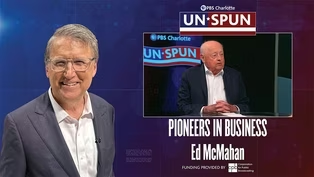
Pioneers of Business: Ed McMahan Preview | Unspun
Preview: S2 Ep218 | 30s | Ed McMahan reflects on shaping Charlotte—and what’s next for the city. (30s)
Providing Support for PBS.org
Learn Moreabout PBS online sponsorship
- News and Public Affairs

Top journalists deliver compelling original analysis of the hour's headlines.

- News and Public Affairs

Today's top journalists discuss Washington's current political events and public affairs.











Support for PBS provided by:
Unspun is a local public television program presented by PBS Charlotte