Unspun
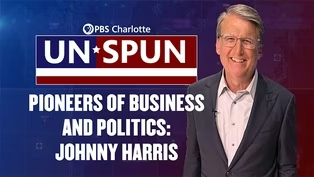
Pioneers of Business and Politics: Johnny Harris | Unspun
Season 2 Episode 201 | 27m 12sVideo has Closed Captions
Examine how politics and private-sector leadership shape Charlotte with Johnny Harris.
We explore the intersection of political decision-making and private-sector leadership—two forces shaping Charlotte’s growth. Few figures are as central to that story as developer and civic leader Johnny Harris. As the city navigates rapid growth, business competition, and future infrastructure, Harris offers a long-term perspective on where Charlotte has been and where it must go next.
Problems playing video? | Closed Captioning Feedback
Problems playing video? | Closed Captioning Feedback
Unspun is a local public television program presented by PBS Charlotte
Unspun
Pioneers of Business and Politics: Johnny Harris | Unspun
Season 2 Episode 201 | 27m 12sVideo has Closed Captions
We explore the intersection of political decision-making and private-sector leadership—two forces shaping Charlotte’s growth. Few figures are as central to that story as developer and civic leader Johnny Harris. As the city navigates rapid growth, business competition, and future infrastructure, Harris offers a long-term perspective on where Charlotte has been and where it must go next.
Problems playing video? | Closed Captioning Feedback
How to Watch Unspun
Unspun is available to stream on pbs.org and the free PBS App, available on iPhone, Apple TV, Android TV, Android smartphones, Amazon Fire TV, Amazon Fire Tablet, Roku, Samsung Smart TV, and Vizio.
Providing Support for PBS.org
Learn Moreabout PBS online sponsorship(bright music) - [Narrator] This is a production of PBS Charlotte.
- Tonight on the first "Unspun" of 2026, we connect the dots between political decision making and private sector leadership, two forces that have defined a region's growth.
You know, few names are as closely tied to Charlotte's story as developer and civic leader Johnny Harris.
As Charlotte continues to navigate rapid population growth, compete for business, and plan for the next era of infrastructure and livability, there are a few voices with a better long-term perspective on where the city has been and where it needs to go next.
In today's America, welcome to the spin game.
Believe me, I know.
I'm Pat McCrory.
When I was governor and mayor, I played the spin game.
I was played by the spin game.
But aren't we all done being spun?
Let's take the spin out of the world we're in, here on "Unspun."
Hi, I am Pat McCrory.
Tonight in this special edition of "Unspun," pioneers in politics and business, we sit down with Johnny Harris to talk about the past, shaping the present, and the present shaping the future.
Charlotte is facing big decisions, how we grow, how we move, how we attract jobs, and how we keep this a place where people want to live, work, and raise a family.
For more than 40 years, Harris has been at the center of those decisions for major commercial and mixed use projects to his leaderships in sports, transportation, civic organizations, and strategic planning.
Johnny, it's great having you on the show.
Thank you very much.
- Thanks, Pat.
It's always good to be with you.
- I wanna talk about the past a little bit, going all the way back to your grandfather.
- Neither one of us do that very well.
We don't look back about anything.
- No doubt about it.
- But go ahead.
Yeah.
- But I think it's important, because one of the reasons I want to do this pioneers in politics and business is to get new people familiar with how Charlotte got to where it was.
And they need to know the history so they don't repeat our mistakes and maybe repeat some of the good things that happened.
But one of the first, the first governor ever from Charlotte, North Carolina was your grandfather, Cameron Morrison.
You were a young man when he passed.
Do you remember him?
- Well, yes I do actually.
I was about seven when he passed away in 1953.
And of course that was when everything was really beginning to start to happen here.
And, you know, all of the people, I actually remember meeting Adlai Stevenson.
He was running for office.
And Dwight Eisenhower and all, President Eisenhower and that group.
And so I always sort of understood there was politics out there.
And then you begin to look at the people that were making things happen, even back then.
Dave Ovens, who was with Ivey Company and- - Ovens Auditorium.
- Ovens Auditorium and the Coliseum that we built out there.
- So what do you remember about your grandfather's impact on Charlotte?
- Well- - Being a governor from Charlotte, and did he feel the great state of Mecklenburg feedback at that time?
- Oh, I think he always felt the great state of Mecklenburg, but that comes from, he grew up in Rockingham, North Carolina.
And he was a person who, back then they didn't really have loudspeakers.
So when you got up to speak and he was governor from '22 to '26, he had to have a booming voice and he wasn't a big man.
He was kind of a little bit short, like, maybe 5' 10", and 5' 6", 5' 9".
But his voice was booming.
He had a photographic memory.
And he could, he would read books, and he'd read a book in about three hours and you could ask him page 23, and I promise you he could answer it.
It's unbelievable.
He could go to the page and tell you.
- Now, he grew up at the SouthPark area, right, which was a farm?
Grew later on in life.
- He grew up in Richmond.
No, he didn't move here until after he left the governor's mansion in '26.
Right, but that farm was right next to the Graham farm.
- Oh, absolutely.
The farm, that farm, I mean, yes, that farm.
And then when we moved out there in '53 after he died, we lived, we grew up right next to Dr.
Graham and the Graham family.
- Do you remember that, the fields out at SouthPark?
- Oh, yes, I remember the whole, oh, yeah.
- The fields?
- I mean, I remember- - Park Road Shopping Center.
- I remember what the ditch in Colony Road was a creek that sort of separate the bull barns from the milk cows.
Oh, yeah, it was the largest dairy farm in North Carolina.
- So that gets us to your dad.
Your dad also had a big impact on Charlotte, especially with the development of Quail Hollow Country Club.
Would he understand today, if he were still alive, what you've done with that regarding golf and the future- - Oh, I think he would be so very, very pleased.
And I think that and all of his friends, and I had the great good fortune to be, through my father, had great knowledge and understanding of people like John Belk and Bill Lee and Cliff Cameron and Ed Crutchfield, and of course one of my closest friends, Hugh McColl, who always looked to make things better.
And it really was an interesting experience to watch leaders who had ideas and then watch public buildings begin to follow that leadership or vice versa.
And they played such an integral part in the transition of this community.
- Well, there was another guy that played an integral part in putting Charlotte on the spotlight, and it was someone who became a close friend of yours, a national, international figure by the name of Arnold Palmer.
- Well, that's true.
But, you know, Arnold was from Latrobe, Pennsylvania through and through, but loved North Carolina.
He loved being here.
He loved being a part of the Charlotte- - But he had a house here in Charlotte.
- Oh, he did.
He did.
- On the golf course.
- Out of Quail Hollow.
Yes, sir.
- And a dealership.
- That's right.
- I remember Arnold Palmer dealership, downtown Charlotte.
So did that help bring sports and the golf tournaments to Charlotte?
- Oh, I think absolutely it did.
And my father had been working at the masters and at the scorers table.
And when Arnold won in '58, he actually received the scorecard from Arnold when he turned it in, and handed it on to a guy named Mike Grainger, who was from Wilmington, North Carolina.
And it was during that that they became friends and he asked him to come talk to a group of leaders here who wanted to build a golf course.
And that's how it all started.
- Well, we kind of center on the center city in talking about our history, the growth of that, and we're gonna talk about that.
But two other major cities in Charlotte are called SouthPark and Ballantyne.
In fact, I think during the time I was mayor and governor, SouthPark was probably the third largest city in North Carolina regarding a business park.
- Yep.
- Can you go through how the concept of SouthPark started and how important that was?
'Cause it could have been developed in a very poor way, like parts of our east side at the time.
- I'll do it quickly.
When my grandfather died and we were, he was operating a very large dairy farm, my father, ironically, was allergic to cows.
And so it wasn't gonna work.
And he was running an insurance agency here, a casualty insurance agency.
And he and my brother would, you know, that was not gonna be where my father was gonna be, was on the farm.
So they began to, they sold the cows, the milk cows to Biltmore Dairy and gave the beef cows to Laurinburg down to the university.
And it's interesting that we began to think about what was the best way to do something with this land, which was between 45 and 5,000 acres.
And you had to plan it.
And that was sort of the beginning of me understanding that you couldn't do anything well unless you stopped and thought about it and planned it and then pursued a good plan.
And there was a guy named Jack Delaney, who was the first head of the Planning Commission here in Charlotte, who'd been been working with the development guys in the war and building, you know, the towns that the soldiers lived in.
And he came to Charlotte and he started talking about, have all this land, you have plan it.
And he and, got my father and Jack Blythe, who was in the construction, Millennial Construction, and Bill Barnhart.
And they started talking about building things.
And they built, you know, it's funny, Cotswold shopping center over there.
They built houses over there.
- Which is sustained.
- Yeah, sustained.
That's right.
Still there.
But it started the process, and then SouthPark was gonna be a jewel.
And then along came George Ivey, young George Ivey, the young George Ivey, not Mr.
Ivey, and John Fielder, who was with Ivey's, and John Belk.
And Tom, John and Tom.
And they wanted to build a really large shopping center.
And so my mom and dad sold them the land.
It's now SouthPark shopping center.
And my father and Jack Delaney were convinced they thought that the land around the center could be worth more money than the center.
And then a guy named Smoky Bissell, my brother-in-law, finished the service and moved back here after teaching school in San Diego.
And next thing you know, we were in the business of real estate as well as the land around SouthPark and starting to put together a well-planned community around SouthPark.
- It's made a difference in Charlotte's economic development.
Speaking of Smoky, you and Smoky then, I guess applied the same learnings to Ballantyne- - Correct.
- Which used to be nothing.
In fact, as mayor, I did the first groundbreaking at Ballantyne.
I think it was '96, '97 time period.
- Yeah, it was, and it was really the thing that you don't, it's so much easier to do a good job when you control all the land and there are not competing interests.
- I mean, it's easier to say we don't wanna put something there.
I never will forget out at Ballantyne, everybody who was doing developments were putting all their money and all of the show up on the street, up on the interstate.
And we sat down with Martin Crampton and the planning staff and said, there was a guy named John Rennekamp from Philadelphia who was helping do the planning.
He said, "Let's move the center back into the middle of the property and let it be the center of it and leave this more open."
And if you go now to Ballantyne, there's very little up on the outer belt because we really were trying to leave it where it would move.
It was on the other side of the road.
We didn't- - I think you made a point.
When you have a large piece of property you can work with, you can plan, if it's piece by piece- - It's really hard to do.
- It's not sustainable.
- That's right, it is not- - Real quick, Phillips Place.
- Yes, sir.
- People don't know the historical value of this small shopping area in mixed use development.
I recall as mayor in '97, it was very controversial 'cause it was a mixed use development, which became the model in the future for our high-density areas like South End.
- Yes, correct.
And it was really, and again, you gotta go back, I went to see Martin Crampton.
I said, Martin, I've been to look at these various centers.
Smoky and I had been to look at all these different projects, and we kept saying, you know, they're mixing the uses now.
It's not only retail but it's residential and it's office.
It's a place where people can live, work, and play.
And, you know, you'd never heard that up until that was going on.
And we didn't, at least you didn't hear it associated with Charlotte.
And we had the great opportunity to do that.
- You and I have had a lot of discussions about what's made Charlotte, Charlotte.
What do you think are the three or four major things that made Charlotte beat our competition at the time?
Greenville, Columbia, Richmond, you know, Knoxville.
- I think- - That was our competition back in the sixties and seventies.
- I think when you go back, when you go back and you look at number one, during the civil rights movement, there was a real chance for us to fail.
And because of John Belk, our mayor, and Fred Alexander, we had a situation where our leadership went to the rest of the leadership, both Black and white, and said, "Okay, we just can't let this city lose."
We have got to win at doing the best job we can for that.
And we started and we did it.
And that's when public facilities became so important.
1958, Billy Graham had his first crusade here.
My dad was treasurer of the Crusade.
And I remember going to the Charlotte Coliseum and it was the first time I'd been to a public facility with integrated facilities.
And Billy would not appear in the Coliseum if the facilities weren't integrated.
And of course, Paul Buck, you know, he was all for that.
So we had, but I think you watch that happen and then all of a sudden we built this building, largest unsupported dome in the world at that time.
And we began attracting things.
And because our leadership had stood up and made this building happen, Dave Evans and others, you all of a sudden saw it begin to be an integral part, bringing our community together.
And all of a sudden that public facility became a sports facility with the NCAA and bringing them here.
And John Belk's involvement with the NCAA.
And that was just the beginning.
- And we had major business leaders later on serve on the school board.
Dick Spangler.
- Absolutely.
The wealthiest person in North Carolina ran for the school board.
- Yep.
And won, and won.
- And won.
(both laughing) And won.
Another area.
- And a wonderful man too.
- Let's talk about the present and the future.
- Yes, sir.
- The airport.
- Mm-hm.
- I mean, you've been crucial in that.
I gotta give Richard Vinroot a lot of credit where we started, and Jerry Orr, the airport director.
I was on council at the time, and then we started third parallel runway, the concourses.
That airport changed our city.
- Yeah, I think you go back.
I think our public facilities, our leadership, our people in the airport, and of course John and Jerry Orr.
I mean, you know, along the way, you've been associated with so many different community leaders and were part of the structure of Charlotte, Jerry Orr, Wendell White, David Taylor, all these guys that were so important to Charlotte worked within the guidelines that we have.
Truly the airport established the fact that we were more than just a crossroads for the textile industry or this, or the trucking industry.
- And this is at a time, too, when during my tenure as mayor, we didn't know what was the airline's future because- - That's right.
- US Airways was going up and then it'd go down.
And then the mergers and acquisitions.
I mean, literally it could've gone the other way.
- I can tell you, I sat in a boardroom in London trying my best to get BA to buy Piedmont Airlines and then US Airlines.
- I think I dealt with four different CEOs during that time.
- That's where Lord King and those people, it was really interesting.
- It was- - But then I- - We didn't think of what, it could have gone another direction.
- I'm worried you're not gonna let me answer the rest of the question.
- What's that?
- The next most important thing that's happened to Charlotte was the decision by a mayor after working with a former CEO that he worked with, where he told him, "Don't wait.
Go work on building the light rail."
And I remember all of that and I remember Bill Lee telling me it's the most important thing the city will ever do and Pat can make it happen now.
So all of a sudden, you know, like, so many people in Charlotte, when they get told it's a good idea, they think about, and then we all joined in to help you.
And, you know, we built light rail when nobody thought it would work.
And think about, think about what's been created, you know, along that rail system, not just South End, but now NoDa and up north and going towards the university.
And, you know, I've told the people in Raleigh over and over again, the biggest mistake you ever made was not connecting Raleigh, Durham, and Chapel Hill with light rail, the three greatest universities on the East Coast that close together.
- It helped us.
- It helped- - It helped us because we beat 'em out for the money at the federal level.
- That's right.
So it worked out great.
But I think, I think the light rail, you know, and then of course we always heard about education and the university becoming what it is today, Charlotte- - Which wasn't in the city limits- - Uh-uh.
- When I was elected mayor.
- Oh, no.
Oh, no.
- Yeah.
- And it was a little bit like, you know, there was a mistake made, and I was an integral part of the mistake when we talked about, we built the Coliseum out on Billy Graham Parkway.
- Yeah.
- Because we, the land was free and we thought it was great, and we were gonna build it downtown.
But Bill Poe and the Baptist Church didn't want a neighbor that was the Coliseum.
'Cause the Coliseum was a little concerning.
- So Bill Lee told me, and I wanna apply this now to the future.
Bill Lee said, "You can wait until the pain arrives and do it then, and then it'll be an easy sell but you've probably waited too long.
Or you can do it now and it'll probably work, but it's gonna be one hell of a sell for the future."
If you had to talk to future mayors and local officials and business people, what do we need to start doing now before we feel the pain?
- Whew, well, we're fortunate that private industry, Atrium, with their new Pearl, which I think will be one of the most dramatic impacts on this city going forward.
I think we have people who we gotta continue to focus on jobs.
We are in a location nobody really understands.
But if you think about it, and you take the three lowest cost provider of electricity in this country, two of the three control Virginia, North Carolina, and South Carolina.
Virginia Energy owned SCANA, and they own Virginia.
- We got Dominion.
- We got, and Dominion, that's right, Dominion Energy.
And so it's an amazing situation.
And now you find yourself with the ability to track that whole new industry that's developing.
And it's jobs, but it ain't a lot of jobs 'cause they're just big buildings with, you know, with five, I mean, 15 or 20 people.
- So what are we not doing now do you think that we should be doing to prepare for the future?
Until the, to prepare for the pain or try to avoid the pain?
- Well, I think there are always gonna be challenges, but I think education, we got to figure out a way to make our education system work.
Our transportation system is bad as people think the traffic is.
Every time you move somebody here and they tell you where they came from and they say, "You just can't believe it.
This is so much nicer than where we came from."
And you don't wanna get into talking about other places.
- But we wanna learn from that too.
- That's right, we wanna learn, and that's why- - We don't wanna become- - That's why planning is so important.
- what made people leave.
- That's why planning is so important.
- So real quick, sports and entertainment in the future.
You are instrumental in bringing golf tournaments, the PGA, the Wells Fargo championship, but also the Panthers.
God, we gotta get them in.
- What we gotta do, we gotta get it through this year and pull it out, so.
- So what's the future in sports and entertainment?
Because travel and tourism is a major part of our economy.
- Sure, and I think, again, facilities.
You know, when Bruton and those guys went out and built NASCAR- - It's Bruton Smith.
Yeah, NASCAR.
- NASCAR, I mean, wow.
And now look at the industry that's been created, you know, in North Charlotte and in North Mecklenburg County.
And, you know, we gotta get over just Charlotte.
What we gotta do is begin to talk about, as you did, I mean, you went from being a mayor, being the head of Charlotte to being governor, the head of the state.
And I think you have to always stay focused on the area surrounding you and looking at the edge conditions of what you're trying to do.
But I do think sports and entertainment is gonna do nothing but go forward.
And you look at what David Tepper is now talking about a 4,400-seat entertainment facility next to the Coliseum in uptown.
That's really important.
That's really important to keep it as focused as we can.
- Let's talk politics.
- Yes, sir.
- For the remaining three minutes.
- Sure.
- First of all, I read somewhere that at one time you considered running for governor.
Was that because of the influence of your granddad, do you think?
- Oh, I think that was a little bit of my grandfather.
And I think then when I was, I don't know whether you remember all these old names, but Bert Bennett and Jimmy Glenn, after we'd just done the Coliseum out on Billy Graham Parkway.
They came to me and asked me to consider.
And I actually went around the state for a while thinking about it.
And then Deborah and I had a long talk and we decided that wasn't such a good idea.
- My wife wish she would've had the same conversation.
No doubt about it.
- But I do think that anything we can do to reach out through the political aspects of the state of North Carolina and bring people to understand Charlotte is not the Great State of Mecklenburg, but it is a one of the shining lights in the state.
- What did you learn and what can we learn by, as I learned traveling throughout the state running often for statewide office that you may be, even while you looked at that possible position a long time ago, what did you learn from the rest of the state about Charlotte?
And I think that's changed now.
- I think it's changing.
I think it's changing.
I think it's changing because it's all happening so fast.
- Yeah.
- And I think about, I think people, there are three kind, you know, Ben Franklin said there are three kinds of people in the world.
The people who watch change, the people who fear change, and then the people who embrace change.
And they're the ones that create a vision for the future.
They embrace change.
And we call those people leaders.
And we call them, you know, they end up being mayors and governors and all of that.
And I think what we have to do is stay focused on what we're going think about how to plan for it.
I do think the understanding that jobs keep this city so much safer and so much more productive, because people are hearing, bettering themselves as well as bettering the city.
- Well, Johnny, I'm convinced that the city and the state that adapts to change better than everyone else in the future, 'cause change is coming, whether we like it or not.
- Absolutely.
The city and state that adapts to change will be the city that survives.
- Yep.
- And you're one of the great change agents of Charlotte and of North and South Carolina.
And I just wanna personally thank you for that.
- Well, thank you.
- For being on our show.
- Thanks for having me.
- Appreciate it.
- I've enjoyed it, as I always do.
- Thank you very much.
- Thank you.
(intense music) - One of the many reasons why Charlotte during the past 50 years jumped ahead of its peer cities was because of a very strong, visible presence of corporate and business leaders in civic and political leadership.
John Belk, a retail leader, Richard Vinroot, a top corporate lawyer, Harvey Gantt, an architect, were all successful mayors.
CD Spangler, owner of National Gypsum, was chairman of the school board.
Doug Booth, president of Duke Power, was elected to the County Commission after he retired.
But those days are long gone.
In fact, even mid-level business leaders, people like me aren't stepping up to run for local or statewide office much anymore.
Corporate visibility and civic life has also dropped dramatically from the good old days of Hugh McColl, Ed Crutchfield, Bill Lee, Ken Thompson, Ken Lewis, Bill Grigg, Johnny and Cammie Harris, the Dixons and Shelton Brothers, and Dale Halton, names that once defined Charlotte's civic backbone.
So why the decline?
First, the time demands are brutal.
Corporate executives no longer run just Charlotte-based regional companies, they're running national and global operations.
And public service becomes like a second full-time job.
Second, they worry that stepping into civic leadership could backfire.
You know, in today's hyperpartisan environment, one comment can anger shareholders, customers, or entire markets.
And most CEOs don't wanna spend Monday cleaning up something they set on Saturday.
And third, something I know very well, the personal toll.
Business leaders tell me that they don't wanna drag their spouses and kids into the arena, especially when social media turns disagreement into a threat, a pile-on, or a character assassination.
It's not the criticism, it's the cruelty of the criticism.
But here's the truth.
Whatever city figures out how to bridge this gap in leadership, how to reconnect business, civic vision, and public service will hold a massive competitive advantage in the decades ahead.
You know, I hope Charlotte leads that charge.
We've done it before and we can do it again.
Because when business leaders step back, politics gets lopsided, driven more by principles than by practical problem solving.
Well, that's the truth as I see it.
Thanks for joining us on "Unspun."
(bright music) (bright music) - [Narrator] A production of PBS Charlotte.
Pioneers of Business and Politics: Johnny Harris Preview | Unspun
Preview: S2 Ep201 | 30s | Examine how politics and private-sector leadership shape Charlotte with Johnny Harris. (30s)
Providing Support for PBS.org
Learn Moreabout PBS online sponsorship
- News and Public Affairs

Top journalists deliver compelling original analysis of the hour's headlines.

- News and Public Affairs

FRONTLINE is investigative journalism that questions, explains and changes our world.









Support for PBS provided by:
Unspun is a local public television program presented by PBS Charlotte