
October 29, 2026 - PBS News Hour full episode
10/29/2026 | 57m 46sVideo has Closed Captions
October 29, 2026 - PBS News Hour full episode
October 29, 2026 - PBS News Hour full episode
Problems playing video? | Closed Captioning Feedback
Problems playing video? | Closed Captioning Feedback
Major corporate funding for the PBS News Hour is provided by BDO, BNSF, Consumer Cellular, American Cruise Lines, and Raymond James. Funding for the PBS NewsHour Weekend is provided by...
October 29, 2026 - PBS News Hour full episode
10/29/2026 | 57m 46sVideo has Closed Captions
October 29, 2026 - PBS News Hour full episode
Problems playing video? | Closed Captioning Feedback
Where to Watch PBS News Hour
PBS News Hour is available to stream on pbs.org and the PBS app.
Providing Support for PBS.org
Learn Moreabout PBS online sponsorshipGEOFF BENNETT: Good evening.
I'm Geoff Bennett.
Amna Nawaz is away.
On the "NewsHour" tonight: Republicans seize on a controversy in Alaska's closely watched Senate race, while Democratic surrogates make a final push to rally voters in Georgia ahead of Election Day.
We speak with a retired Israeli general to examine what that nation's election results could mean for its national security and its relationship with the U.S.
And Nobel Peace Prize winner Maria Ressa discusses her new book on how to protect and rebuild democracy in an era of authoritarians, big tech, and artificial intelligence.
MARIA RESSA, Author, "The Fight Back: A Citizen's Guide to Standing Up to Dictators": You're living through this now in America.
Don't normalize it.
Realize it is death by 1,000 cuts.
If you do not act, if you do not reclaim your rights, you will lose it.
(BREAK) GEOFF BENNETT: Welcome to the "News Hour."
With Election Day just days away, the battle for control of the U.S.
Senate is intensifying, and so are allegations of political dirty tricks.
Alaska's governor has ordered an investigation into Democrat Mary Peltola's Senate campaign over reports it recruited a spoiler candidate to siphon votes from Republicans.
Meantime, President Trump is campaigning in South Carolina, another Republican stronghold where his endorsed candidate is struggling.
Our Liz Landers has more.
DONALD TRUMP, President of the United States: Thank you.
LIZ LANDERS: President Trump rallying for his handpicked Senate candidate today in a state he won by nearly 20 points in the last presidential election.
DONALD TRUMP: And five days from now, we're going to elect Darline Graham to the United States Senate.
(CHEERING) LIZ LANDERS: The president attacking Graham's opponent, Dr.
Annie Andrews, with a false slur.
DONALD TRUMP: But we can't have tranny Annie.
If you have one or two victories, you're going to have communists in control of the U.S.
Senate.
The reason is that the other Democrats, there aren't too many sane ones to start off with, I will be honest.
Most of them are horrible.
Their policy is so bad.
LIZ LANDERS: Graham's bid to succeed her late brother for a full term may be on shaky ground, a recent New York Times/Siena poll showing her race against Andrews in a dead heat.
That's evident on the ground at early voting sites, where even Republicans are fed up with the affordability crisis and the war in Iran.
BRENT CHAPLIN, South Carolina Voter: Most people would get fired.
You would get fired from your job if you don't perform.
So it's time to -- like Donald Trump says, you're fired.
It's time to fire some people.
JAIME WALKER, South Carolina Voter: Do I love the current administration and everything they do?
I like a lot of things, but there's some things I don't like.
However, for me, voting is more like against the other -- the other party.
LIZ LANDERS: En route to the Palmetto State, the president continued to question how officials are administering the election in another state, Alaska.
DONALD TRUMP: It's called voter fraud.
Should not have been allowed to happen.
LIZ LANDERS: A New York Times investigation found that the campaign of the Democratic candidate, Mary Peltola, recruited a candidate named Dan J. Sullivan to run against the incumbent Republican, Dan S. Sullivan.
Trump suggested Peltola should be criminally charged.
DONALD TRUMP: It's hard to believe that she could even be allowed to run.
LIZ LANDERS: For her part, Peltola called the story a distraction.
REP.
MARY PELTOLA (D-AK), Senatorial Candidate: It's another diversion.
Every day it's some new look over here moment, not Dan Sullivan, registered Republican, incumbent, voted for this war in Iran 14 times.
LIZ LANDERS: Dan S. Sullivan, the incumbent senator, also weighing in by phone this afternoon.
SEN.
DAN SULLIVAN (R-AK): To the Alaskan people, don't let your ballot be thrown away.
Don't let the dirty tricks of Peltola and her campaign trick you.
LIZ LANDERS: Alaska's governor now ordering an investigation into whether Peltola's campaign violated Alaska's laws.
The Department of Justice already filed a lawsuit late last week, preemptively asking that the results of the Alaska Senate race not be certified if the Democrat wins.
Last night, former President Obama used his star power in Georgia to rally for Democrats Jon Ossoff and Keisha Lance Bottoms.
While Ossoff appears to be in a comfortable lead in the race to keep his Senate seat, polls show Bottoms neck and neck with her opponent, Rick Jackson, in the race for governor.
If she wins, Bottoms would be the first black woman governor in U.S.
history.
BARACK OBAMA, Former President of the United States: I heard the president was not happy.
LIZ LANDERS: The former president also addressed a joke he made over the weekend that President Trump's renovations make the White House look like a Cheesecake Factory.
BARACK OBAMA: They mobilize a whole-of-government response to that joke.
(LAUGHTER) BARACK OBAMA: Not to inflation, but to that joke.
They don't have solutions to actual problems.
So they'd rather have the media and you talking about the Cheesecake Factory.
LIZ LANDERS: Outside the rally... WOMAN: No insult to Cheesecake Factory, because I do like them.
LIZ LANDERS: ... attendees said that, while they love the restaurant, they understand that the former president's joke gets at a larger issue.
DARLENE WEBB, Georgia Voter: The rule of law does not apply to the Republican Party for some reason at this time.
So I just want to make sure that we're out here trying to change and put good people in office that's going to support the people and not just their pockets.
LIZ LANDERS: The rule of law exercised last night in California, where a district judge denied the federal government's request to stop the processing of 20,000 ballots that they alleged were sent to noncitizens.
The judge calling it an attempt to -- quote -- "coerce a state and local government to abandon their own constitutional elections procedures."
The Justice Department also declared in a late filing Wednesday night that it would not send FBI or ICE agents or employees to serve as poll monitors.
President Trump will continue his midterm blitz tomorrow with a rally in Florida.
For the "PBS News Hour," I'm Liz Landers.
GEOFF BENNETT: And we start the day's other headlines in Ukraine.
A local cease-fire in Oleshky held for a third day with humanitarian aid set to enter the city soon.
Roughly 2,000 people remain trapped in the Russian-held area.
The Russian military began clearing land mines today.
The explosives have prevented residents from leaving Oleshky, and it remains unclear whether they will be able to evacuate to Ukrainian or Russian-controlled territory.
Meantime, local authorities in Central Ukraine say a Russian drone slammed into a train platform in Dnipro, killing at least 14 people.
One woman who was waiting for her train described the terrifying moments after the attack.
SVITLANA SHCHERBAK, Train Passenger (through translator): I am simply lost for words with outrage.
Why?
Why on earth did Russia, that occupier, those bloody invaders, attack the civilian passengers on the commuter train?
Why?
What do the people have to do with this?
GEOFF BENNETT: Meantime, Russian President Vladimir Putin says he's in close contact with Elon Musk as Russia develops its own alternative to his Starlink Internet service.
Putin also praised the tech mogul as a genius.
The reported contact raises questions about Musk's relationship with Moscow, given Russia's ongoing war in Ukraine and Starlink's critical role in Ukrainian military operations.
The Pentagon is reportedly accusing a recently fired Army general of misconduct amid allegations that he leaked classified information to the media.
Defense Secretary Pete Hegseth removed Lieutenant General Brett Sylvia from his position overseeing strategy, plans and policy for the Joint Chiefs of Staff.
Sylvia is the latest senior military official ousted by Hegseth and the second general removed from that same post.
The Pentagon has not publicly confirmed a reason for his dismissal, and Sylvia has not commented.
A reporter asked President Trump today about the officer's removal, but referred to him only as Lieutenant General Sylvia.
The president appeared not to realize the officer is a man.
DONALD TRUMP, President of the United States: She's got problems.
She's going to have big problems.
She did.
Well, we're very much looking for leakers.
And she's going to have big problems, long-term problems.
GEOFF BENNETT: Sylvia's removal comes amid reports that the Trump administration is considering renewed military strikes against Iran after the midterm elections.
Spain started three days of national mourning today for the victims of yesterday's high-speed train crash.
Cranes worked through the night to clear away crushed cars as search-and-rescue teams combed through the wreckage.
Crews found one more body, bringing the death toll to at least 69.
Dozens of others were injured, and families have been traveling to the area in a desperate search for their missing loved ones.
CESAR VICENTE, Son of Missing Train Passenger (through translator): We don't know anything.
This is chaos.
I have my father, and I don't know where he is.
I hope to find him.
Oh, my lord.
I don't want this to happen to anyone.
This is unbearable.
This is hell.
GEOFF BENNETT: This is Spain's second major train disaster this year, adding pressure to the government of Prime Minister Pedro Sanchez just weeks before national elections.
European Central Bank President Christine Lagarde says she's stepping down in February, months before her eight-year term was set to end.
CHRISTINE LAGARDE, President, European Central Bank: I leave this institution with a sense of good work done and an ECB that is fit for the future.
GEOFF BENNETT: Lagarde announced her decision on social media, appearing with bandages on her face.
The 70-year-old said she had undergone minor surgery to remove what she described as a little skin cancer.
She later told reporters that she's stepping down to speak more freely about global affairs.
Her departure sets off a process among European leaders to select the next president of the European Central Bank.
Delivery giant DoorDash is buying Instacart in a $17 billion deal, pending regulatory approval.
Instacart would retain its name and app while customers could order through either platform.
Instacart shoppers would also gain access to 50,000 additional stores through DoorDash.
The merger would help the companies compete with retail giants like Walmart, Costco, and Amazon.
Shares of DoorDash jumped more than 5 percent today, though Instacart closed lower.
Elsewhere on Wall Street, a sell-off of Google's parent company Alphabet weighed on stocks.
The Dow Jones industrial average lost a quarter-of-1-percent.
The Nasdaq dropped more than 1.33 percent.
The S&P 500 also closed in negative territory.
And we have two passings of note to report this evening, starting with Oscar nominee Barbara Barrie.
PAUL DOOLEY, Actor: What are we going to do about it?
BARBARA BARRIE, Actor: I don't know, dear.
We could always strangle him while he's asleep.
GEOFF BENNETT: She was nominated for her role as a supportive mother to an Indiana teenager in 1979's "Breaking Away."
Barrie was also a familiar face on television, appearing as the wife on "Barney Miller," and later as Brooke Shields' grandmother on "Suddenly Susan."
She earned three Emmy nominations and a Tony nomination for originating the role of Sarah in Stephen Sondheim's "Company."
Her daughter says Barrie died with medical assistance following a terminal cancer diagnosis.
Barbara Barrie was 95 years old.
And stage and screen legend Patrick Stewart has died.
PATRICK STEWART, Actor: Engage.
GEOFF BENNETT: He brought gravitas to the role of Captain Jean-Luc Picard in "Star Trek: The Next Generation," a character he went on to portray in four feature films.
PATRICK STEWART: I may be able to help you find some answers.
HUGH JACKMAN, Actor: How do you know?
PATRICK STEWART: You're not the only one with gifts.
GEOFF BENNETT: And he was known to millions around the world as Charles Xavier, or Professor X, in the X-Men films.
Before that, though, he built an impressive stage career in the U.K., bringing his commanding voice and statesmanlike presence to countless roles, both classic and contemporary.
Stewart sat down with our Jeffrey Brown in 2023 and explained how his life's path began the day a teacher handed him Shakespeare's "Merchant of Venice."
PATRICK STEWART: He said: "All right, Act 4, Scene 1, you're all cost.
All right, start reading."
And of course, we all went -- and he yelled at us: "Not to yourselves, you idiots."
And then he said: "This is a play.
It's people.
It's real life.
It's not just being on a stage.
You have got to invite people into it."
There was something about having those words, even though I was mispronouncing them, in my mouth that felt good, felt I was in control.
JEFFREY BROWN: It gave you a voice.
It gave you a self.
It gave you a confidence.
PATRICK STEWART: Yes, exactly.
What it gave me was that I could drop being Patrick Stewart.
Nothing bad can happen to me on this stage.
JEFFREY BROWN: You were not "Star Trek"-literate, huh?
PATRICK STEWART: Not remotely.
I wasn't even a fan.
I wasn't a fan of sci-fi.
(LAUGHTER) PATRICK STEWART: And I still struggle just a little bit.
JEFFREY BROWN: But you're saying that, in these characters for television and film, you were able to find the same way in that you found to Shakespeare on the stage.
PATRICK STEWART: Exactly the same.
JEFFREY BROWN: The complexity.
PATRICK STEWART: Yes, and making sure that, if the complexity was inside him, when I released it, it would make sense, it would be understandable.
And I think... JEFFREY BROWN: To yourself, as well as the audience?
PATRICK STEWART: Always to myself, yes, but hopefully as often to the audience.
That was always my objective.
I wanted to bring the audience into our world.
I was never that interested in thrusting it out, but just inviting people to come in and share what we were experiencing.
GEOFF BENNETT: Stewart had been suffering from Alzheimer's disease and Lewy body dementia.
A statement on social media says he died yesterday at his home in Los Angeles.
Patrick Stewart was 86 years old.
Still to come on the "News Hour": we travel to Pennsylvania, where congressional races could hinge on who voters blame for high prices; colleges try to prepare students for the work force by building social skills; and how the Milwaukee Brewers won their first ever World Series.
Democrats are favored to retake the House in November, but the size of their potential majority could hinge on a handful of competitive races.
Four are in Pennsylvania, where President Trump and Republicans made significant gains in 2024.
Now Democrats are betting that the president's low approval rating and frustration over high prices will shift the political landscape.
Lisa Desjardins traveled to two of those districts and has our report.
LISA DESJARDINS: It is rainy, cold, and gray.
In Bethlehem, Pennsylvania, Mike McMaster shows us how his dream of owning a home is also overcast.
MIKE MCMASTER, Bob Brooks Supporter: Now, for me, if I could even get my hands on one of these little houses, that'd be cool.
Good enough.
LISA DESJARDINS: The affordable housing shortage here is not new, but recently has spiked as prices soar.
MIKE MCMASTER: Just pushing them out because they can't afford to keep up with the taxes and the mortgage and all that.
LISA DESJARDINS: There's, like, nothing left for you.
MIKE MCMASTER: There's nothing, no, nothing at all.
LISA DESJARDINS: McMaster is a UPS driver and proud Teamsters member, which he credits with his $30-an-hour job.
But even so, he's been living paycheck to paycheck.
Last month, the Allentown-Bethlehem area was listed as one of the nation's worst 25 cities for housing affordability.
But it is politically powerful, a corner of the state with two key congressional races, Pennsylvania 8, where freshman Republican Rob Bresnahan is in a toss-up race with Scranton Mayor Paige Cognetti, and Pennsylvania 7, where Republican Congressman Ryan Mackenzie faces former firefighter Bob Brooks.
MIKE MCMASTER: Basically, this room right here is kind of like our war room.
LISA DESJARDINS: Mike is all in for Brooks.
Not his first campaign for a Democrat, but he says something's different this time.
MIKE MCMASTER: It seems to me like the people are more vigilant and more aware of what's going on, in my personal opinion.
The last time around, we would knock on Trump supporters' doors,they didn't want to hear from us.
Now they actually do want to hear from us.
LISA DESJARDINS: Bob Brooks stresses his working class background as a union president and foster parent.
BOB BROOKS (D), Pennsylvania Congressional Candidate: In 20 years of fighting fires, I've never seen a dumpster fire like Washington.
LISA DESJARDINS: Hoping it will help earn votes from fellow blue-collar workers.
It is earning their help.
Dozens of union members bussed in from Philadelphia and New Jersey to canvass for him on a Monday morning.
Tangibles are the talking points, housing prices, gas prices, and diesel prices.
Those are up more than $2 a gallon in a year in this state.
BOB BROOKS: I own my own small business, right?
So I have three diesel pickup trucks that I use to plow snow.
I don't want to drive those trucks.
I'm driving my wife's car right now, because, if I drive those trucks, the other day it cost me $220 to fill one.
BOB BROOKS: I mean, we have to stop this endless war that he has going on for what reason, nobody knows.
I don't even think he knows.
LISA DESJARDINS: "He" is President Trump, who launched war in Iran and historic tariffs elsewhere in the name of American security and long-term wealth, but that has brought short-term price increases and a political nightmare for other Republicans.
JOE GRUTERS, Chairman, Republican National Committee: What we do have going for worse is, we have candidates like Ryan Mackenzie, who's proven himself to be a winner over and over again.
LISA DESJARDINS: That's National GOP Chairman Joe Gruters stumping alongside Congressman Mackenzie.
Across this district, some praised Mackenzie as accessible and hands-on.
NATE BARNDT, Ryan Mackenzie Supporter: For me, when I lost my job, and very much felt down and out.
I reached out to plenty of people who didn't help and didn't give me any resources, but he was someone who did.
LISA DESJARDINS: But Mackenzie knows the challenge.
REP.
RYAN MACKENZIE (R-PA): Well, certainly with when it comes to housing, that has been a long-running issue in our local community.
LISA DESJARDINS: As for his actions, he points to passage of the bipartisan housing bill in June, which limits corporate homebuying and boosts community banks.
REP.
RYAN MACKENZIE: We have made actual, real, substantial legislative changes that are going to bring more housing stock online and that will bring prices down in the long run.
WOMAN: Brooks borrowed big money from his family, then never paid it back.
LISA DESJARDINS: Mackenzie attacks Brooks for financial issues, a debt to his former mother-in-law he settled last month, and accusations of false information on a COVID application.
Brooks says Mackenzie's ads lie.
BOB BROOKS: I worry about the people in Pennsylvania 7.
LISA DESJARDINS: And he is focused on the campaign and affordability.
So is Deb Modica, whose farm nearly straddles the two competitive congressional districts.
A real estate agent, she harvests much of her family's food here and cares for a small group of horses.
DEB MODICA, Rob Bresnahan Supporter: So this is Stormy.
Stormy has Lyme's disease.
LISA DESJARDINS: Hey, Stormy.
Thanks to rising fertilizer prices, even the cost of hay is up.
DEB MODICA: Better grasses like alfalfa, they're like $12 to $20 a bale.
LISA DESJARDINS: Yes, I saw that.
DEB MODICA: It's crazy.
LISA DESJARDINS: That's wild.
DEB MODICA: So it's -- it's getting harder and harder for farmers.
LISA DESJARDINS: And you don't have choice.
Like, you got to... DEB MODICA: You have no choice.
You have to feed them.
LISA DESJARDINS: But Deb sees these costs differently.
She supports what President Trump is doing and believes in short-term sacrifice.
She's campaigning for Mackenzie and voting for Bresnahan, her congressman, this election.
DEB MODICA: To fix something doesn't happen overnight.
The economy has to get put back together.
And, unfortunately, it's got it -- things hurt, like a broken leg hurts why it's healing.
So we have to go through a little hurt until we get back to our healing.
LISA DESJARDINS: For Deb, a prime issue is the rise of Democratic Socialists, like New York Mayor Zohran Mamdani.
You're not saying that all Democrats are socialists or communists?
DEB MODICA: Absolutely not.
I have a lot of friends that are Democrats, but they're not voting Democrat right now.
They're afraid of the same thing I am.
They're just commonsense people with commonsense wants, needs, and desires for their family, their life, their country.
PAIGE COGNETTI (D), Pennsylvania Congressional Candidate: My kids' great-great-grandparents grew up in Scranton in these two houses.
LISA DESJARDINS: The Democrat running here is not a Democratic Socialist.
Scranton Mayor Paige Cognetti is running on affordability and banning corporate PAC money.
In this district, she is the one on the attack.
PAIGE COGNETTI: In Congress, members trade stocks on the same bills they vote for.
I will ban it.
LISA DESJARDINS: Bresnahan's account traded hundreds of stocks last year, including health care stocks ahead of his vote for the so-called Big Beautiful Bill that limited Medicaid.
REP.
MIKE JOHNSON (R-LA): The motion is adopted.
LISA DESJARDINS: Billboards cast him as deceptive, but: REP.
ROB BRESNAHAN (R-PA): Paige Cognetti and her allies are full of baloney.
LISA DESJARDINS: Bresnahan insists a third party handles his trades and points out he voted for stock trade limits this year.
Some voters we met praised his work.
Who are you voting for and why?
BRUCE STEWART, Rob Bresnahan Supporter: Rob Bresnahan.
And we're voting for him because he's done a great job.
So he's done a lot to bring funding to our -- to the -- to Northeastern Pennsylvania.
LISA DESJARDINS: However, Bresnahan's biggest problems may not be his record or his Democratic opponent, but his party and president.
MICHAEL O'BRIEN, Paige Cognetti Supporter: Bresnahan is a Republican.
He's a Trump supporter.
I just think that a lot of the things that they're in favor of, I'm not.
CARLOS MARTINEZ, Paige Cognetti Supporter: I plan on voting for Cognetti.
I don't really like what the Republican Party's doing, so definitely voting blue.
LISA DESJARDINS: In Northeast Pennsylvania, two vulnerable Republican incumbents and two ways of thinking about a common problem.
Everyone is feeling rising prices.
The question is whom they will blame or not on the ballot.
GEOFF BENNETT: And Lisa Desjardins joins us now at the super screen for a deeper dive into the battle for the House of Representatives.
So, Lisa, this is an expensive contest for the House.
Where does it all stand?
LISA DESJARDINS: Expensive and expansive.
Look at this map of all the races.
These are the 81 somewhat to very competitive races that we are tracking.
Now, The Cook Political Report lists a lot of competitive races.
It's important to also know this number, three.
This is the magic number.
Democrats need to flip three seats on net in order to take over the House.
So I don't want to just look at this large map, but let's look at the most competitive seats that are toss-ups or leans.
These 50 dots represent those 50 seats that may determine the fate of the House of Representatives.
What's important here is who occupies them now.
Look at this.
It's mostly Republicans, 39 of these seats occupied by Republicans.
They are on defense.
Remember that magic number three?
So, essentially Democrats need to pick up three seats right here -- this is the line -- in order to flip the House.
Now, The Cook Political Report already forecasts that Democrats are likely to flip some seats.
How many?
Ten.
So, if you remember this line that determines control of the House, Democrats have already put themselves in position to pass that.
And, right now, Republicans need to push back.
But they are in a good position at this moment, Geoff.
GEOFF BENNETT: And on the substance of all these races, the economy is the top issue, per usual.
But how and where is that playing out?
LISA DESJARDINS: Right.
I love looking at this the substance.
Let's talk first of all, about housing, that issue that we found in Northeastern Pennsylvania.
These are the places where housing is particularly an issue in the campaign.
You see it in Florida, in Nevada, in Southern California.
But let's talk about the issue that a lot of Americans also feel, gas and fuel prices.
It is everywhere, but I want to point out these races where they are particularly facing record high fuel prices, or like in Maine or Alaska, where they are more dependent on diesel or heating oil.
And let's focus on one race in particular where this is a factor.
Let's go to Colorado's Eighth District.
This is a situation where the gas prices have still been rising this month.
The Democrat, Manny Rutinel, says that the issue is Iran and tariffs.
He says he had pushed back against President Trump.
But the Republican, Gabe Evans, says, no, it's the problem of regulation, and he has supported President Trump.
So this is a factor in this race.
GEOFF BENNETT: And what about the other issues driving these midterm races?
LISA DESJARDINS: There's one more I want to talk about because a lot of the country is, and that is data centers.
Here's an example of four of the races where that has become a campaign issue this year.
And I want to focus on one.
This is Central Michigan, Michigan's Seventh District.
The Democrat, Will Lawrence, won his primary in part because he campaigned so hard on a ban, at least temporarily, on data centers.
This is a district where we just saw a $10 billion data center put on hold because of protests from locals.
Now, Tom Barrett, the Republican incumbent, he has a different tact.
He instead says each locality should be able to decide whether they want the data center or not.
This race is a good test of how far voters want to go when it comes to data centers.
And all of these issues, of course, around the country do have ties to the economy.
And it's important to see how that layers in.
GEOFF BENNETT: Lisa Desjardins, our thanks to you, as always.
LISA DESJARDINS: You're welcome.
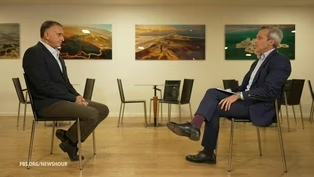
GEOFF BENNETT: Israel is once again facing political uncertainty after an election that has produced no clear governing majority amid competing allegations of voting fraud and irregularities.
But beyond the political maneuvering, what do the results reveal about how Israelis want their leaders to confront the country's mounting challenges?
For that, our Nick Schifrin spoke with retired Major General Tamir Hayman, former chief of Israeli military intelligence and current executive director of the Institute for National Security Studies.
That's a leading Israeli think tank.
NICK SCHIFRIN: Tamir Hayman, thank you very much.
Welcome to the "News Hour."
Regardless of whether Benjamin Netanyahu stays prime minister or Gadi Eisenkot becomes prime minister, is there an overall agreement on how Israel should approach its national security since October the 7th?
MAJ.
GEN.
TAMIR HAYMAN (RES.
), Former Chief, IDF Intelligence Directorate: It seems like Israelis are still in the trauma after post-October 7, and they are reluctant on going to any kinds of concessions in the Palestinian-Israeli conflict.
Most parties argue for a very hawkish, proactive approach in terms of the next state needed in confronting Hamas and Iran, et cetera, et cetera.
So it seems like, in that aspect there's a proactive, hawkish military, security approach that is accepted, and we are not entering a zone of agreements or a peace-aspiring environment.
NICK SCHIFRIN: You write that pursuing peace is considered a danger, and -- quote -- "War is necessary and preventive war is preferable."
Does that mean Israel is set to be in a perpetual state of war?
MAJ.
GEN.
TAMIR HAYMAN (RES.
): Let me just emphasize that, in this article, I wanted to provoke a discussion, so I exaggerated a little bit in order to be able to observe trends.
But it seems to be describing trends that are in the consensus.
NICK SCHIFRIN: And where Israel is going?
MAJ.
GEN.
TAMIR HAYMAN (RES.
): And where Israel going, if not diverted.
We are headed right now, brings us into very dangerous place.
NICK SCHIFRIN: Does Israeli leadership believe that a perpetual state of war is better?
MAJ.
GEN.
TAMIR HAYMAN (RES.
): They do not believe that peace is a viable or tangible solution right now.
Most Israelis will consider any form of a peace as weakness, naive approach, trusting the Arabs, trusting the enemies.
The general sentiment is, we trusted the Arabs, and they betrayed us.
So what left is an ongoing state of confrontation.
NICK SCHIFRIN: You describe, even if it's exaggerated, this severing with the United States.
And, again, I will I will read it, knowing that you say it's exaggerated, but it's very provocative.
"The United States is a declining power, and, given its ongoing social and political shifts, will soon abandon Israel.
In any event, excessive dependence on the U.S.
exposes Israel to the influence of a progressive American value system incompatible with Israel's Jewish character."
I mean, it's an understatement to call that controversial among American Jews, but is that where we're headed?
MAJ.
GEN.
TAMIR HAYMAN (RES.
): It seems like we are losing our position as a consensus among Americans, and we are losing the bipartisan approach.
We have already lost the bipartisan position, and we are going to be maybe homeless in the political spectrum of United States.
Secondly, the fact that we are dependent on our national security on capabilities and backing from United States create vulnerabilities.
So, what is the rational outcome?
We must rely on ourselves.
NICK SCHIFRIN: Netanyahu has referred to Israel as super Sparta, basically being self-reliant on weapons, as you have been describing.
He's even suggested that Israel might have to rely on Bitcoin because of future sanctions.
How isolated, in your opinion, is Israel?
MAJ.
GEN.
TAMIR HAYMAN (RES.
): The idea that if Israel will be ever isolated, it is an existential threat to the existence of Israel, OK?
The economy is based on high-tech and an advanced science.
That cannot be established in an isolation mode based on crypto.
Second, there's a true threat of isolation and sanctions.
But the way to handle it is to approach the causes of that.
NICK SCHIFRIN: But given the results of this election, even if we don't know exactly the numbers, in which Netanyahu and his bloc maintained the lead over the opposition bloc, doesn't that suggest that these trends are accelerating, that many Israelis have embraced these ideas that you're critiquing?
MAJ.
GEN.
TAMIR HAYMAN (RES.
): The political spectrum map is moving right.
The problem is that there is radicalization in the right-wing establishment after October 7.
NICK SCHIFRIN: And back to the concept that you write about.
And again, acknowledging that you say that you're exaggerating, there's one fundamental conclusion that you have, and that it's that the consensus is to -- quote -- "guarantee Israel's continued existence as a Jewish state, even at the cost of eroding its democratic values."
Explain that in simple terms.
MAJ.
GEN.
TAMIR HAYMAN (RES.
): The whole article asks critical question, whether it's good for Israel to move in that path.
Of course, it is wrong.
And that's what -- that's the whole purpose of this idea.
Why do I emphasize the tension between democratic and Jewish values?
Because if we're not going to do anything in the Palestinian arena, and we will annex the Palestinian territories, we will annex the West Bank into Israel, we will not have a Jewish majority.
And the only way to maintain a Jewish statehood is by eroding democracy.
This is an, again, existential threat to the identity of Israel as a Jewish democratic state.
And we must address this problem right now before it's too late.
Otherwise, you are losing -- you are losing the ground beneath your feet of the legitimacy of Israel to be a such unique balance between democracy and the Jewish state.
NICK SCHIFRIN: Tamir Hayman, thank you very much.
MAJ.
GEN.
TAMIR HAYMAN (RES.
): It's my pleasure.
GEOFF BENNETT: Journalist and Nobel Peace Prize laureate Maria Ressa chronicled her fight against the Duterte regime in the Philippines in her 2022 book, ""How to Stand Up to a Dictator."
She detailed years of attacks in her reporting and her newsroom's struggle to defend press freedom and democracy.
Now, in a new book, Ressa warns of different threats to those same freedoms.
Amna Nawaz spoke with her earlier today.
AMNA NAWAZ: According to Maria Ressa, there's a dual threat now by autocratic leaders and big tech companies weaponizing information and algorithms to create new crises for democracy and humanity.
That's all in her new book called "The Fight Back: A Citizen's Guide to Standing Up to Dictators."
And Maria Ressa joins me now.
Welcome back.
It's good to see you.
MARIA RESSA, Author: Good to see you.
Thanks for having me, Amna.
AMNA NAWAZ: You talk in the book about what you call an unholy alliance between state power and platform power.
What do you mean by that?
MARIA RESSA: A decade of harms from artificial intelligence, right?
We're only talking about the tail end of it.
But we have talked a lot about my two dictators in the Philippines.
It was Rodrigo Duterte, who won as president in 2016 with the help of Facebook.
And my second dictator, who I would argue is more powerful is Mark Zuckerberg, because, at that point, 93 percent of Filipinos on the Internet were on Facebook.
Facebook is our Internet.
And here's the part.
They both act with impunity, but Rodrigo Duterte is now waiting at The Hague for his trial to begin, his charges of crimes against humanity, while, from 2016 to today, Mark Zuckerberg is still acting with impunity.
He's not been elected for anything.
And the three phases of harms that we have had from the attention economy, the tech that hacks our biology, right, when lies become facts, so the attention economy in social media, chatbots, and the harm, the intimacy that is taken from us, and the last one is agency itself with the agentic and multi-agentic world.
AMNA NAWAZ: We have seen that battle for facts, battle for the truth play out here in the United States.
As we talk here, we're days away from another critical midterm election.
You break it down in the book to talk about the convergence of three crises, truth, order, and accountability.
AMNA NAWAZ: How similar is all of this to what you saw under Duterte in the Philippines?
And be specific to what we're seeing here in the U.S.
now.
MARIA RESSA: What we lived through in the Philippines is that we found out we needed to leave the virtual world to come to the real world, right, and because I was getting an average of 98 messages per hour.
When we came into the real world, that was how we had a whole-of-society approach that ultimately led to the arrest of Rodrigo Duterte.
And then we had just recently Brazil.
Brazil, if you remember, right, they have the same two dictators we had in the Philippines in 2016.
President Trump, similar, right?The state and Meta, Mark Zuckerberg under a different name now.
And what the -- after the first run-off elections, when it looked like President Lula was going to lose, I'd never sensed such a desperation in Brazilians.
And they used WhatsApp to mobilize in the real world.
And they mobilized the largest ever out, same thing that happened in Serbia.
This time, the students, they moved from the virtual world to the real world.
I don't see that same kind of desperation yet in America.
But I do see an awareness that AI and, more importantly, data centers are something Americans don't want.
And that seems to be bipartisan.
But, having said that, this is the moment, right?
The world is looking at America.
What choices are you going to make?
AMNA NAWAZ: You offer very specific, tangible steps at the end of each of your 10 chapters that you want people to try to follow just to be aware of the role that they play in the spread of misinformation... AMNA NAWAZ: ... in the maybe falling apart of accountability in many ways too.
The very first chapter, step one, you say track your screen time for seven days.
MARIA RESSA: Yes, absolutely.
AMNA NAWAZ: Why is that important for Americans to do?
MARIA RESSA: Because think about it.
The more time you spend on here, the less time you spend in person with someone else.
And this is not meant to educate you or to build real intimacy, real connections.
This is done for power and profit.
It's meant to keep you scrolling, right?
And so that first step, how much of your life have you given to screens, to technology that is both extractive and predatory?
And then the second step after that in chapter one is delete the app, one app on your phone, and hopefully it's the one that makes you angriest, because what the technology has done is to take the worst of us as people.
And when you're angry, you stay scrolling the longest.
So that gives more power and money to the tech company, but takes away from you, right?
So that's -- these are the steps, 10 chapters, 10 steps at the end of every chapter.
And at the end of it, I put 10 strategic goals to defend our rights, to protect our rights.
But I had a debate with my publisher on this because they wanted me to put it in -- at the back cover of the book.
I didn't want to do that because then you would look there first and you will look at it and you will say, oh, my God, that's like climbing Mount Everest.
It isn't hard.
And every step, one step at a time, I learned this in the Philippines.
I think the other part is this.
When you are the target, and each of us on these platforms are the target, you have tremendous power.
So don't give up your power.
Use it.
AMNA NAWAZ: There are people who will hear what you have to say and think it sounds very hyperbolic.
Democracy is not really at stake.
Humanity can't really be at stake when you're talking about the power and the confluence of big tech and state coming together.
And the institutions in America have held, right?
What would you say to that?
MARIA RESSA: I would say they have been hollowed out, if you take a look at where we are in America today.
It took Rodrigo Duterte six months to collapse our institutions, and the Philippines has a Constitution patterned after the United States, right?
So we had the strongest executive ever.
Just remember, our first dictator, Marcos, Ferdinand Marcos, the father, declared martial law by executive order.
In the first 100 days of Trump 2.0, he issued 143 executive orders in 100 days.
And those executive orders, we journalists covered in the physical world.
But what we didn't show was how each one was a content trigger in the virtual world that further separated any kind of gatekeepers, the journalists, the courts, actually the judiciary and the legislature, right?
And it became a gladiators' battle to the death, the executive just rallying, very similar to what happened on January 6.
That's what happened online.
The institutions have been hollowed out.
Your data has been taken God knows where right now, right?
DOGE, that's the second part.
It's in the unholy alliance.
Journalism, the business model of journalism is at a market failure point.
Public broadcasting in so many ways has been curtailed, right?
So you're fighting an upstream now.
And the key part here is to take the power that you have, to take the laws that are in the Constitution and hold the line.
You're where we were in 2017 or 2018.
Look, in 2017, hashtag #arrestMariaRessa was trended by the information operations against us.
It became number one in the Philippines.
I was arrested two years later.
And then I was arrested.
It took a little over a year where I had 11 arrest warrants.
You're going to living through this now in America.
Don't normalize it.
Realize it is death by 1,000 cuts.
If you do not act, if you do not reclaim your rights, you will lose it.
AMNA NAWAZ: The author is Maria Ressa.
The new book is called "The Fight Back: A Citizen's Guide to Standing Up to Dictators."
Maria, thank you for being here.
MARIA RESSA: Thanks for having me.
GEOFF BENNETT: Much of the debate over higher education today centers on cost, career prospects, and whether a college degree can prepare students for a rapidly changing job market.
But in an era increasingly shaped by artificial intelligence, one of the oldest skills taught on college campuses may be more valuable than ever.
Paul Solman reports for the next installment in our higher education series, Rethinking College.
PAUL SOLMAN: Isolated by COVID, bombarded by social media, screen-swamped in general, and headed for an all-bets-are-off job market, no wonder today's students feel, to use a lament from my college days, as if they're up a tree, that is, precariously perched.
Well, most of us remember from college learning to fend for ourselves by making friends outside the safe bubble of home and high school.
But nowadays, with all the job pressure today's students face, is learning to socialize still as crucial?
JILL BARRY, Student, University of Massachusetts Amherst: I think, for me, it is one of the most important aspects, because when you're in college, you're meeting all these people of different backgrounds and you want to be able to use that knowledge once you graduate into a job.
PAUL SOLMAN: Is it the single most important aspect of college, learning to live on your own, be with other people?
KOSI CHUGBO-JUNIUS, Student, University of Massachusetts Amherst: Yes, I think it is like the single most important.
I think whether you're an engineer, whether you're a science person, business, anything, that's the one thing I think all -- any job you're looking for, anything you want to do beyond here is going to have in common.
You're going to have to work with people.
PAUL SOLMAN: For better or worse.
KOSI CHUGBO-JUNIUS: For better or worse.
(LAUGHTER) PAUL SOLMAN: We started this story last spring at Michigan universities, where the emphasis from the top was crystal clear, not so much socializing as reorienting college to get students jobs.
BRENDAN KELLY, President, Eastern Michigan University: It's not about courses and credit hours anymore.
And that's been our model for the last 100 years.
PAUL SOLMAN: Eastern Michigan University President Brendan Kelly.
BRENDAN KELLY: We have to understand that our business is rooted in the student, and then has to be connected to their participation in the economy after graduation.
PAUL SOLMAN: Job readiness is equally top of mind for Michigan State President Kevin Guskiewicz.
KEVIN GUSKIEWICZ, President, Michigan State University: We have got a ranking recently two years in a row as top 10 among all publics for employability.
That's a metric that we're proud of and one that we advertise proudly.
PAUL SOLMAN: But when we talk to students, they emphasize something different.
REILLY COON, Michigan State Graduate Student: I come from a rural community in Northern Wisconsin, and so going to college for me was the first exposure I'd had to new ideas, new people.
It was the most diverse environment I was ever in.
PAUL SOLMAN: Michigan State grad student Reilly Coon got her undergraduate degree at the University of Wisconsin.
REILLY COON: I'm sure three years from now I won't remember every single thing or every reading, but the skills gained from that are I think essential for going out into the world and have definitely made me a more holistic human being and just helped me develop as a person.
ITZEL SEGOVIA, Michigan State Alumna: I came from Texas.
And it's a very big Latino community, so when I came here, it was, like, very diverse.
PAUL SOLMAN: We heard the same thing from new MSU Itzel Segovia.
ITZEL SEGOVIA: So I met people from all different backgrounds, and I will catch myself, like, on a Tuesday morning eating pho because of the friend that I made, and she's from Vietnam.
So I think that it's essential to create those relationships in college, because that's one thing that will go with you through life.
PAUL SOLMAN: And we didn't just hear it in Michigan; 800 miles east at the University of Massachusetts Amherst, same story.
KOSI CHUGBO-JUNIUS: I came here, I didn't know a single person.
PAUL SOLMAN: Senior Kosi Chugbo-Junius.
KOSI CHUGBO-JUNIUS: Everything I have here, every resource I lean on is someone that I had to form like a social connection with.
Like, I rely on that every day.
PAUL SOLMAN: Seniors Jill Barry and Ben Luu.
JILL BARRY: When you're in college, you kind of develop a sense of self and you become more yourself, and you know how to communicate with people, and you're more confident in who you are.
PAUL SOLMAN: When you first came here, how freaked out were you about, say, meeting other kids or meeting girls?
BEN LUU, Student, University of Massachusetts Amherst: Oh, I would say it was intimidating.
But, as you get along, it gets easier.
Like, now I'm an R.A.
on campus, so I live in with a bunch of kids, and so it kind of builds on you.
Like, when -- if you were to ask me in freshman year if I were to ever be an R.A., like, I would have never even dreamt of it.
But as... PAUL SOLMAN: Would you have talked to me when you were a freshman if I came to you at a table?
BEN LUU: Probably not.
I would probably run away or something.
I was a very shy kid in high school.
PAUL SOLMAN: Shy, isolated.
So many higher ed students these days actually report feeling lonely.
BETSY CRACCO, University of Massachusetts Amherst: We start to see the erosion of social skills because people are spending so much time in virtual world.
So when they come to campus, it might be the first time they're really immersed in a community.
PAUL SOLMAN: Betsy Cracco runs the student well-being initiative at UMass Amherst.
More of a challenge now than it was?
BETSY CRACCO: More of a challenge now than it was.
We started looking at loneliness as an outcome measure.
In 2023, about 54 percent of the students here and higher than that nationally reported being lonely.
We were able to get that down to about 42 percent, which is lower than the national average.
PAUL SOLMAN: But 42 percent, that's four out of 10 kids who are walking by here now.
BETSY CRACCO: Not wrong.
After the pandemic, we saw scores in social anxiety really peak, and they have started to taper back down.
Students are really craving opportunities to be in person with each other.
They're looking for sort of structured and scaffolded opportunities.
This is the playdate generation.
PAUL SOLMAN: What does that mean?
BETSY CRACCO: For a lot of these young people, they were not told to go out and come back when the lights go -- turn back on, on the street, right, that, you know, when we were younger, perhaps go outside, and play and come back.
PAUL SOLMAN: UMass has created what it calls scaffolding for students to interact with one another, often in phone- and screen-free ways, bonfires, climbing events, even a glow light dance party.
The goal, says Christopher Blakely, head of student engagement at UMass: CHRISTOPHER BLAKELY, University of Massachusetts Amherst: Our desire is that we design a campus where every student is known.
PAUL SOLMAN: But there are 20,000 students here.
How could you?
CHRISTOPHER BLAKELY: And that's a challenge for us.
So our design is that every student is known.
They're not known by everybody, but they're known by somebody, so that we build a student engagement model where it's reciprocal, that we're not asking students to engage just with us, but we're engaging with the students.
PAUL SOLMAN: So in an era where getting a job is iffier than ever, schools like UMass and Michigan State and Eastern Michigan have been forced to realize that soft skills are required, both for a non-lonely offline life and for a shape-changing work force.
LAURA LEE MCINTYRE, Provost, Michigan State University: Campuses are a place where young people learn to become adults.
PAUL SOLMAN: Michigan State University Provost Laura Lee McIntyre.
LAURA LEE MCINTYRE: Over a span of four years, they're managing their schedules.
They're managing their social commitments.
They're managing their appointments with their advisers and their faculty.
They are managing their workload.
PAUL SOLMAN: And the soft skills that may well, in the era of AI, be the work skills of the future.
LAURA LEE MCINTYRE: There's something unique about the conditions under which college campuses are intentional about student well-being in the classroom, but beyond.
That preparation prepares our students, who are young adults, to transition into the world of work and life.
PAUL SOLMAN: And so, yes, kids up a tree, but socializing.
For the "PBS News Hour," Paul Solman in Amherst, Massachusetts.
ANNOUNCER: Two-one pitch, Palacios grounds one softly.
Unshakable, unstoppable, and champions at last, the Milwaukee Brewers!
(CHEERING) GEOFF BENNETT: Well, tap the kegs and break out the bratwurst.
The Milwaukee Brewers are World Series champions.
The win is the first in the franchise's 58-year history.
And, as Stephanie Sy tells us, it capped a campaign that was as improbable as it was inevitable -- Stephanie.
STEPHANIE SY: Yes, you can't forget the cheese curds, Geoff.
GEOFF BENNETT: True.
STEPHANIE SY: The Brewers are the smallest market team in the Major Leagues, but this year they dominated the regular season and then rolled through the playoffs with ruthless efficiency, including an emphatic sweep of the defending champion Dodgers, a team with a payroll more than twice their size.
To break it all down, we're joined now by Jason Gay, sports columnist at The Wall Street Journal.
What a night for Milwaukee, right, Jason?
I mean, you have called this World Series a triumph.
And it has, of course, the irresistible makings of an underdog story with the Brewers outspent, but never outplayed this whole season.
How did they do it?
JASON GAY, The Wall Street Journal: They did it by reverting to some old-school baseball.
They started playing what people know as small ball.
They were running.
They were hitting to opposite fields.
They were even bunting.
Bunting's really frowned upon in 2026.
They could generate runs and they were relentless.
You saw in this World Series, you saw against the Dodgers Milwaukee was never down and out.
They were always coming back.
This was a team really without a weakness.
Their pitching was fantastic, and they were clutch all the way through.
STEPHANIE SY: And the series itself challenged the assumption that the highest paid players were necessarily going to always win, not only with the Dodgers being bested, but Tampa Bay beating the Yankees on their way through the World Series.
What does that say to you?
JASON GAY: It says that the high school Bullies were vanquished in the corridor before this World Series.
I mean, you had two powerhouse franchises with massive payrolls knocked out embarrassingly by, again, these sort of plucky, well-managed, smart, strategic teams.
And what was fun about this World Series, we didn't get the seven-game trauma, which is always great.
But you had in the Rays and in the Brewers, of course, the opportunity to see a team that had never won this win this.
And that's what we saw on Wednesday night.
STEPHANIE SY: For all the celebrations, no doubt happening in Milwaukee right now, there's a storm brewing over the MLB, as you know.
The players and owners are headed toward a potential lockout with owners wanting these player salary caps.
How does this World Series outcome weigh in on either side of this debate over salary caps?
JASON GAY: Well, in a funny way, it's kind of a nightmare for baseball ownership, which very much wants a salary cap.
They want the ceiling, they want a floor, maybe, but they definitely want a ceiling in the same way you have in basketball, football, other sports.
When a team like the Rays comes forward, when a team like the Brewers comes forward and does it on a shoestring budget, it gives ammunition to the players to say, hey, look we don't need a cap.
You guys just need to be better managed.
You just have to be smarter with your money.
What do we need a cap for?
I still think that the ownership is going to be very, very adamant about getting that cap.
And we could see a lockout situation, which really would be a terrible setup for the league.
STEPHANIE SY: Well, I know this is a story you're going to be following in coming weeks.
Jason Gay with The Wall Street Journal, thank you.
JASON GAY: Thank you.
GEOFF BENNETT: And that's the "News Hour" for tonight.
I'm Geoff Bennett.
For all of us here at the "PBS News Hour," thanks for spending part of your evening with us.
 New
Brewers bring World Series title to MLB's smallest market
Video has Closed Captions
Brewers bring World Series title to MLB's smallest market (3m 47s)
 New
How colleges are helping students build social skills
Video has Closed Captions
How colleges are helping students build social skills for the workforce (7m 45s)
 New
Mapping the battle for control of the House
Video has Closed Captions
Mapping the battle for control of the House (3m 31s)
 New
Maria Ressa on defending democracy and 'The Fight Back'
Video has Closed Captions
Maria Ressa offers a guide to defending democracy in 'The Fight Back' (8m 42s)
 New
News Wrap: Ceasefire in Oleshky holds for a third day
Video has Closed Captions
News Wrap: Ceasefire in Oleshky holds for a third day (8m 57s)
 New
Pennsylvania races test who voters blame for high prices
Video has Closed Captions
Pennsylvania congressional races could hinge on who voters blame for high prices (7m 31s)
 New
Republicans seize on controversy in Alaska’s Senate race
Video has Closed Captions
Republicans seize on controversy in Alaska’s closely watched Senate race (5m 5s)
 New
Retired Israeli general on what the election results tell us
Video has Closed Captions
Retired Israeli general on what the election results tell us (6m 59s)
Providing Support for PBS.org
Learn Moreabout PBS online sponsorship
- News and Public Affairs

Today's top journalists discuss Washington's current political events and public affairs.

- News and Public Affairs

FRONTLINE is investigative journalism that questions, explains and changes our world.
 New Episode


 New Episode


 New Episode
 New Episode




Support for PBS provided by:
Major corporate funding for the PBS News Hour is provided by BDO, BNSF, Consumer Cellular, American Cruise Lines, and Raymond James. Funding for the PBS NewsHour Weekend is provided by...