
October 27th, 2026 | Carolina Impact
Season 14 Episode 1408 | 27m 40sVideo has Closed Captions
The Price of Trust; Singer with Serious Injuries; Art Is Hope; & Second Helpings, Second Chances
Local seniors learn how to spot scams, protect their money and stay ahead of fraudsters; a local singer Lynsea Schurbon overcomes severe brain injuries following a car crash; Charlotte therapist turns art, crafts and community into hope and healing; and at a Charlotte culinary school, students build kitchen skills and confidence for new jobs.
Problems playing video? | Closed Captioning Feedback
Problems playing video? | Closed Captioning Feedback
Carolina Impact is a local public television program presented by PBS Charlotte
October 27th, 2026 | Carolina Impact
Season 14 Episode 1408 | 27m 40sVideo has Closed Captions
Local seniors learn how to spot scams, protect their money and stay ahead of fraudsters; a local singer Lynsea Schurbon overcomes severe brain injuries following a car crash; Charlotte therapist turns art, crafts and community into hope and healing; and at a Charlotte culinary school, students build kitchen skills and confidence for new jobs.
Problems playing video? | Closed Captioning Feedback
Where to Watch Carolina Impact
Carolina Impact is available to stream on pbs.org and the PBS app.

Introducing PBS Charlotte Passport
Now you can stream more of your favorite PBS shows including Masterpiece, NOVA, Nature, Great British Baking Show and many more — online and in the PBS Video app.Providing Support for PBS.org
Learn Moreabout PBS online sponsorship(bright music) - [Announcer] This is a production of PBS Charlotte.
- [Announcer] "Carolina Impact" is brought to you in part by Bragg Financial, serving high-net-worth families with portfolio management and planning advice.
Bragg Financial is committed to our clients and our community.
BraggFinancial.com.
- Just ahead on "Carolina Impact," scammers are getting more creative, but a local community helps seniors protect their hard-earned money.
Plus, a rising singer faces a long road to recovery after a devastating crash, but her fight now goes beyond the stage.
And a Charlotte culinary school serves up more than delicious food, giving people skills to build a brighter future.
"Carolina Impact" starts right now.
(bright music) Good evening.
Thanks so much for joining us.
I'm Dara Khaalid.
A familiar name, an urgent request, and a convincing lie can cost someone their life savings.
Scammers continue to target older adults using everything from phony investments to fake emergencies, all just to steal their money.
But a Charlotte community gathering aims to turn fear into knowledge and help seniors recognize those warning signs.
My colleague, videographer Russ Hunsinger and I bring you the story.
(keyboard clicking) (gentle apprehensive music) A familiar name appeared on Patsy Burkins' screen, (digital beep) carrying a desperate plea for help.
She trusted the message, never imagining someone had stolen her friend's identity to steal her money.
- They used her name, and I think they went to Facebook, and it had details that they probably got off of Facebook, saying that I'm hoarse, I can't talk, but, you know, I really need your help with, you know, one of her children.
They knew the name of the child and everything.
- [Dara] Patsy purchased a $500 gift card, only to discover her real friend never sent the request.
The money vanished, but the embarrassment, it lingered.
- Oh, you feel stupid.
And you think, I'm educated, you know, I pretty much know how to handle my business and whatever.
And then you have to realize you are no different from anybody else.
- [Dara] Now, Patsy shares her experience to help others avoid that same heartache.
Inside First Baptist Church-West, colorful African attire brightens the room as neighbors share laughter, music, and a meal.
But between the dancing and conversation - - What we're seeing an awful lot is government and bank impersonation.
- [Dara] A serious message captures their attention.
- Right now, we're in a moment where scam artists are taking advantage of seniors at record pace.
So we thought this would be a perfect opportunity to provide some exposure, some information, offer a system to combat that issue.
- [Dara] The church's Silver Hub gathering combines fellowship and education.
This time, Fifth Third Bank and law enforcement joined the conversation.
- North Carolina is in the top nine in the United States for these types of scams altogether.
- [Dara] Presentation slides expose bank imposters, government imposters, and tech support scams, while financial experts explain how criminals manipulate trust.
- Either through charming you or frightening you or shaming you and getting you to give them money or information, generally speaking.
What's different now is the scale and the technologies.
- [Dara] Hall warns that scammers now clone voices, disguise phone numbers, and create convincing digital messages.
Some promise romance or lucrative investments.
(bill whirring) Others impersonate bank employees or claim a loved one needs emergency cash.
(atm machine bleeps) Their common weapon: urgency that pushes people to act before they think.
- Most people are good and trust other people.
It's bad people take advantage of the goodness in people.
- [Dara] Mildred Green nearly learned that lesson the hard way.
While shopping, two strangers pointed out a lot of cash, then convinced her to help them find its owner.
The search led to another area where someone demanded money before offering help.
- I just said, "This can't be true."
So I left that location.
- [Dara] Mildred's suspicion saved her money, but that close call left her more cautious.
(phone ringing and vibrating) Now, even an unexpected phone call can raise concerns about who really wants her attention.
- Oh, yes.
I am nervous about it.
I'm aware of it.
Sometimes I don't answer the phone because they don't leave a message.
(phone dings) - [Dara] Experts urge seniors to question unexpected requests, never share banking PIN numbers, and verify suspicious calls through trusted contact information.
They also recommend daily account checks and fraud alerts to catch unusual activity early.
- If you're not sure, just stop.
You don't have to click on that link right away.
Give it a second.
Just slow down, because that gives you just those few seconds to say, "Wait a minute."
(light airy music) - [Dara] Outside the church, Fifth Third Bank brings financial education directly to the community through its mobile banking center.
Inside the eBUS, employees help visitors explore their financial options, while credit card information and one-on-one conversations offer more opportunities to ask questions.
The bus also provides free soft credit checks and other resources to help seniors better understand and protect their finances.
But even the most careful people can fall victim to fraud.
Experts encourage anyone who suspects a scam to contact their bank immediately.
Quick action may help protect their accounts or recover stolen money.
Dr.
Ricky Woods hopes those conversations continue long after the event, reminding seniors that support and guidance remain within reach.
- I want them to know that they're not living in isolation or in a silo alone.
There is ample support that's present here for them.
- [Dara] And Patsy hopes her experience encourages others to speak up without shame.
- For me personally, you know, I'm like, "If in doubt, sit it out.
Take it slow.
You shouldn't move that fast on anything.
Anybody calling you, double-check."
(upbeat music) - [Dara] As the music continues and neighbors share another laugh, Patsy's painful lesson now carries a powerful purpose because protecting a community starts when people share what they know and look out for one another.
And pretty interesting fact here, scammers don't always need a computer or phone to steal your money.
Fifth Third Bank warns that criminals also steal paper checks from mailboxes, sometimes changing the amounts before cashing them in.
Well, financial experts encourage customers to avoid leaving checks in unattended mailboxes and to activate fraud alerts through their banks.
Up next, each year, there are about 6.1 million police-reported car crashes in the United States.
That's just under 17,000 per day.
Annually in the US, the National Highway Traffic Safety Administration reports roughly 40,000 deaths and three to five million injuries from these accidents.
"Carolina Impact's" Jason Terzis joins us with the story of a local singer still recovering from a violent accident one year ago.
- Well, her career was on the rise.
She sang in a church, had a local residency, was named Charlotte's Best Pop Artist by QC Nerve, and her songs were even picked up for a Netflix show.
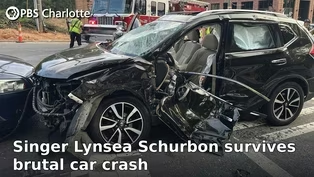
Everything was progressing nicely for singer Lynsea Schurbon, and then an impaired driver ran a red light, and everything changed.
- Okay, I'm here to talk to you about my current reality, but in order to do that, I need to take you back just a little bit.
- [Jason] Lynsea Schurbon recently shared her story at the Charlotte's Creative Monthly Breakfast lecture series.
- Music has always been innately a part of how, or who I've known myself to be.
It was always a part of my life.
- [Jason] A musical journey, the seeds of which were planted by her father.
- He would pull me up on stage, and I would sing for the audience.
I absolutely loved it.
- [Jason] Originally from Texas, Lynsea earned her bachelor's degree in music business management from Berklee College of Music in Boston.
That led to a job on the Elevation Church worship team in Charlotte.
- I remember leaving Texas and telling my parents, "I'll see you in three months," and that was 10 and a half years ago, so.
I love it here.
- [Jason] But over time, Lynsea wanted to write and produce her own music.
- When I decided I wanted to pursue my dreams, I was like, "Great, how do I do that?"
I tried everything.
I put out a song every month, and then I experimented with posting on social media, with making merch, playing shows live, putting out songs in other languages, anything.
♪ Coffee at midnight ♪ ♪ No words just your eyes ♪ - [Jason] With a sound blending acoustic, folk, indie pop, and alternative rock, Lynsea slowly but surely started making inroads in the music biz.
- I've just been very stubborn throughout my whole life, like, "This is what I want to do, and I'm not going to stop trying until I see something happen."
♪ Now it's getting serious ♪ - [Jason] She landed a weekly residency at the Ritz-Carlton Uptown and was named QC Nerve's Best Local Pop Artist of 2024.
- I mean, I can still feel the emotion of it.
I felt relieved.
I felt validated.
I felt, I mean, ultimately encouraged to keep going.
- [Jason] And then the big breakthrough.
♪ Tonight I'll be yours if you want it ♪ - I got the call about my music being placed on Netflix reality shows.
- [Jason] Five of her original songs were featured on Netflix's spicy reality show "Temptation Island," one of which was on the show's trailer.
- And then I had to have my parents watch the trailer in the first episode.
They were like, "Oh.
Oh.
Oh."
- [Jason] For Lynsea and her budding career, everything was falling perfectly into place.
- I had been so desperate to create, to find myself as an artist for so long, and I finally felt like I was doing it, and it was getting noticed.
I felt encouraged to keep going.
I felt like, oh, someone's noticing.
My dreams can come true.
♪ You're a little late ♪ ♪ I'm already torn ♪ - [Jason] But then it happened: September 20, 2025.
- I don't have any memory of any of that.
I actually don't have memory of that entire day.
- [Jason] Lynsea was driving her sister to the airport following a weekend visit.
- An impaired driver who had just stolen a car ran his red light, and he ended up directly in my driver's side door.
The impact threw me toward the center of the car, and then she got whiplashed back towards me because of the side curtain airbag.
Because we both got thrown kind of toward the center of the car, we hit heads.
That impact shattered this center part of my skull.
I was taken immediately to surgery.
- [Jason] With brain swelling so bad, doctors were left with no choice but to cut out part of Lynsea's skull.
- So my hips were broken, severe brain injury, and they had to cut out half of my skull.
There was the area at the center that was shattered, and so they had to remove those pieces and really pick pieces out of my brain, which is crazy to think about.
I went home without half a skull.
Yeah, I think there was a disbelief that it was me.
- [Jason] Lynsea's road to recovery was a long one.
Undergoing two brain operations, spending a full month in the hospital, and, due to the severity of her brain injury, couldn't feel any emotion.
- I woke up and I was aware that I almost died, but I'm alive, and people I loved were with me.
I didn't really have a lot of emotional capacity to even process it, so I think my brain was protecting me from how scary all of it was.
- [Jason] A 3D-printed, custom-made, hard plastic skull piece was then attached to Lynsea's head to fill in the missing piece.
She then had to wear a helmet to protect it all.
- And then there's little brackets, metal titanium brackets, that connect, or they attach, my actual skull bone to the skull piece to hold it together.
Today is 10 months since my accident.
- [Jason] Just past the one-year mark now, Lynsea has made miraculous progress, even though her ability to sing and perform like she used to isn't quite there.
- I do notice improvements slowly every few months.
The struggle right now, though, is that if there is no vocal or melody to follow along to, I can't get the right notes out.
- [Jason] And as far as the guy who caused all this trauma is concerned, Lynsea, amazingly, has no ill will.
- My biological father was an addict, so I have an immense amount of compassion for addicts, so I don't want him to suffer.
I just want him to heal.
I don't want this to happen to anyone else.
- Lynsea, everybody.
Thank God that she's alive.
(audience cheering and clapping) - Now, Jason, I understand Lynsea is trying to raise awareness now.
- Yeah, trying to raise awareness and trying to create a little bit of a change.
Although side-center airbags were introduced by General Motors in 2013, but very few car models have them, mainly because it's not required.
Lynsea is trying to change that, starting a Change.org petition to mandate to get those side-center airbags in all cars.
As she says, "I may not be using my voice in the same way singing, but I am still using my voice."
So she's trying to get that change to get those.
You wouldn't think of those airbags in the middle of the car - - Right.
- So passenger and driver don't hit heads.
- Absolutely.
And it's interesting to know that she's trying to make a change using what happened to her to fix things for others.
- Absolutely.
- So good for Lynsea.
Thanks, Jason.
Well, crafting can be a hobby, a creative outlet, or simply a way to spend time with friends.
For one Charlotte woman, it became something much more.
Michelle Fernandez discovered that making art helped her navigate some of life's toughest challenges.
Producer John Branscum shows us how today that journey has inspired a community and business that's helping others do the same.
(bright music) - All right, guys.
Hello, hello.
Welcome, welcome.
Thank you for being here.
Came out here with a friend to do some arts and crafts, which I probably haven't done since I was a kid.
- If it was your first time at Craft Club, welcome.
It's just a great way to meet new people here in Charlotte.
Craft Club's always on the first Sunday of each month.
We always want to make it free.
We always want to make it interesting.
I grew up being a crafty kid.
Craft was my therapy.
You know, that is how I processed my emotions.
I later went to school, became a therapist, and used art as my primary modality of therapy.
And so Craft Club came from that.
- I just really like the energy here.
I really like how she incorporates crafts and kind of incorporates that with mental health.
- I'm Michelle Fernandez.
I am the owner here at La Bodeguita.
I am a single mom to a wonderful 11-year-old boy.
I am also an artist, an art appreciator, and a therapist, a mental health therapist.
(gentle pensive music) It really wasn't until college when I got pregnant, and it was just a change of plan.
I was 23, still finishing college, and really just didn't know what was happening.
I was so happy and grateful for this little baby, but I didn't know why I felt the way I felt.
And postpartum hit hard.
You're told this should be the happiest time of your life.
You have this gift of raising this little child, and I did not feel that way.
I felt stuck.
I felt so anxious.
Throughout COVID, I found that these symptoms were escalating to, like, a full panic attack, so I felt extreme loneliness.
It was just one of the most isolating, lonely times of my life.
I was just really at my wit's end.
I knew that I needed to do something.
I knew that to be able to give my child a childhood that I really desired, something had to change.
(bright cheerful music) I started going to therapy, and she helped me just through so much.
She was like, "How did you pass your time as a kid?
And how did you process emotions?"
And I was like, "Well, I used to make things."
So I ended up finding different mediums that helped and started that process of giving form to the feelings I had inside, giving language to the emotion.
I started looking at art more as a practice.
It wasn't just something I was doing when I had spare time.
It was something I had to do so that I could be alive.
When I would start feeling anxiety, instead of sitting in it and trying to escape that feeling, I would go make something.
I knew that I wanted to work in the perinatal field.
I knew that I wanted to approach therapy differently, and I kept finding that a lot of the women I was serving were struggling in the same ways I was.
I started bringing it in small ways.
Okay, so if we talk and collage about identity and values, how much further can we go?
If we play with clay while we talk about trauma, how do we process it?
And I kept seeing that my clients would push themselves further.
They would open up more.
We had our first craft club.
It was amazing.
There were, like, 50 people there, and we collaged our values for the year, and from there, it really took on a life of its own.
- You can kind of lose your mind in doing the arts and crafts.
Like, you're just focused on what you're doing in that moment.
You're present, and I think that's what's really relaxing.
A lot of times, we're constantly thinking about the future, what's tomorrow, what's coming next, but now you just get to be in the now.
- It's brave for anyone who walks through these doors to come to a space that they're not familiar with and to be brave enough to come here and sit down and share what's in their brain.
Art is hope, and hope is life-changing.
- Thank you, John.
If you'd like to check out the Craft Club for yourself, it's held on the first Sunday of each month, but you don't have to wait for the free event to get creative.
Michelle's business is a craft café at Camp North End, where visitors can choose a project from a menu and create at their own pace.
Sounds pretty cool to me.
Well, your final story tonight: starting over isn't always as easy, especially when you're trying to build a new career.
But there's a place in Charlotte where people get that opportunity, and what they learn goes well beyond the kitchen.
Carolina Impact's Chris Clark takes us inside a program that helps people build a future one lesson at a time.
- Look at that flakiness.
That's the best part.
- [Chris] Almasi Cooper grew up around her mother and grandmother's restaurant on the Outer Banks, and Grandma had her own way of measuring.
- If she say, "Don't use a tablespoon, just sprinkle it," and she said, "Sprinkle it."
- [Chris] But she's not in Grandma's kitchen now.
- The measurements, I want to be precise, so they'll tell you I'm very hard on measuring.
- [Chris] The Community Culinary School of Charlotte helps people facing barriers to steady employment.
Some are rebuilding after incarceration or recovery.
Others are trying to move beyond low-paying work.
Chef Ron expects a commitment from everyone.
- We have systems and standards, policies and procedures, just like any other place of business.
Our school is tuition-free.
It does not mean it's free.
It's tuition-free.
We still demand their time and talent.
- It's the beginning of all soup stocks and sauces, so we did that, remember?
- [Chris] Sheryl Bauknight already has a catering business, but she's still working a regular job and wants this training to make cooking her career.
- This is the first time in my life that I'm able to put me first and come to the school and make it happen for me, so I was excited.
You're not going to let anything stand in the way of that.
- [Chris] Meanwhile, Chef Alvin Howard keeps an eye on more than what's cooking.
- Knife skills are the most important thing that we try to push in and pushing and keep going, keep going.
Hold on one second.
- [Chris] The interview can wait, but in this kitchen, the teaching can't.
- Put that in the oven now, guys.
- I thought that was already in the oven.
- We're not really creating chefs.
We're creating really good employees.
They'll know all aspects of the kitchen, from pot washing to sautéing to high-end dining experiences, to the business model that a lot of our folks want to open, whether it be a catering company, a food truck, selling plates from the home.
They'll understand the back of the house, the finances, and, of course, the taste of what they're trying to do.
- [Chris] The program lasts 14 weeks, and nobody's expected to walk in knowing everything.
- You didn't do anything wrong.
- I got it.
- You knew what was happening; you just didn't know what to do next step, which is not a problem.
So what we do, that's why you're in school, to learn this stuff.
- [Chris] Ron wants them aiming beyond that first job.
- I want every student to want my chef instructor's jobs.
I want them coming gunning for the chef instructors, because that's what's going to really charge them, because we do hire from every class, just about.
- Chef Anthony Watkins started here as a student.
He continued his education at Central Piedmont Community College and then spent more than 20 years at The Capital Grille.
- Worked my way up from the line, from prep to line, to boil cook to sous-chef, and actually made it to executive chef.
- [Chris] Now he's back teaching, and his connection with Almasi started outside this kitchen.
- I was at my job, and I saw Chef Anthony walk in with a chef coat that said Community Culinary School of Charlotte.
And I felt like that was my sign, like that was my confirmation to go ahead and enroll.
- So you want to add a little bit more?
- [Chris] Now she's learning from someone who once stood where she stands.
- Just giving back.
Just giving back what was given to me.
- And for a student to become a mentor to a student, oh man, that's as delicious as it gets.
- [Chris] A new mentorship program connects students with business owners, and a life and job coach helps them work toward employment.
- Cooking, but I also teach my students how to be successful in anything they're doing, whether it's cooking, being at home with the kids and family.
- [Chris] Before lunch, Alvin wants someone to explain what the class made.
- You're gonna do the speaking today, you're gonna do the speaking today 'cause you said you don't want to, so you're gonna tell everybody what we did today.
- [Chris] Almasi remembers worrying about meeting everybody.
- Well, I'm not technically the most social person, so when I got here, I'm like, "I'm gonna have to talk.
I'm gonna have to tell people about myself."
- Just keep that right here, and we'll get it set up for lunch.
- [Chris] For Alvin, the payoff comes long before graduation.
- That student who's been struggling, you ask him a question, and the answer comes right off the bat.
He remembers.
He's like a computer over there.
Makes you feel like, all right, I am doing my job.
They are participating.
- [Chris] The school's café is part of the operation, too.
Ron says the place sold 35,000 baked goods in 2025, and its customers extend way beyond the people walking through the door.
- We are in partnerships with a bunch of coffee shops so that purchase our baked goods, which is a great revenue-generating income stream, but most importantly, it puts folks to work.
- [Chris] Not everyone who walks through the door is here to buy lunch.
Some arrive with something for the kitchen.
- What do you got today?
This is Ken Steiner.
His family grows for us.
These are end-of-season peppers, eggplant, little eggplants, and this was not staged.
This is absolutely... He just comes in when he has product and donates it to us.
- [Chris] Donations give students fresh ingredients to work with, but receiving help is only part of what happens here.
- We also feed a lot of folks in need.
We feed a lot of organizations in need.
It's something I'm proud to say we do.
It gives a nice pat on the back to that community part of Community Culinary School of Charlotte.
- [Chris] Sheryl is still deciding where she fits in the food business, but she already knows who she wants to cook for.
- I wanna be able to give really nice home-cooked-type meals from where I'm from, which is Charleston, so Gullah-type meals, to people who can't really afford those types of things.
- [Chris] Almasi's career is still taking shape, too, but these classes have already changed what she expects from it.
- We're worth benefits.
We're worth pay over the minimum wage.
We're worth being respected as chefs and not just as workers.
- I'm hoping that they're creating a community for themselves and even more community for those around them.
- [Chris] For Carolina Impact - - Does that makes sense or is it too esoteric?
- [Chris] I'm Chris Clark.
- Stories like that always make me hungry.
Thanks for that, Chris.
Well, the Community Culinary School of Charlotte also operates a café that's open to the public, where students get valuable hands-on experience.
Plus, the school supplies baked goods to several local coffee shops, giving students even more opportunities to put their training to work.
Every purchase is another way that the community can support what they're doing.
Well, before we leave tonight, I'd like to thank the group from Cleveland Community College's TRIO Program for joining us in studio.
Well, that's all the time we have tonight, and thanks so much for joining us.
We always appreciate your time, and I look forward to seeing you back here again next time on "Carolina Impact."
Good night, everyone.
(bright music) (bright music continues) - [Announcer] A production of PBS Charlotte.
 New
Art Is Hope: Healing Through Art and Community | Carolina Impact
Video has Closed Captions
Clip: S14 Ep1408 | 4m 56s | Charlotte therapist turns art, crafts and community into hope and healing (4m 56s)
October 27th, 2026 Preview | Carolina Impact
Preview: S14 Ep1408 | 30s | The Price of Trust; Singer with Serious Injuries; Art Is Hope; & Second Helpings, Second Chances (30s)
 New
The Price of Trust | Carolina Impact
Video has Closed Captions
Clip: S14 Ep1408 | 6m 5s | Local seniors learn how to spot scams, protect their money and stay ahead of fraudsters. (6m 5s)
 New
Second Helpings, Second Chances | Carolina Impact
Video has Closed Captions
Clip: S14 Ep1408 | 6m 9s | At a Charlotte culinary school, students build kitchen skills and confidence for new jobs. (6m 9s)
 New
Singer with Serious Injuries | Carolina Impact
Video has Closed Captions
Clip: S14 Ep1408 | 7m 25s | Local singer Lynsea Schurbon overcomes severe brain injuries following a car crash. (7m 25s)
Providing Support for PBS.org
Learn Moreabout PBS online sponsorship New Episode
- News and Public Affairs

Top journalists deliver compelling original analysis of the hour's headlines.

- News and Public Affairs

Today's top journalists discuss Washington's current political events and public affairs.



 New Episode


 New Episode
 New Episode



Support for PBS provided by:
Carolina Impact is a local public television program presented by PBS Charlotte