January 27, 2026 | Carolina Impact
Season 13 Episode 1313 | 24m 13sVideo has Closed Captions
Central Piedmont Dual Enrollment; Art With a Purpose; Fixing it Together; & Legacy Through a Lens
Central Piedmont's Dual Enrollment allows students to take college classes for free; A local artist remembers victims of the Holocaust through his work; A community Repair Café fixes everyday items and shares skills that reduce waste; & A local photographer uses a vintage picture processing method to preserve the past.
Problems playing video? | Closed Captioning Feedback
Problems playing video? | Closed Captioning Feedback
Carolina Impact is a local public television program presented by PBS Charlotte
January 27, 2026 | Carolina Impact
Season 13 Episode 1313 | 24m 13sVideo has Closed Captions
Central Piedmont's Dual Enrollment allows students to take college classes for free; A local artist remembers victims of the Holocaust through his work; A community Repair Café fixes everyday items and shares skills that reduce waste; & A local photographer uses a vintage picture processing method to preserve the past.
Problems playing video? | Closed Captioning Feedback
How to Watch Carolina Impact
Carolina Impact is available to stream on pbs.org and the free PBS App, available on iPhone, Apple TV, Android TV, Android smartphones, Amazon Fire TV, Amazon Fire Tablet, Roku, Samsung Smart TV, and Vizio.

Introducing PBS Charlotte Passport
Now you can stream more of your favorite PBS shows including Masterpiece, NOVA, Nature, Great British Baking Show and many more — online and in the PBS Video app.Providing Support for PBS.org
Learn Moreabout PBS online sponsorship- [Announcer] This is a production of PBS Charlotte.
- Just ahead on Carolina Impact, find out how area high school students are getting a jump on college that saves students time and money.
Plus how a local artist remembers victims of the Holocaust through his work.
And trash or treasure, see how an area nonprofit restores items you're thinking about disposing of.
Carolina Impact starts right now.
(upbeat music) Good evening.
Thanks so much for joining us.
I'm Amy Burkett.
When it comes to our four-year degree, the cost these days is about $100,000.
A public institution averages $25,000 a year.
If you could cut that in half, would you?
Carolina Impact's Jason Terzis joins us with what might just be the best kept secret in higher education.
- Well, as someone who currently has two kids in college, I'm all too familiar with the rising cost of education.
and the main reason why I told my two daughters they would be applying to in-state colleges only.
Now, depending on where you go, public college, private, or out of state, adding in student loans, investing in a bachelor's degree can ultimately cost more than a half million dollars.
But what if there was a way to earn college credits without actually paying for them?
Sounds like a no-brainer, right?
♪ Your kisses lift me higher ♪ Northwest School of the Arts, a magnet school in Charlotte specializing in dance, music, theater, and the visual arts.
And a mainstay at the annual Blumey Awards honoring the best of local high school theater.
- It's a balancing act, especially going to a performing arts school, we have performances, productions, et cetera.
So you're not only working on a regular high school schedule but working on a performance high school schedule.
- [Jason] Much like college, potential students need to apply, be accepted, and choose a major.
- I'm double majoring in fashion design and fashion marketing.
- [Jason] Northwest has multiple students who are actually already enrolled in college.
133 of them through Central Piedmont's dual enrollment program.
- Dual enrollment is a wonderful opportunity for high school students to earn college credit through Central Piedmont while they are enrolled in high school.
- So that means they go to high school each day at their home high school, and then starting in the 11th grade, depending on their GPA, they're able to begin to take college courses.
- [Jason] The program is open to any student in Mecklenburg County, whether they attend a public school, private school, charter school, or even homeschool.
- This is legislatively mandated.
So the North Carolina legislature passed this Career and College Promise program, and it replaced some earlier versions that had existed.
- [Jason] There are some grade point average requirements, and high schools must grant permission.
Classes can be offered at any one of Central Piedmont's six Charlotte area campuses, online, or even at the student's home high school.
- We have between 5 and 6,000 dual enrollment students attending classes.
That makes up about 20 to 22% of our overall curriculum student body.
- The classes are only like, no more than 16 weeks.
And I'm like, "Oh my gosh, yes!"
- [Jason] For students, like Northwest School of the Arts Nyla Martin and Jaison Maxwell, it's a home run, the opportunity to earn college credits while still in high school.
- I think they definitely laid it out as a way to one, get ahead in college, but one to get ahead in high school, because of the big GPA boosts with it being considered AP credit.
- We're learning about finances, we're learning about mortgages and car payments and stuff like that.
Things that we'll actually need.
- This step that CPC gives the opportunity for all these kids to earn is awesome.
(upbeat music) - [Jason] For some dual enrollment might be just a class or two, for others it's a way to earn as many college credits as possible, towards either an applied degree or a transfer degree.
Those earned transfer credits are guaranteed to transfer into all of the UNC system universities.
- Students do take classes along a pathway and they are limited to what's in the pathway.
Our most popular is the pathway that corresponds to our Associate Degrees Designed for Transfer.
So a lot of those are getting their general education classes out of the way for students who know that they want to either get an associate in arts with us after they graduate high school, or they wanna go on to a four-year university and they're really getting those liberal arts general education requirements out of the way early so that they can jump right into their major classes when they get to a university.
- [Jason] So you'll be more than halfway done with college?
- Yeah, 'cause I'm earning my associate's degree right now in business as well as the liberal studies pathway.
- [Jason] The main competition for dual enrollment, if you want to call it that, is advanced placement classes where high school students can also earn college credit, but the main difference is how those credits are earned.
- With advanced placement you are in that class all year long, but your credit comes down to how you perform on that advanced placement exam.
And if you have a bad test taking day, you're not feeling well when you walk into the test, everything that year is for nothing.
Whereas during dual enrollment, you are in that class for an entire semester and you're performing all the time.
It doesn't come down to one test.
You have the entire class to perform.
- [Jason] For parents, there might be some concern with their students possibly being overloaded, trying to finish high school while simultaneously doing college coursework.
- So as a mom, I'm concerned.
Will you have time to do this?
Will you have time to devote?
And anything you sign your name onto, you're gonna finish it.
- [Jason] But the best part of the dual enrollment program, and something no parent is probably yet to complain about, it's all tuition free.
That's right, free.
- It's really cool.
You know, my mom was like, "I'm not gonna be paying like $200,000 just for you to go to college."
So, it's great that I can get these classes out of the way and go to college, you know, cheaper.
- I think when parents hear about it, they're very much on board.
Getting to make sure that all the parents know that this is an opportunity is a key message.
- I think more people do need to know.
I didn't know anything about it.
If I had this opportunity when I was in high school, I would've taken it.
- [Jason] Some might say the dual enrollment program is the best kept secret around.
- It really truly is.
It is absolutely the best deal in Charlotte.
You can do upwards of an entire associate degree while you're in high school paying no tuition costs at that point.
- I agree, it's the best deal in Charlotte right now because our students are getting a phenomenal education.
They're getting college exposure, career exploration.
- I wish more students would get involved in this.
- If anyone doesn't know about it, I mean, I'm so sorry.
Like, can we wave a flag like, "Hey, it's here."
"Your opportunity is here."
- Okay, that secret cost me $50,000 in education.
My son already graduated from Clemson a couple of years ago.
You can basically get the first two years before you'd have to transfer to a four year institution.
Amazing.
- It is.
It's cool.
And they do have a couple of other programs.
Early College and Middle College, and those programs are run through CMS.
Early College students start as 9th graders, but are actually taking classes at Central Piedmont's campuses.
So by that time they finish up, they're pretty much have finished up the majority of their required high school credits.
They graduate high school with their diploma and an associate's degree.
Middle College, pretty much the same except students start that in the 11th grade as opposed to 9th.
So plenty of options out there for kids to really start knocking out some of those core classes.
You know, math 101 and some of these main classes.
You know, especially if kids are gonna go to private college, or one of the students we talk with is gonna go to Savannah College of Art and Design.
That's a pricey school.
So if you can knock out some of those early, you know, just the core curriculum classes, definitely save a lot of money - And that's something everyone's looking to do these days.
Thanks so much, Jason.
- Absolutely.
- Well, while higher education prepares students for the future, remembrance teaches us why the past still matters.
January 27th is International Holocaust Remembrance Day, commemorating the victims of the Holocaust and marking the liberation of Auschwitz.
Tonight videographer Doug Stacker shares a story about a Davidson sculpture artist that's dedicated his career to making art that honors and keeps alive memories that shouldn't be forgotten.
- At the age of 75, I still can't comprehend it.
This manmade industrial extermination of 6 million people.
(somber violin music) Okay, my name is Roy Strassberg.
I'm an artist who works in clay, otherwise known as a ceramist or ceramic sculptor.
Vessel maker.
My work is a reflection of my interest in the Holocaust.
I grew up in New York City in the 1950s.
My recollection of my childhood is that I'd experienced a certain kind of ethnicity and culture extremely vividly.
My father and I switched on a television show.
It was called "Remember Us," and it was black and white videos of the concentration camps.
Now I had grown up in a family that was very protective, so I had never seen anything like this.
It created a lifelong interest on my part for the history of our people.
(tape ripping) (energetic violin music) I transformed the work I was doing from kind of a decorative postmodern sculpture and started working on pieces that were reflective of my interest in the Holocaust.
That transition was extremely powerful for me, and I never turned back.
I never looked back, to go back to the work that I had been known for.
And that was a big sacrifice.
I gave up a part of my career that was really meaningful to me in order to focus on something that was even more meaningful.
(energetic violin music) My job as an artist is to reconcile the disparate components that going to make up the entirety of the object I'm working on.
How does this look placed here?
Where should I put this letter?
Where should I put this number?
Where should I put this large fragment that's attached to the form that might represent brokenness?
Most of the surface imagery in my pieces are derived from aerial photographs and blueprints of the killing sites.
I often use numeration in my work, what I call the generic concentration camp number, 0123.
But there's another number I use, 845.
The number of Strassbergs that are contained within a Yad Vashem database of Strassbergs who were murdered in the Holocaust.
That number has very personal significance to me.
- [Vintage Narrator] Auschwitz, a place of unequal horror.
4 million died here in the gas chamber.
The crematory chimneys belched their black smoke.
- I had an Aunt Ceil who had concentration camp numbers on her arm.
The survivors, there are very few left, most of them are gone.
There's an irony of me using a gas kiln to fire my work.
(gentle piano music) People have oftentimes referred to my work as beautiful and then apologized immediately.
The apology is completely unnecessary.
It means I've done my job because it's drawing that viewer in and perhaps allowing them to see the subject more clearly than they otherwise would have.
I've probably made over a thousand pieces.
Someone has to commemorate, memorialize this event, so that in future generations people will understand what happened so it's not repeated.
- Thank you, Doug.
Roy has sculptures in numerous private collections, institutions, and museums.
His work is also part of the collection of the art museum at Yad Vashem in Jerusalem.
Well, this next story may change the way you look at what you throw away, and the value we often overlook.
What started in Amsterdam as a simple idea, don't toss it, fix it, has grown into a global movement.
Carolina Impact's Chris Clark takes us to a local repair cafe where broken items become opportunities for learning, sharing, and connection.
- [Chris] They come with toasters, picture frames, jewelry, chairs that wobbled just enough to annoy, but not enough to throw away.
- Tabletop clock, and it's not working when you put a battery in it.
- [Chris] Hundreds make the trip carrying things they just couldn't quite give up on.
- There is a dancing Santa that we have had since our oldest son was born, and he doesn't dance anymore because our youngest son knocked him off the shelf.
- [Chris] That's why she brought it here to the repair cafe.
- It originally started in the Netherlands.
So it's a global concept, and the idea of sharing community knowledge, and community tools, and community skills to help keep items repaired and in circulation and out of the landfill.
- [Chris] What comes through the door is as varied as the people carrying it.
- Antique cuckoo clocks.
- He's got a small stone grinder, - Turkey hat that has Christmas lights on it.
- [Chris] Ask anyone why they brought something here and the answer usually starts somewhere else.
- This was a wedding gift to my wife and I 29 years ago.
My wife loves to bake.
She makes marshmallows every year for the holidays.
Cookies, cakes.
- A lady brought in her VHS player, which had a VHS tape in it.
The VHS tape held videos of their child at two years old, and their house had burnt down and that was the only thing they had left.
- [Chris] The people doing the fixing are volunteers.
Around here, they're called coaches.
- I like to just kind of think of myself as a hobbyist, and I just wanna help people keep their memories and jewelry for as long as possible.
- [Chris] It's easy to picture a room of engineers, but the backgrounds here are as varied as the repairs.
- I am an operations manager.
- The Director of NC Cooperative Extension.
- I'm a physical therapist.
- [Chris] And some of the volunteers don't work with tools at all.
(sonorous cello music) - I am a private music teacher and also soloist.
My main instrument is cello.
I like shiny things and I'm gonna fix shiny things.
Didn't give myself enough slack.
- [Chris] Some repairs are about finesse.
- I'm restringing it for her so she can wear it again for the first time in years.
- [Chris] Others are about leverage, which by the way, how's that mixer coming along?
(hammer pounding) We'll come back to that.
But while we wait, how about those jeans?
- Because it has that material backing already, it's nice and sturdy.
- [Chris] The repair is what you see, but what matters just as much happens in the moments around it.
- There you go.
That's a good one, yep.
- People aren't taught home-ec.
People aren't taught shop.
People aren't focused on that anymore, so they don't have those skills, and that's what Repair Cafe is here for.
- It's to inspire skills within you to be able to repair your own items.
So the theory is that you would be able to go home and feel a little bit more confident about working on the next project - And it'll get hot without the plate.
- This is fascinating.
It's like art.
I mean it's science, but it's art too.
- Gave me some insight in to be creative at home with what I have, and maybe try some other things, try to fix some other things on my own.
- [Chris] That is the moment we're waiting for.
Which, by the way, do we have an update on that turkey hat?
- Unfortunately, it's got corroded from batteries leaking.
- [Chris] Keep at it, because when hundreds of items come through the door, not all of them make it back, but most do, and when they do, there's a photo to celebrate the moment.
- It means something to them, you know?
And it's just wonderful to be able to fix things, which I love to do, and help people, which I love to do.
What could be better?
- The ability to see something that isn't functioning, either at all and make it work, as well as, you know, making the world a better place.
- [Chris] Before everyone packs up, one last check on that Turkey hat.
- Yay!
Thank you, Tom.
- [Chris] Almost forgot about that mixer.
Will mom be able to make those cakes this year?
(mixer whirring) Sometimes fixing one small thing changes how you approach the next.
- We have a winner, ladies, and gentlemen.
- [Chris] For Carolina Impact, I'm Chris Clark.
- I had never heard of that organization before.
Thanks so much for sharing it, Chris.
In Repair Cafe NC there's no cost, no judgment, just neighbors sharing skills, reducing waste, and keeping both knowledge and connection alive.
Well, closing out tonight, we have one more story about preserving what matters.
For one local photographer, that means holding on to a traditional way of capturing memories by shooting and developing film.
In a digital world where the process has become pretty darn rare, he's keeping it alive.
Carolina Impact's Dara Khaalid and videographer John Branscum show us this vintage craft is about more than just photographs for this man.
It's about preserving family history.
(upbeat music) - [Dara] We live in a selfie world.
People love snapping digital pictures that produce immediate results.
- We're gonna load the camera.
- [Dara] Josh Gomez is choosing a different path by going old school, shooting and developing film.
Loading a roll of film into a camera- - There we go.
- [Dara] To snap the perfect picture.
- [Josh] 3, 2, 1.
- [Dara] Film photography basically died by the mid 2000s.
Josh's passion is rooted in this slower, more intentional approach to photography.
One that requires patience, precision, and care.
- I love the process of film because I think it forces you to slow down from, you know, loading the camera, to taking the pictures, to developing it, it's not an instant gratification.
- Film photography began in the late 1800s.
It's a method that requires a photographer to load a roll of light-sensitive film into their camera.
Once the shutter opens and the light hits the film, the pictures captured.
From there photographers can develop the film in a lab notoriously known as the dark room.
In Josh's case, he uses this.
- [Josh] Nothing in my process has to be done in the dark.
- [Dara] Which is more time consuming than anything he ever had to do with the camera that sparked his photography journey.
- My very first digital camera was a Sony camera that took floppy discs.
- [Dara] Josh says his love for photography began at an early age.
- I always had a VHS camera on my shoulder, and whatever cameras my parents had growing up, I was always making movies with friends.
- [Dara] As he was capturing moments in his life, his dad was never too far behind doing the same thing.
- My dad kind of always dabbled in photography, capturing memories of my childhood and growing up, and you know, every event that I had, there was a camera there.
- [Dara] Josh was always aware of the fascination he and his dad had with photography, but he had no idea how far back in his family that fascination went until he connected with a relative on Ancestry during the pandemic lockdown.
- He mentioned that my grandfather's father had a photo shop and my grandfather worked in that photo shop.
- [Dara] His exploration didn't stop there.
- I ended up getting in contact with my great-grandfather's sister, and she sent me an envelope with the original Thirty Nine Photo Shop logo.
She told me the meaning of the name, which was, back then it cost 39 cents to develop a role of film.
- [Dara] In 1930, Josh's great-grandfather opened the business in Puerto Rico.
He developed film, printed pictures, and sold cameras and printing items until it closed in the late 1950s.
But that wasn't the end.
So Josh, when you look at this photo here of your great-grandfather who started Thirty Nine Photo Shop, you hold this, you see the man who began the legacy, and you're continuing that legacy.
How do you feel?
- Really, I just feel honored to be able to continue the legacy and honor it, and bring back the photo shop, you know, almost 100 years later.
- [Dara] While Josh revives Thirty Nine Photo Shop, he's also running another family business, We Are One Photography that he shares with his wife, Brooke.
- Having a partner that shares passion with me, I think is everything, and a gift that we have that I don't think everybody gets to experience.
- [Dara] As partners in life and work, they use photography and videography to tell other couples' wedding stories, a process that often reminds them of their own beginning.
- We started taking photos, going to parks and stuff as dates, as any excuse to be together.
Photography was the excuse.
And then that grew to shooting weddings together as we got engaged.
And now, 12 years later, we have been shooting weddings every year since then.
- [Dara] Old memories come rushing in as they sit together at their dining room table sifting through dozens of black-and-white photos.
They touch images that they've each captured throughout their careers, faces and places they've encountered across the globe, from time they spent working for nonprofits.
- Some of the highlights of being able to work in photography have been some of the jobs that aren't paid, the ones that are international, where you're there to tell a story of hope.
- [Josh] Photography, for me, has always been a way to document and capture people's stories, and everybody's story has value and meaning.
- [Dara] They're words josh lives by, whether he's creating memories with his wife, or capturing moments on film.
Through every frame he continues a family legacy rooted in storytelling, compassion, and connection.
For Carolina Impact, I'm Dara Khaalid.
- Thanks, Dara.
If you've got film you've been meaning to develop, Josh makes it easy.
Just drop it off at one of his two area locations and he'll handle the rest.
You can find more information on our website at pbscharlotte.org.
We'd love to hear about your story ideas.
There are amazing people and places all over our region, and we need your help to learn about them so we can share them on Carolina Impact.
Just email the details to stories@wtvi.org.
Thanks so much for joining us.
We always appreciate your time, and I look forward to seeing you back here again next time on Carolina Impact.
Goodnight, my friends.
(upbeat music) - [Announcer] A production of PBS Charlotte.
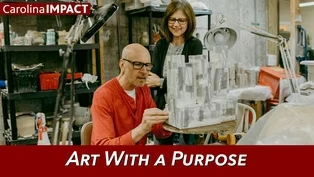
Art With a Purpose | Carolina Impact
Video has Closed Captions
Clip: S13 Ep1313 | 4m 32s | A local artist remembers victims of the Holocaust through his work. (4m 32s)
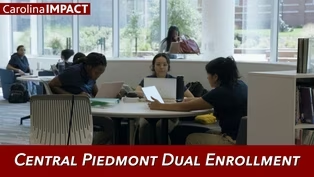
Central Piedmont Dual Enrollment | Carolina Impact
Video has Closed Captions
Clip: S13 Ep1313 | 7m 21s | Central Piedmont's Dual Enrollment allows students to take college classes for free. (7m 21s)
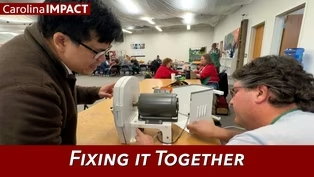
Fixing it Together | Carolina Impact
Video has Closed Captions
Clip: S13 Ep1313 | 4m 36s | A community Repair Café fixes everyday items and shares skills that reduce waste. (4m 36s)
January 27, 2026 Preview | Carolina Impact
Preview: S13 Ep1313 | 30s | Central Piedmont Dual Enrollment; Art With a Purpose; Fixing it Together; & Legacy Through a Lens (30s)
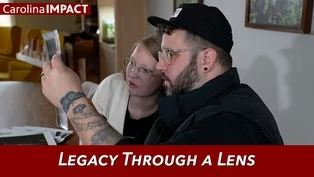
Legacy Through a Lens | Carolina Impact
Video has Closed Captions
Clip: S13 Ep1313 | 5m 30s | A local photographer uses a vintage picture processing method to preserve the past. (5m 30s)
Providing Support for PBS.org
Learn Moreabout PBS online sponsorship
- News and Public Affairs

Top journalists deliver compelling original analysis of the hour's headlines.

- News and Public Affairs

FRONTLINE is investigative journalism that questions, explains and changes our world.











Support for PBS provided by:
Carolina Impact is a local public television program presented by PBS Charlotte