Unspun
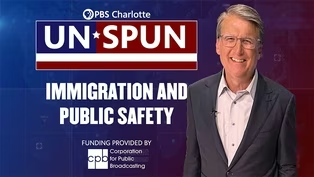
Immigration and Public Safety | Unspun
Season 2 Episode 207 | 27m 3sVideo has Closed Captions
Unspun examines immigration enforcement, public safety, and community trust.
Unspun tackles a highly contentious issue in American politics: immigration enforcement and public safety. Recent federal operations in North Carolina and Minneapolis have drawn intense scrutiny, especially after fatal shootings by immigration agents. The incidents raise pressing questions about how enforcement should be conducted and its impact on community trust and safety.
Problems playing video? | Closed Captioning Feedback
Problems playing video? | Closed Captioning Feedback
Unspun is a local public television program presented by PBS Charlotte
Unspun
Immigration and Public Safety | Unspun
Season 2 Episode 207 | 27m 3sVideo has Closed Captions
Unspun tackles a highly contentious issue in American politics: immigration enforcement and public safety. Recent federal operations in North Carolina and Minneapolis have drawn intense scrutiny, especially after fatal shootings by immigration agents. The incidents raise pressing questions about how enforcement should be conducted and its impact on community trust and safety.
Problems playing video? | Closed Captioning Feedback
How to Watch Unspun
Unspun is available to stream on pbs.org and the free PBS App, available on iPhone, Apple TV, Android TV, Android smartphones, Amazon Fire TV, Amazon Fire Tablet, Roku, Samsung Smart TV, and Vizio.
Providing Support for PBS.org
Learn Moreabout PBS online sponsorship- [Narrator] This is a production of PBS Charlotte.
(gentle music) - Tonight on "Unspun," we're taking on one of the most controversial issues in American politics: immigration enforcement and public safety.
Recent events in North Carolina and Minnesota shined a spotlight on the way federal agents operate in communities.
The fatal shootings of two US citizens by Immigration and Custom Enforcement officers during a sweep in the Twin Cities sparked widespread protests and demands for investigation and accountability.
The incidents have raised big questions about when, how, and where immigration enforcement should be conducted and how it affects both public safety and community trust.
In today's America, welcome to the spin game.
Believe me, I know.
I'm Pat McCrory.
When I was governor and mayor, I played the spin game.
I was played by the spin game.
But aren't we all done being spun?
Let's take the spin out of the world we're in here on "Unspun."
(dramatic music) Good evening, I'm Pat McCrory.
Is the federal government doing too much, too little, or simply the wrong thing?
What does the Minnesota case and others like it tell us about the state of immigration policy in 2026?
Let's ask our guest who has looked at these questions from a national perspective.
Mark Halperin is an award-winning political analyst and current host of the podcast "Next Up."
Mark, it's great to have you back on "Unspun."
Thank you very much.
- Good to be here, governor, thank you.
- You know, just a month or two ago, I did your podcast on "2WAY" in which the Charlotte immigration authorities, where the federal government came down to Charlotte.
We were one of the first cities.
And I said on your show for the first time, "I see Republicans on their heels regarding immigration."
What is the political environment for Republicans now on immigration, which is one of the reasons they got elected, especially at the presidential level.
- I think that the president has veered into areas where there's not a national consensus and where public opinion is either mixed or against him.
I think people now largely believe the border being secured is a good thing.
People largely think that finding and deporting people who've come to this country illegally and committed violent crimes should be deported.
But after that, we've moved into areas where there's less consensus.
I'd say clearly even the president has said that we don't want to see American citizens being killed by federal immigration officials.
So that's an area that's caused a lot of consternation.
But below those headlines and those tragedies, there's some other areas where there's no consensus even amongst the president's own advisors.
How many people should be deported who've come here illegally but haven't committed violent crimes or any crimes and people who've been here for years or decades?
No consensus on that.
What about dealing with employers who have broken the law by hiring people who are here illegally?
And then how should enforcement take place?
And I don't think there's a national consensus, but, again, I think public opinion leads against the president.
Should they go into a city like Charlotte without full cooperation from local law enforcement?
And we saw in Minnesota what the repercussions of that are.
We've seen in other places like Chicago and Charlotte where it's more mixed.
But if you go into a liberal city, and most of our cities are liberal, regardless of what kind of state they're in, and you don't coordinate, particularly if there are copycat behavior after Minneapolis, you're asking for trouble.
- You know, one of the things I saw not only is there lack of cooperation, which during my 14 years as mayor with two Democratic administrations and one Republican, we demanded cooperation.
Both sides got along.
Now the immaturity that I see among the state, local, and the federal officials, primarily the White House, they're saying anything and everything not to calm down a crisis.
What are the ramifications with the Congress and other political officials who are up for the midterms on this immaturity that we're seeing?
- Well, we'd hope voters would punish officials who were immature, right, and particularly in things so important as matters of life and death as it turns out.
I think that in the age of Trump, both sides escalate everything to 11 right away.
And within their own tribes, there's no price to be paid for behaving in an immature way or a way that divides and exacerbates and creates tension as opposed to calm things down.
It wasn't that long ago that you were a mayor and a governor, but the political culture not that long ago was much different.
And now we see over and over again on both sides, a level of ranker and escalation that just doesn't produce good public policy results.
I'd hope the voters would punish that regardless of party.
But we'll see.
Because in a midterm election, a low turnout, a lot of members of the base of the blues and the reds, unfortunately, like the immaturity.
- Speaking of tribes, you've mentioned the word tribes.
There seems to be tribal warfare within each party.
Let's start with the White House.
Even within the White House, we're seeing a tribe with the current Homeland Security Secretary, with the border czar, and maybe with some staff within the White House that report directly to the president.
Can you tell us some insight on this internal warfare in Washington that maybe we in North Carolina aren't seeing directly or hearing about?
- Right, well, North Carolinians will be familiar with the concept of infighting and some of the disagreement within the tribe in the administration is pure personality and power.
It's not about policy differences.
It's not about a vision for the country.
It isn't even really about style so much as it is people and the jobs still fight for power.
Below that, and I think that's unfortunately the biggest reason, there are differences in questions of emphasis.
They all support the President's immigration agenda broadly.
There's a different style.
Mr.
Homan who's gone to Minnesota has a much different style than some other officials, including the head of Homeland Security.
And the president has clearly shifted some of his emphasis, some of his rhetoric.
But the underlying orientation is keep the border closed and deport a lot of people as quickly as possible.
- And at the Democratic side, you see a mayor who's, you know, using some pretty strong language to put it mildly, and going against maybe more moderate Democrats who don't like that more extreme language being used.
Despite the anger and maybe some reason for the anger, what kind of divisions are we seeing in the Democrats on this issue that we don't hear about publicly?
- Well, I'd like to think that privately, some modern day Pat McCrory is calling the mayor of Minneapolis aside and saying to him, really, "It's just not in the interest of your constituents to do this."
But according to the realm, the table stakes within the Democratic party right now is to confront Donald Trump aggressively and angrily whenever he does anything that people in blue America don't like.
Behind the scenes, the main thing that's going on, I think, is the Democratic leaders do not want the party to become the party of abolish ICE.
And reporters are on the lookout for Democrats, whether they're in office or candidates or prominent activists who say abolish ICE.
Democrats don't want that.
They want to make sure the mayor can be for reform, he can be for changes, but they don't want leading Democratic voices to be for abolishing a law enforcement entity.
- This could go back to defund the police, which put the Democrats on the defensive four years ago.
- Yes, sir.
Exactly parallel to that.
And Democrats feel they let that get out of control and that it hurt them politically.
And they don't wanna repeat that.
- You know, one thing I learned as an elected official, especially in the executive branch, is I'd meet with the other side, and I had to deal with riots as a governor and as a mayor, we'd have wonderful conversation, but the minute the meeting broke up and the people went in front of the cameras, I'd see a different person.
I hear some of that happened when JD Vance went up to Minnesota.
I heard very positive conversations behind closed doors.
But once the public conversation went on, went back to the political language to their bases.
Is that what you're hearing too?
- Yes, and it happened with the president too.
And the president's actually mused about this in public.
The president said, "I had a great conversation with the mayor.
I had a great conversation with Governor Waltz," both in Minnesota privately, but then publicly, they're back to being pretty on him.
But this is an area where I think the president sees fault in others, but doesn't look in the mirror.
Same with him.
He can say he had a good conversation with them, but he and his administration have been pretty aggressive.
Now, the president would say sending Homan in, withdrawing some of the folks on the ground have been helpful and conciliatory.
But there's no doubt as your question suggested privately, there is more comedy than there is in public when the cameras are on and the bases are very demanding.
The negotiations over reforming ICE, if they took the cameras away and they took the political pressure away, they probably could strike a deal.
It's very difficult now under these circumstances because whatever deal struck has to be done in public.
And that inflames both sides.
- Are we facing a unique constitutional crisis right now where all of a sudden the Democrats are for more state local control, the Republicans are now for strong federal control, and there seems to be no in-between of, why can't we work together, enforce federal laws, get the local and state government involved in that?
Are we in a potential constitutional crisis in which both sides have flipped on state rights versus federal control?
- Yeah, I don't know if it's a constitutional crisis as much as a hypocrisy derby.
There's maybe nothing in our system that I think brings that hypocrisy more than the 10th Amendment.
The notion that what's not delegated explicitly to the federal government belongs to the states.
Both parties are situational about the 10th Amendment.
The Republicans probably talk about it more as a bedrock principle.
But you see not just on immigration, some of these issues, but on election issues as well.
The president's now talking about a larger federal role.
In this case, the Democrats hypocrisy is a little bit shakier because immigration is a federal issue.
Immigration enforcement is not something that's supposed to be left to state and local.
And so their concern about is a little hypocritical.
But at the same time, the president's not been cooperative.
He's gone in guns blazing, literally and figuratively, rather than trying to go in on the front end with a clear understanding about cooperation.
- Who's gonna be political damaged most by this?
Who's gonna be kicked out of the White House?
You know, there were theories when the cabinet were first formed.
Most people predicted Marco Rubio would be the first to go.
Surprisingly, he seems to be the strongest.
Now people are saying Kristi Noem.
In fact, Mark, last week in Charlotte, I saw a commercial paid for by Homeland Security with Kristi Noem riding a horse.
- Yeah.
- It was like an advertisement for Kristi Noem.
Can she survive wanting this attention as opposed to the President getting attention?
Is she gonna be the first to go?
- I don't think so.
Based on my reporting, she's in pretty good standing with the President.
And anyone who is in the cabinet or the government who wants to survive, their smartest play would be to call members of the Squad and other liberals in the Congress and ask them to attack them.
Because the minute that happens, the president's not inclined to give them their way.
So the more she's attacked by the left, the more I think the president's inclined to say, "Yeah, she should stay."
- Let's talk about the conflict with law enforcement.
I know whenever I had a police shooting, and sadly during my 14 years as mayor, I had some very tragic police shootings.
Some were justified, some were not.
But immediately there would be an investigation, in fact, legally a criminal investigation.
All of a sudden we have federal authorities wanting to do their own investigation of an event that occurred in a city.
How are we gonna resolve this gray area on who handles criminal investigations?
- Well, if it's a state or a local crime, it should be investigated at a minimum jointly.
There are overlapping jurisdictions when it does involve law enforcement.
The courts are pretty clear that you're not gonna have a trial of a federal officer engaged in discharging their duties in a state court.
But an initial investigation, again, this goes back to the lack of cooperation, the lack of trust between different parts of our government, federal and state and local.
And that lack of trust between the elites unfortunately creates a lack of trust in the citizenry.
And that's so important.
So it should be a joint investigation if you look at the olden days.
But in this new realm, the Republicans just don't want to give the local folks a chance at it because they're worried about where it might end.
- By the way, this reminds me of the Kennedy assassination when I was seven years old.
Who does the autopsy, the federal government or the local Dallas?
Which the law said they should do, but the body was taken away.
So this has happened before.
Let's talk about the future real quick in the remaining minute, Mark.
What's the next step in immigration enforcement?
What is Trump gonna do and what's Congress gonna do?
- Well, we'll have to see how they work out this fight over changes in ICE.
There's agreement on some things, but a lot of the things that Democrats won't, it's gonna be very difficult to solve.
I usually think people in my business are overly dramatic and pessimistic about finding a solution.
This one seems very tough to do because both sides think they have both the politics and the substance on their side.
So that fight will take place.
And then it's gonna be up to the president to decide how aggressive he wants to be.
Does he go into new cities?
What does he do on the ground in Minnesota?
But if he goes into new cities and new states, how much do they change the way they operate?
How much do they reach out to the locals?
I think that's largely up to the president and his deputies and they haven't shown their hands on that yet.
- Mark, it's honored to have you back on "Unspun."
Thank you very much.
And best of luck with your great podcast.
- Thank you, governor, good to see you.
- Take care.
(dramatic music) All right, tonight on the top five, the top five immigration policies that most Americans agree on, but there's still political gridlock in Washington DC.
Who knows why?
But these are the top five policy issues.
We'll start out with number five.
Most Americans agree with strong enforcement on the border.
Number four, deport illegal immigrants who break local, state, and federal laws, especially those violent criminals.
Number three, expand legal immigration numbers.
We need the workers.
Let's expand legal immigration.
Number two, local, state, and federal officials should actually work together like in Minnesota.
And number one, Congress needs to pass a new immigration bill.
What's taking them so long?
(dramatic music) All right, it's time now for 1-on-1.
Tony Mecia, the editor of "The Charlotte Ledger," is joining me for this go around.
Tony, this is an opportunity for you to ask me questions for the media, and you know from covering me in the past, how much I love the media.
- I know you love the media, so I'm looking forward to our conversation, governor, thank you very much.
And I enjoyed the conversation with Mark Halperin.
You know, it strikes me that this whole issue, it's obviously a national issue.
It plays out at the local level as we've gotten a taste of here in Charlotte.
It seems like a lot of it has to do with- - [Pat] Immigration.
- Immigration, yeah.
A lot of it has to do with these different roles of law enforcement.
You're certainly seeing very robust enforcement at the federal level.
Not so much on the immigration at the local level.
You've been a mayor, you've been a governor, what's your take on on those different, you know, how those different police forces sort of interact and work together?
- I'm shocked at the lack of cooperation and communication because most law enforcement is very nonpolitical at the local, state, and federal level although that is starting to change more as cities become blue and then we have the MAGA at the presidential level.
So you're all of a sudden seeing, can I work with these other agencies?
But if they don't work together during a time of crisis, say a police shooting or a bank robbery, which is a federal crime or a riot, we're in big trouble.
And I gave an example during the 2'16 riots here in Charlotte.
Me and the mayor at the time weren't getting along too well.
She did not want me to call in the National Guard.
My SBI director, who was a former chief of police here, Bob Schurmeier, my SBI said, "You gotta get there, or the city of Charlotte's in big trouble.
It's gonna burn."
So I called the chief police of Charlotte here and I said, "I tell you what, the mayor doesn't want me here, doesn't want us here, but I will give you full authority over the National Guard and my highway patrol," to take politics out of it completely.
And it worked.
And I also said though, "Don't have any of your mayor or city councilmen mess with your decisions.
I don't want any of it political and I won't mess with you either."
And I think we saved Charlotte during that time in 2'16.
Seems like yesterday to me.
- Why is it that the federal government and state and local officials can cooperate on things like drugs and terrorism?
They have all these task forces, but on immigration it seems like it's sort of everybody wants to stay in their lane.
- I think it's because of the segregated community, political structure we now have where the cities are blue, the rural areas and states are often red, and there's no political incentive to work together.
And the police chiefs are being pulled into the politics of their bosses, whether it be the mayor or the governor, where in the past that usually wasn't the case.
And I'll tell you, I even brought up to Mark, I'm worried about a constitutional crisis of if a mayor or governor or a president continue that conflict, what happens when someone doesn't blink?
And we could have a real tragedy and even more loss of life like we had in Minnesota.
- Do you think the media plays a role in this?
I know you've got opinions on the media.
Where do you we fit in?
- Absolutely.
I think the media is segregated too.
I mean, during the Minnesota riots, I was watching CNN and MSNBC and all they showed was some of the police or ICE officials making some major mistakes, right?
Turn it on Fox and all they show were the videos where the protestors are spitting and kicking and being outrageous activity toward them.
Neither one showed both.
And that's dangerous because that means the information is segregated, and the anger then is being stirred up and the other side doesn't know why their anger is different from the other people's anger.
Well, I don't know, what do you think?
Do you see that segregation in the media?
- I mean, I think there are certainly incentives with the way things work now, to the attention economy, you're trying to get attention, right?
- [Pat] And they know their audience demographics.
- Yeah, I mean, I think so you can see different media organizations tailoring things, you know, to back up different narratives or different ideas that they have.
Yeah, most media, I think, if I can defend most of it.
- Go ahead, try.
- I think they all try to do a good job.
I mean, they're certainly- - But their producers are making many of these decisions on what to cover.
- Well, yeah.
I mean, a lot of it looks very inflammatory, but a lot of it, I mean, you have guys beating on people, shooting people, that's gonna make it out there.
- But if you only show it on one side, like Fox will only show the protestors, which I've had to deal with, the anarchists who attacked me at times.
If you only show that, then someone's only getting one perspective.
And now with the internet, you know, you pull up X, they know what you like, and they'll only show you the same things that Fox or MSNBC are showing.
- Yeah, I mean, I think you definitely in these silos.
I can tell you one thing that is frustrating is as media try to fact check a lot of this, we don't really know when ICE or the border patrol arrest somebody.
I mean, I think most people do agree let's get the violent criminals off the streets.
We don't know, are they going after the violent criminals?
Or they just going after guys going to work?
- I will say this, I thought the administration did a horrible job in communicating about the people they were arresting.
And it was too much secrecy and not enough transparency.
And one thing I learned as a mayor and governor, if you aren't communicating, you're failing tremendously.
- I know when you were mayor and governor, you talked to people in the business community a lot.
- [Pat] Yeah.
- What are they, I mean, there's a lot of fear out there.
You have a whole sector, you have a lot of people staying home when border patrol or ICE is here.
- [Pat] Yeah.
- What are you hearing from the business community about the effect of all this?
- Mixed, they wanna stay out of it.
The business community is paranoid.
They're afraid of their own shadow right now on controversial issues.
And they have a dual interest.
They're looking for labor and different businesses looking for different labor.
So some businesses impacted by this and others isn't.
And then you've got issues, well, I do think we need to have strong borders.
But if you notice in the last three or four years, the business community is staying away from hardball politics where 10 years ago when I was governor, as you know, with a social issue, they got very active.
Since then, they're withdrawing because they don't want to get caught in this division.
As Michael Jordan once said, you know, "Republicans buy shoes too."
I think that's what's happening.
- Why do you think this issue is so much in the forefront right now?
Is it just the Trump administration and the beefed up enforcement, or are there other things that are changing with how we view different issues?
- I think there's a lot of hypocrisy on both parties and on immigration.
You know, we say we don't want illegal immigrants, but we want the cheap labor, we want lower prices.
And then at the same time, we don't want crimes by immigrants.
We need a strong enforcement.
And those conflict with each other.
I think there's total hypocrisy on both parties on the immigration issue for the past 20 years.
- When you were mayor, were there issues on immigration?
Did you have things like this?
- Absolutely.
- Or what were some of the things that you saw?
- I did a mayor's report on immigration in 2003 in which I said we need to increase legal immigration and enforce illegal immigration.
And even when I ran for the Senate, that report was used against me in a primary on a commercial.
So it can come back to haunt you almost two decades later.
This is not a new issue, we're just stalling.
There's something we're gonna be working together on soon.
- There is.
- In fact, we're gonna be doing a joint effort.
- Yeah, "The Charlotte Ledger" is working with PBS Charlotte on a sort of a webinar format.
People are invited.
I think they can come in, ask questions, they can have a kind of join the conversation I think.
- [Pat] Two-way conversation with you, the public, on this conversation.
In fact, I think you have the website - [Tony] Wtvi.org/unscripted, and you can find out more about that.
- And we're gonna do this the last Friday of every month.
So we look forward to that.
It's an honor to have you.
- Thank you.
- I don't hate the media that much.
We love "The Charlotte Ledger."
Y'all do a good job.
- Thank you.
- [Pat] We need that local reporting.
- Thank you.
(dramatic music) - During a natural or manmade crisis, leaders at the national, state, and local levels must work together regardless of political affiliation.
Why?
Because saving lives is more important than short term political points.
Having been a mayor and a governor through 100-year ice storms, droughts, floods, hurricanes, and events like 9/11, race riots, and a major airline tragedy, I learned something early.
Politics rarely helps in a crisis.
Teamwork does.
In each of those emergencies, politics didn't come up once as we worked with presidents, governors, mayors, public safety officials, and emergency operation personnel in both the public and private sectors.
The motto wasn't "Win the argument."
It was "Get the job done" because it took teamwork, not politics, to get safety measures to as many people as possible.
The one time politics almost entered into the decision-making process was during the 2016 Charlotte protest and some people would call riots.
As governor, I called up the National Guard despite initial objections from some local Charlotte politicians.
To prevent political disputes, I gave my full authority over the Guard to the Charlotte police chief with one caveat.
No local politicians could interfere with the chief's command.
It worked.
Some political advisors told me that decision could cost me credit and potentially votes in my reelection campaign coming up the next month.
My response, "Who cares?
We need to save our city and save lives."
What we've seen over the past couple of months in places like Minnesota and Washington, DC doesn't look like that kind of teamwork.
Instead of unified calm leadership, too often we see blame, division, and quick political posturing.
That should concern every American, especially when the stakes are so high.
In times of crisis, We don't need political theater, we need practical cooperation.
Well, that's the truth as I see it.
I'm Pat McCrory, and I'll help you join us next week on "Unspun," where we tell you what politicians are thinking but aren't saying.
(bright music) (upbeat music) - [Narrator] A production of PBS Charlotte.
 New
NewImmigration and Public Safety Preview | Unspun
Preview: S2 Ep207 | 30s | Unspun examines immigration enforcement, public safety, and community trust. (30s)
Providing Support for PBS.org
Learn Moreabout PBS online sponsorship
- News and Public Affairs

Top journalists deliver compelling original analysis of the hour's headlines.

- News and Public Affairs

FRONTLINE is investigative journalism that questions, explains and changes our world.












Support for PBS provided by:
Unspun is a local public television program presented by PBS Charlotte