Unspun
How Politics Impacts Prices, Hiring, and Growth | Unspun
Season 2 Episode 219 | 27m 13sVideo has Closed Captions
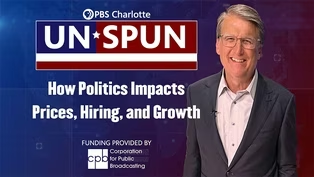
Government and business are increasingly intertwined, affecting prices, jobs, and growth.
The line between business and government is becoming harder to define as policy decisions increasingly shape the economy in real time. From rising prices at the checkout line to shifts in hiring, investment, and corporate growth, consumers and companies are feeling the impact every day. Explore how government actions and business decisions now influence one another more than ever before.
Problems playing video? | Closed Captioning Feedback
Problems playing video? | Closed Captioning Feedback
Unspun is a local public television program presented by PBS Charlotte
Unspun
How Politics Impacts Prices, Hiring, and Growth | Unspun
Season 2 Episode 219 | 27m 13sVideo has Closed Captions
The line between business and government is becoming harder to define as policy decisions increasingly shape the economy in real time. From rising prices at the checkout line to shifts in hiring, investment, and corporate growth, consumers and companies are feeling the impact every day. Explore how government actions and business decisions now influence one another more than ever before.
Problems playing video? | Closed Captioning Feedback
How to Watch Unspun
Unspun is available to stream on pbs.org and the free PBS App, available on iPhone, Apple TV, Android TV, Android smartphones, Amazon Fire TV, Amazon Fire Tablet, Roku, Samsung Smart TV, LG TV, and Vizio.
Providing Support for PBS.org
Learn Moreabout PBS online sponsorship(bright music) - [Announcer] This is a production of PBS Charlotte.
- Tonight on "Unspun."
The line between business and government is getting harder to see, and the decisions made in one are driving the other, from prices at the checkout line to decisions about hiring, investment, and growth.
What's happening in the economy is showing up in real time for consumers and companies alike.
In today's America, welcome to the spin game.
Believe me, I know.
I'm Pat McCrory.
When I was governor and mayor, I played the spin game.
I was played by the spin game.
But aren't we all done being spun?
Let's take the spin out of the world we're in here on "Unspun."
(triumphant music) Good evening, I'm Pat McCrory.
In a time of renewed inflation pressures, global trade tensions, and rapid change, from housing to technology, business leaders are having to make decisions faster with less certainty, and those decisions don't stay in the boardroom.
They impact prices, jobs, and broader direction of the economy.
Joining me now is "Carolina Business Review"'s Chris Williams, and a long-time observer of business and economic trends across the Carolinas.
Welcome, Chris.
- Governor, thank you.
- You know, for once you have to answer the questions and I get to ask the questions; this is gonna be fun for me.
- Thank you.
Raise your bar a little bit higher and your expectations, but thank you.
- Let me also say we miss "Carolina Business Review."
You did a great job for a long time.
- Thank you.
That's my honor.
- We are very proud of that show being broadcast right here at WTVI in Charlotte.
- Thank you.
Thank you, Governor.
- But let's talk about the tough economy right now.
First of all, how tough is the economy right now?
- Interesting times.
So the economy is good, but... - [Pat] But, the big but.
- The darker side of that, high inflation, of course, employment is good, but when you have tight employment and high inflation, the Fed's probably not gonna drop interest rates.
That's unsettling for a lot of folks because they're expecting, you know, interest rates to come down so they can refinance their home.
So that's gonna be a pretty big bugaboo.
Tariffs are still working their way through the economy.
And Governor, it's a little bit like, it's a little bit of a graphic situation, but it's kind of like the python eats the antelope and the antelope takes so long to go through the python.
It's hard and it's slow, and that's what's going on with this economy.
It's good.
And especially in the Carolinas and Charlotte, you know, this engine has been stoked for a long time, so we've got high-class problems, but we still have problems to get through.
- Tell me about what you're hearing from the consumer, and maybe do it by age, if you don't mind, older people like us versus the millennials versus the 20-somethings.
What are they saying?
Are they saying different things?
- They are.
I would say the more established baby boomers and a little bit younger than that are pretty secure in this.
There's been the large talk of this wealth management or wealth transition going on there.
And I would say the youngest, the Gen X, the Gen Z are not as dour or pessimistic as many people report.
I think there's more of a innovation mindset and a natural tendency to look for opportunities.
They work differently, they think differently, but that doesn't mean they're negative about it.
I would say the younger gen is more skeptical but not cynical.
That's what I see and that's what I hear.
- It seems like to me right now, if you're between the ages of 20 and 30, it reminds me of you and I are similar in age to the time when we had high interest rates.
My first condo that I bought in 1980, 14% conventional loan.
It was tough to buy anything.
I bought it for $49,000, I think sold it two years later for 47.
No principal whatsoever.
I was real good at timing.
But right now, the 20- and 30-year-olds, how can they afford a house with somewhat higher interest rates?
They're not as low as they were for the 30- and 40-year-olds today.
They had a pretty good time.
And what are they saying about purchasing and buying and saving and investing?
- Well, clearly there's a headwind, and many young people, Gen X, Gen Z, et cetera, et cetera, don't have the point of view of going back to the 1980s.
In fact, when you bought your condo, 1980 was the peak year for inflation, was about 15%.
And let me just say a word about this if I can, about inflation, because at that point in time, it took about a decade for that high inflation to work itself through the system.
Meaning when inflation goes up and then starts to come down, the effects of the drop are not felt as well as it does when it goes up.
Many people say, like the cost of a barrel of oil, it'll rise like a rocket, but it drops like a feather, and it's a very slow process.
So here, and I'm staying on inflation just for a second, sir.
This inflation number we just got at 4.8%, the peak for us recently was back in 2021, 2022.
It's 7%, and we're still feeling the effects of that.
And here we got another little bump up.
So this inflation feel is going to take a while to work through the system.
So you've got a lot of people that think the natural level should be around 1 or 2%, and that really isn't the case long term.
And one more word on that, the natural level of interest rates, just broad interest rates over a 90-plus-year period tend to be about where we are, interestingly, 5 or 6%.
- Do you see the young people who are concerned about the economy and how can we do... but to me they seem to more entrepreneurial.
You know, our generation looked at going to corporations, you know, large companies.
I went to Duke Power Company right outta college, $900 a month, and I thought I'd be set for life.
The young people I'm meeting especially wanna start up business.
They're not even investing in the usual things.
We invest the 401k's, they wanna invest in something.
Are you seeing the same thing that I'm seeing?
- Yeah, I think you put your finger around it.
I think innovation, entrepreneurship, but really innovation, and especially when you got it powered by AI, which we have no idea really how that's gonna plan out.
But you know, the adoption by AI in all things at that demographic level is so broad, and they embrace it so quickly that they're going to be benefactors, or beneficiaries of that, rather.
And whether it's in an investment or whether it's lifestyle or whether it's their careers, I think that the way the innovation in AI will play out is going to be exceptional.
- Back in '08, during my last several terms as mayor, Charlotte was booming, just booming, and all of a sudden we started seeing the housing being impacted primarily in Texas and California.
We were still booming, then all of a sudden it hit Charlotte maybe like six months later.
Are we seeing a similar trend now where you're seeing housing all of a sudden, more houses up for sale in even Austin, Texas, which is similar to Charlotte, kind of a boom town, or Nashville, Tennessee?
Are we a lagging indicator in housing, or are we a leading indicator?
- Well, you know, that's a good question.
I would say we're uncoupled to a large degree, and I would say we do mirror places like Myrtle Beach for a long time in the Grand Strand was the hottest housing market.
Charleston, Austin, Birmingham, those type of smaller to midsize markets.
And Charlotte would always compare itself to that.
Charlotte is still very much a hot housing market, but not like it was.
There are pockets in certain zip codes that remain strong with the higher-end buyer.
But there is a plateauing, there is a pausing.
I don't know that it's gonna go down dramatically, sir, but I think there's a pause in this go-go kind of, you know, arms race about trying to meet the bid on a house to compete.
So I think that's a big thing.
I think the other thing for Charlotte and Charlotte-Mecklenburg specifically is there's been so much capital investment here, and I want to take for a second, I don't wanna make this a long answer, but this is, I think this is important.
Three years ago, almost exactly three years ago, Bloomberg reported, it was June of 2023.
And I'm gonna read from the article: "For the first time in this nation's history, six fast-growing states in the South: Florida, Texas, Georgia, the Carolinas, and Tennessee, contribute more to national GDP than all of the Northeast, including the Washington, New York, Boston corridor, all of that."
It's a hundred billion dollars that was added by the South in wealth for two years, 2020 and '21.
And I know this is kind of hard to keep up with, but also during that period of time, the Southeast added two-thirds of the jobs in the country during '20 and '21.
So these record numbers have expanded places like Charlotte, Governor, and have become, and I feel like I'm telling you something you already knew 'cause you were on the point of the spear, but it's made this growth exceptional.
But the dark side of the growth is what economists call creative destruction.
And that is, in Charlotte specifically, you've got this I-77 corridor DOT debate with City Council that have turned away from the DOT process and the new transportation commission.
At some point we have to deal with that.
And I think that specifically there has to be compassion and debate, but if we don't deal with that, and this is not a threat, but we will be left behind and we will have exacerbated issues like housing.
- And we're seeing some other debates, and not just roads because of the growth, power.
We're seeing the data center debate going on right now.
I mean, where do you get the energy from, yet data energy is running this, the data centers are running our iPhone and everything.
- Yeah, so secretaries of commerce in North Carolina and South Carolina over the years have all told me the same thing.
And that is we have a shortage of power.
There is a shortage of power.
And I would say, sorry, it's a long answer.
I would say back to them, it's kind like Chicken Little and the sky is falling.
We've heard that for years and years, but yet the growth still comes.
So sometimes, you know, these things don't square up, but you're not wrong about that.
At some point there is a tipping point.
I don't know where it is, but it's probably coming.
- Well, ever since my tenure as mayor in '95, the growth came, and we're now having, what, a thousand people a week move to this region.
- Is it a thousand a week?
- It's what I'm hearing, a thousand a week.
- That seems a little rich, but... - There's four times 12, and that's about what's happening right now.
I mean, sorry, four times... Yeah, that's correct.
- I know what you... even though I did know what you mean there, it's the Governor McCrory to English.
- But the issue is gonna be the economy as it relates to infrastructure and water and sewer needs, power needs, road needs.
Where's the money gonna come from?
- Well, and where's the public commitment going to come from for the infrastructure around it?
These are high-class problems, but we truly have to deal with it.
You can drive the corridor, as you know, between Charlotte and Columbia and see Scout Motors coming out of the ground down there and, you know, approaching being open, and it's a massive project, and it's only one of several massive projects.
So it will tax the system, no pun intended, but it will tax the system.
- And I think the question will be in the future: will we continue to give economic incentives to new industry coming here?
Because we'd rather have growing pains than dying pains.
But if we grow too fast beyond our infrastructure, there could be more NIMBY battles, for example, with data centers.
- Right, I agree, yes.
- So in the remaining two minutes here, the future of the Carolinas regarding the economic development and growth and the economy.
- Yeah, it's bright.
It is bright.
I think there are challenges.
Housing, structure, and here's another one: childcare.
You know, people write that off as being, well, that's a family community issue.
Not so much.
It certainly is that, but I think the childcare issue has gotta be worked out.
And the fact that the opportunity that Charlotte has in the economic opportunity ranking in the US is 38.
It's moved up a little bit, but it's still fairly dismal.
I think that is going to be a challenge.
But by and large, the momentum, it's gonna be hard to stop the train, if you will, here, and especially in the Charlotte region.
- One other issue though that's important that I see changing from just my time in elective office, with the invention of AI is education gonna have to flip again.
You know, we used to go, "Oh, we need all these programmers, we need all these people who can set up the new software."
Now those jobs are saying now they're kind of obsolete.
- Yeah, some.
- How's AI gonna impact legal work, accounting work, professional work, and getting a four-year college degree?
- Well, and on a basic DNA level, I don't have any insight that many other experts much better than me.
But I can tell you, somebody once said, sir, that, you know, things never get as bad or never good as we expect.
AI will have a basic molecular change, and it is happening in banking, in law, in the service economy.
Will it replace the person?
It'll supplant some people.
I don't know that it'll replace the person.
It will also help and endorse and expand services and goods and hopefully bring prices down to do that.
- Or will it mean the highest paying jobs in the future will be the plumbers, the electricians, the builders?
- Could be, could be.
- And maybe they deserve it.
- It could be, go to community college.
- Still that hands talent that AI can't do.
Chris Williams, we've learned something today.
You're a darn good guest, in addition to moderator, and I appreciate it very much having you on the show.
Thank you very much.
(lively music) All right, time for our "Unspun" Top Five.
Most people think the president or the governor or a mayor can snap their finger and change the economy.
Most of the time that's not true.
But there are five, top five reasons when a president can actually have a big impact on the economy and pretty quickly.
Let's start out with number five.
Number five: they sign legislation with big new spending.
If you pour a lot of money from the federal government into the economy, good things can happen.
But also bad things can happen, including inflation.
Number four: sign legislation with massive tax cuts.
It can have an immediate sign on giving consumer confidence 'cause they have a lot more money in their pocket.
But what's the bad news?
Deficits.
Number three: initiate new tariffs.
This is something President Trump's big on, new tariffs, because he wants more things made in America.
What's the downside?
Inflation.
The price of products goes up with tariffs, especially tariffs from Asia.
Number two: impact oil production.
A president can either shut off oil production or increase oil production.
Both have an impact.
One can raise prices of oil, the other can lower prices of oil, which overall have a huge impact on the economy.
And the number one presidential action with immediate economic impact is start a war.
Mm, big spending.
But there's many downsides to that also.
(dramatic music) It is time now for One-on-One.
Please welcome political writer Andrew Dunn back to the show.
Andrew, it's great to have you on One-on-One.
You know how much I love the media.
- That's right.
- To take questions from them, but this is a wonderful opportunity to have interaction to see what the media's thinking about and what answers need to be questioned.
- Yeah, absolutely.
Well, thanks for having me back, and loved hearing the conversation earlier with, you know, talking about the intersection of government and business, and they're absolutely intertwined.
But I'm curious, you know, when you were out recruiting companies to come to Charlotte, to come to North Carolina, what makes the bigger difference?
Is it targeted incentives or is it the broader business climate?
- I think it's the broader business climate.
The infrastructure, the education, the availability of workforce was very important.
Back in '95 when I was first elected mayor, we had to tell 'em where Charlotte was.
I literally, you know, "This is Charlotte," not "Charlotte, North Carolina," 'cause Charlotte was new on the map.
So we had to really market ourselves as a legitimate competitor to the larger cities throughout the United States, especially Atlanta and Tampa and Nashville and other cities.
But Charlotte was known as Charlotte, North Carolina.
The incentives made a difference.
I think they're overrated.
And I think if I were governor, my big fight as governor, in fact, with Phil Berger of the North Carolina Senate at the time, was lowering corporate tax rates.
And we constantly lowered them.
I never got a negative feedback on lowering the corporate tax rate in North Carolina.
Where I got negative feedback was our high income tax.
And the executives who were making the decisions were looking at the income tax in North Carolina, almost 8% at the time, that would say, "I'm going to Texas, or I'm going to Tennessee, or I'm going to Florida, where there's no income tax."
When we lowered it to 5 to 4, 4%, it made a difference.
They went, "Okay, that's enough of a difference to go.
We're not enough of a difference to move to North Carolina."
- Yeah, that's a great point.
And I wanna ask you more about the incentives because, you know, I see in the news it seems like every month there's a new company that had received an incentives package now backing out of it that they didn't meet their growth targets.
Let's get "Unspun" for a minute or two.
How important are the incentives really?
And is it really just about getting a headline and good PR, or does it really make a difference?
- I think the incentives are important to the business recruiters, to the chambers of commerce, to the accounting firms, the law firms who get a cut of the action if we give an incentive.
It's very important to them.
And they'll tell the client or the executive who's reporting to the CEO or the board of directors, "Hey, I can also get you an incentive."
And that guy will probably get a bonus for getting that incentive.
But in the big picture, if it's a multi-billion dollar company, what difference does $20 million make in the long run over a 10- to 20-year period?
It's nothing, but we do make a much bigger deal out of it.
And by the way, that's future tax revenue that we're not giving to or investing in education or in infrastructure.
Both Republicans and Democrats do incentives.
So the Democrats are a little hypocritical when they say we shouldn't give tax breaks to the rich, but we do it all the time with corporations right here in North Carolina with strong support from the Democratic governors and Democratic mayors.
It's gonna be interesting, as we have growth infrastructure problems, whether or not we'll keep pushing incentives and start being more selective on who we give them to.
And I anticipate the state legislature going, "We're not gonna give 'em to the urban areas anymore, but for the rural areas we will," 'cause we have some rural areas that are losing population while the urban areas like Wake County and Mecklenburg County are growing at unbelievable rates.
- Yeah, well, speaking of growth, urban areas, congestion, and business and government, I wanna ask you about the I-77 public-private partnership.
Charlotte City Council unexpectedly rejected essentially proposed toll lanes on I-77 South.
Is this gonna have a major impact on the Charlotte region moving forward, if this project doesn't move forward?
- This is a major cluster.
I mean, the dilemma is this, is, I guess I call it the McCrory effect, not out of narcissism, but out of impacted my gubernatorial election.
When Roy Cooper used the toll lane as a major thing against me, he basically won him the election by 10,000 votes.
So for the next 10 years, they never stopped, the Cooper administration.
And Vi Lyles, the mayor, never stopped the planning for future toll lanes.
They just never talked about it.
So we had a decade go along where the staffs in NCDOT and here in Charlotte kept planning for a new toll lane.
And then up until six months ago, no one had heard about it, and all of a sudden, bam, here's the new plan.
And it really had an impact on some neighborhoods going through the city, primarily predominantly Black neighborhoods.
And everyone was shocked and surprised as though there was gambling in Casablanca.
Well, this has been off on the side forever.
- Since at least 2014.
- Absolutely.
Absolutely.
So Governor Cooper did a smart move delaying it, and he's now put this on Governor Stein's plate, which is Governor Stein's going, "What, what happened here?"
But it's always been in the DOT plans by the DOT secretary reports to the governor.
- Yeah, I mean, and I understand why.
To be honest, I mean, I've talked with a lot of transportation experts, people who know a lot more about traffic patterns than I do.
And they tell me that at least with the toll lane, you have the option of moving fast.
You can add free lane after free lane after free lane after free lane, and you know, they just get clogged up.
I mean, are there really any other options to solve urban traffic congestion other than this?
- There are other options, whether there are affordable or not to the state of North Carolina.
It all comes down to money.
The dilemma in this corridor is, is there room, and the end result may be that corridor will never be widened.
- So North Carolina's booming, Charlotte's booming.
What do you think is the biggest threat to that growth?
Is it public safety?
Is it housing, schools?
What's gonna stop the growth, if anything does?
- I always say public safety has to be our number one priority.
If you start having a high crime, you're gonna scare off recruiting families and workers to North Carolina and to Charlotte.
That's what was happening back in the early nineties where we had a huge murder rate and high crime.
If you don't solve public safety, people will leave your city.
And I think that's what we saw in a lot of the Northeast area.
But there are a lot of areas second and third below that: housing, education, and affordability.
The taxes will make a difference.
So we appreciate you coming, but we do want to tease something that's coming on in the future.
In fact, I wanna talk to our wonderful WTVI audience that watches "Unspun."
We're gonna have an opportunity for you to come visit the WTVI studios right here, and if you have any questions for me whatsoever during a live show, you can come right here to "Unspun Live."
It's next Tuesday, May 19th at 10:00 AM.
To register, go to wtvi.org, and you can sign up right there on the homepage.
So we'd love to have you, give us your feedback, ask us questions, be involved in the dialogue right here on "Unspun Live," and we've run outta time.
Thanks so much for being on "Unspun" One-on-One.
- Thank you.
- Thank you.
(triumphant music) I have always believed that presidents get too much credit and too much blame for the economy.
Why?
Because much of what drives the economy has nothing to do with who is sitting in the Oval Office.
I'm talking about the private sector, new technology, natural disasters, wars, global events far beyond our borders.
Yet every four years, candidates act as if they personally created every job or as if their opponent personally caused every recession.
When the economy is booming, presidents take full credit like it's a victory lap.
When the economy is struggling, they run like hell from the numbers.
But something important has changed over the past two decades, presidents of both parties have relied more and more on executive orders instead of working through Congress.
That trend accelerated under President Barack Obama.
It continued under President Joe Biden and President Donald Trump.
And he has expanded it in a second term even further, taking action on issues like tariffs and military action without legislative authority.
To be fair, there's an advantage to this approach.
When a crisis hits, a president can act quickly, and sometimes quick action is exactly what the country needs.
But there is also a downside.
Our founders designed a brilliant system of separation of powers for a reason: they didn't trust too much authority in the hands of one person, and neither should we.
When power becomes too concentrated in any branch, the risk of abuse, overreach, and corruption grow.
The courts have been doing their job in pushing back.
But Congress, the branch specifically created to debate, compromise, and legislate, has too often been missing in action.
Yes, working through Congress is slow.
It's messy like making sausage.
And if you've ever seen sausage made, you may lose your appetite.
But that messiness is not a flaw.
It's a constitutional safeguard.
It forces open debate, it requires consensus, and it prevents too much power from resting in one set of hands.
It's time for Congress to wake up and do the job the Constitution assigned to it.
Well, that's the truth as I see it.
See you next time on "Unspun."
(lively music) (bright music) - [Announcer] A production of PBS Charlotte.
 New
NewHow Politics Impacts Prices, Hiring, and Growth Preview | Unspun
Preview: S2 Ep219 | 30s | Government and business are increasingly intertwined, affecting prices, jobs, and growth. (30s)
Providing Support for PBS.org
Learn Moreabout PBS online sponsorship
- News and Public Affairs

Top journalists deliver compelling original analysis of the hour's headlines.

- News and Public Affairs

Today's top journalists discuss Washington's current political events and public affairs.











Support for PBS provided by:
Unspun is a local public television program presented by PBS Charlotte