
Here and Now
Here & Now for August 28, 2026
Season 2500 Episode 2509 | 26m 46sVideo has Closed Captions
Watch the entire episode of Here & Now for August 28.
Watch the entire episode of Here & Now for August 28.
Problems playing video? | Closed Captioning Feedback
Problems playing video? | Closed Captioning Feedback
Here and Now is a local public television program presented by PBS Wisconsin
Here and Now
Here & Now for August 28, 2026
Season 2500 Episode 2509 | 26m 46sVideo has Closed Captions
Watch the entire episode of Here & Now for August 28.
Problems playing video? | Closed Captioning Feedback
Where to Watch Here and Now
Here and Now is available to stream on pbs.org and the PBS app.
Providing Support for PBS.org
Learn Moreabout PBS online sponsorshipPBS Wisconsin Original production.
>> I've been with farmers several times over just the last couple of days, and they're really concerned.
>> And all out trade war between the U.S.
and Canada has Wisconsin's strongest trade relationship at risk, and poll numbers in the race between Tom Tiffany and David Crowley offer the first glimpse of the finalists for governor.
[MUSIC] I'm Frederica Freyberg.
Tonight on "Here& Now", the State Economic Development Corporation, on which local industries will be impacted by new tariffs.
Marquette pollster Charles Franklin on the race for governor and the emergence of fake polling.
How data centers are plaguing political candidates.
While voters still make up their minds.
[MUSIC] And a former justice weighs in on the newly formed commutation board.
It's "Here& Now" for August 28th.
>> Funding for Here and Now is provided by the Focus Fund for Journalism and Friends of PBS Wisconsin.
>> The trade war with Canada is a gut punch to Wisconsin.
Given that our neighbor to the North is the state's largest international trading partner.
Wisconsin exports about $7.5 billion worth of goods to Canada and imports about $5.7 billion worth.
We export things like machinery, agricultural products, including dairy and forest products like paper.
Our imports include wood, pulp, oil, natural gas and aluminum.
Trade talks between the countries broke down when the U.S.
imposed an additional 50% in tariffs on a range of Canadian goods, and that country, in turn, said it would impose matching tariffs starting just after Labor Day.
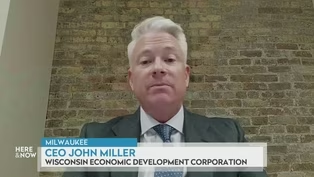
For how this stacks up and what it means, we turn to CEO of the Wisconsin Economic John Miller, and thanks very much for being here.
>> Frederica.
Thanks so much for having me.
>> How surprising was it for you to see Canada play hardball and impose these matching tariffs?
>> Well, obviously, on a state level, you know, we we don't get to decide tariff policy, nor do we get to influence our our partners across the country.
But it is concerning because businesses are the businesses that I meet on a weekly basis are reporting to me that they are very, very concerned about the the unpredictability of the changing landscape of tariff policy.
And the way they say it is just like it would be unfair and chaotic to change the rules in the middle of a sporting event.
Businesses depend on a level playing field and, and also the certainty that the rules that they face today will be the same rules that they face tomorrow.
So this constant roller coaster of tariff policy makes it almost impossible for businesses to plan and effectively run their businesses.
They need to focus on staffing levels and certify and place orders with suppliers.
They also need to spend an extraordinary amount of time locating and training qualified distributors around the world.
So any surprise in tariff policy from a trusted supplier or a critical foreign distributor in a country hit with a tariff can bring production to an absolute standstill.
So replacing a supplier can take months, and losing a foreign market can be devastating.
Our businesses just need clarity on what the rules of the road will be.
>> What sector in Wisconsin will be hit the hardest in this?
>> Our top exports, as you mentioned, are industrial machinery.
And in that category, our exports were down about 12% in 2025.
So we we export a lot of electrical machinery, various vehicle parts, sand, salt.
We also are the large.
Canada is the largest recipient of agricultural goods from Wisconsin.
So overall, the state of Wisconsin exported about $4 billion of ag products in 2025, and 1.4 billion of those went to Canada.
So agricultural products are a huge factor for our our local producers.
>> Specific to that, even though Canada has a really tightly regulated dairy industry.
How important are Wisconsin dairy exports to Canada?
>> Wisconsin imports, excuse me, exports millions and millions of dollars of dairy products to to Canada.
And AG products accounted for about 20% of Wisconsin's exports to Canada in 2025.
So it is a big it is a big part of our export market.
And it's it's not just dairy products.
We do other agricultural products like pro prepared foods, beverages, wood products.
And of course, you know, you wouldn't be surprised that we, we also export a little summer sausage to them too.
But, but as far as dairy, whey cheese and milk are the largest exports to Canada.
>> What does this trade Moore trade war mean for consumers really drilling down to that level?
>> Well, as I think we've seen in a lot of at the grocery store in the last 18 months or so, we have heard lots of stories about products getting more expensive.
And so, you know, Canada is bringing as our other countries, bringing products into the U.S.
that are going to be tariff, which means that they're going to have an impact on what consumers pay at the grocery store.
But I think the bigger factor here is that Wisconsin is a producer.
We produce not only machinery through our factories, but we produce products, dairy products and other things that go outside of the country.
So when when those products are limited in their distribution, our workers have will have to potentially suffer not having a job if they can't, if they can't have a reasonable place to sell their their products.
So it goes both ways.
It's the price we pay for products, but it's also the ability for our workers to earn money producing those products.
>> As to this Canada U.S.
trade war that we are in the midst of right now, do you suspect it will resolve soon?
>> I can certainly hope so, because we're feeling the effects right here at the WEDC, for example, we host trade missions.
It's part of the mission of the WEDC.
And we typically host a trade mission with with Canada and with Mexico every year, because there are largest trading partners.
And we had last year two separate trade missions scheduled with Canada.
And we have Wisconsin companies that we bring along to help them sell their goods in Canada.
But we learn from our Canadian counterparts, counterparts across the border that they were reluctant to engage and meet with our producers because they were concerned about the changing nature of tariffs.
So we actually had to cancel that trade mission.
And so we tried again in November.
Again, we got the same the same response.
But we at the WEDC will remain undeterred.
We decide that we take a different, very local approach.
So we meet with state by state relationships in other countries.
So we really need to do our best to keep those relationships positive.
>> All right.
We leave it there.
John Miller, thanks so much.
>> Thanks for having me.
I appreciate it.
>> Drum roll please.
The first statewide poll conducted after the Wisconsin primary election finds a dead heat among registered voters in the race for governor.
Same holds true for the partizan balance of the legislature.
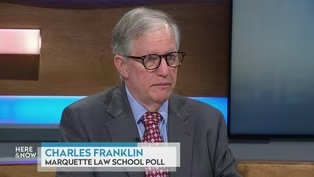
Marquette Law School poll Director Charles Franklin is here with details and insights.
And thanks for being here, Charles.
>> Good to be here.
>> So let's get right to it.
Democratic candidate David Crowley ties Republican Tom Tiffany among registered voters at 44%, each with 12% undecided.
But among likely voters, Crowley comes in at 49% to Tiffany's 44%, with 7% undecided.
What is this gap between the registered and the likely voters?
>> It comes down to two things.
One is Democrats are a little bit more likely to say they're sure they're going to vote in November, so they get a little bump there.
But Democrats are also more loyal to their party's candidate among likely voters than they are among registered voters.
So you put those two things together, and that accounts for why it's five point Steil a close race, but a five point lead with likely while it's tied with registered.
>> Where do independent voters fall in their choice?
>> First of all, pretty undecided.
So there's quite a bit of undecided undecided independence.
They lean towards Crowley more than to Tiffany, but with a between a 30 and a 55% undecided rate.
There are a lot of undecided independents out there.
>> Why do you suppose there are a lot of undecided independents?
>> Familiarity with the candidates is the number one answer.
A little over a third of all registered voters say they don't know enough about David Crowley to say whether they have a favorable or unfavorable view.
Those with an opinion are slightly more favorable than unfavorable, but less than half, as many say.
They don't know enough about Tiffany to have a view, though they're they're slightly more unfavorable than favorable.
So just as with the likely voters, you see a slight edge towards Crowley among on favorability, but a lot of room for voters to learn more about Crowley and the campaigns to compete for, whether they learn good things or bad things.
>> Now, you also found the Democrats hold an advantage in the number, saying, as you said, they are likely to vote.
But more Republicans say they're very enthusiastic to vote.
Is that a hangover from the primary race?
>> It looks like it is.
If you look at Hang Franco Francesca Hong supporters, they are several points less enthusiastic than are either Crowley supporters or Mandela Barnes supporters.
So we were in the field starting the day after the primary.
I think it's kind of natural that if you supported Francesca Hong, you might be a little less enthusiastic.
After she so narrowly lost the primary.
But when we look at how are those people voting, 98% of the Hong voters are saying they're voting for Crowley.
99% of the Crowley voters are voting for Crowley.
So I think we're getting amazing levels of party unity within the Democrats, but a little bit of an enthusiasm gap, mostly coming from disappointed Hong supporters.
legislature, the partizan makeup, really Hughes to the same kinds of results that you found in the governor's race.
>> Very much so.
It's it's a tie with registered voters.
It's a slight Democratic edge, though, a smaller one with likely voters.
This is a statewide look at if the election were held today, would you vote for the Republican or Democrat for legislature?
You really need to dial down into the 4 or 5 competitive Senate seats, the six or 7 or 8 Assembly seats with a statewide sample.
We can't say anything about those individual races.
>> Except we could probably predict that it will all be close.
>> It sure looks like it's close.
Boy, that's a headline for Wisconsin politics, right?
>> So I also wanted to get your take on fake polling conducted by an outfit called Median Strategies.
Now, they released a poll in the Wisconsin primary in California and Nevada, as you know, what was your reaction when it was determined that poll was entirely fabricated, supposedly as a social experiment?
>> It's pure and simple fraud.
So this is a challenge to the polling profession, but it's a challenge to the news media and all of us that try to interpret what's going on in polling for the public.
I just don't think there's a magic wand to make that kind of fraud go away.
When anybody with a Twitter account can publish anything they want to claim they found in a poll.
>> All right, we leave it there.
Charles Franklin, thanks very much for your poll.
>> Thank you.
>> Franklin's Marquette survey also shows that 78% of those polled think the costs of data centers outweigh the benefits.
Across Wisconsin, communities are in battle over the growth of them, the size of data centers, the jobs, their impact on energy, and the economy.
It's all part of the debate tonight, "Here& Now".
Reporter Murv Seymour takes a deep look at the importance of data centers to voters and their potential impact on upcoming election strategies.
>> Wisconsin faces a huge challenge.
>> We need data in everything that we do, and it's got to be stored and secured and accessible and managed in a reasonable and safe way.
>> Parts of the Dairyland.
>> There are locations elsewhere in Wisconsin even that would be more appropriate.
>> Morphing into dandelion.
With the growth of data centers across the state, tech companies drawn to Wisconsin for its climate, water, land, infrastructure and available workforce.
In its polling of Wisconsin voters about the most important issues, Marquette pollster Charles Franklin tells me data centers are barely on the radar for Democratic, Republican and independent voters, but becoming a flashpoint in the race for the governor with heated campaign ads.
>> Data center David Crowley won't roll back data center tax incentives.
>> For data centers accountable and make them pay.
>> What's so striking is there's just no pocket within the state of public opinion.
That's really pro data centers inflation and the cost of living is 42%.
It's been the top issue for at least four years now.
Doesn't seem to be going away at all.
But data centers, in contrast, only 5% name data centers is most important.
Running in an environment where so many people are opposed but don't think it's the most important issue, is a reason for candidates to sort of stay a little clear of that issue or express some opposition, but maybe be a little vague.
Opposition or fear of artificial intelligence turns out to be a pretty big contributor to opposition to data centers.
>> We want Wisconsin to win.
We want America to win.
>> But there is a dedicated constituency in favor of them and the jobs they bring.
>> And we're willing to help anybody who wants to get started in these technologies.
>> And Waukesha Community Technical College President Rich Barnhouse tells me they proudly cultivate students and careers in AI technologies, which includes jobs in the booming data center arena.
>> When I was meeting with a lot of companies who had 20 or fewer employees, which is the traditional, typical Wisconsin business, and they weren't using the words artificial intelligence.
But when I asked what they were looking for in an employee in the next few years, they were describing artificial intelligence without knowing they were describing it.
This is just flourished.
It got so big we had to go out and do a capital campaign, and we're adding about 12,000ft!S of space.
>> Large and small.
A growing number of tech companies are lured to Wisconsin, spending billions to build data centers.
1 billion by meta in Beaver Dam, 15 billion by Oracle in Port Washington in over 20 billion by Microsoft in Mount Pleasant, altogether creating nearly 2000 full time jobs.
Rob Marchant loves it.
He travels the state, lobbying others to fill the same way.
He says he doesn't want Wisconsin to miss out on the growth of the industry.
>> We're a state that makes things.
We build things and we solve problems.
So we did that with heavy machinery manufacturing.
We're doing it now with advanced manufacturing, high technology, medical devices.
>> Marchant leads me to the small town of Winneconne, population 2500.
And some change steps away from the town's bright blue water tower sits Switchgear Power Systems, a 400 person company whose CEO estimates just over a third of its workers build components that support data centers in and outside of Wisconsin.
>> So they've had a really large impact already on our economy.
>> But his group's estimate, a $13 billion impact in Wisconsin, supply chain workers at job sites and in education when it comes to concerns over water and power use.
Rob Marchant says this.
>> These new data centers are paying their own way as far as power infrastructure goes and their power bills.
And we have closed loop cooling, which again uses very little to no water.
Depending on the size of the data center, they can fund schools.
There's property tax revenue.
Does the community need snowplows?
Does it need a library?
Does it want stream restoration?
It's really kind of depends.
But those benefits are real.
And I hate to I hate to think of a community just saying no without exploring the possibilities, understanding the facts, and then making an informed choice.
>> A few blocks from the heart of downtown Port Washington, also called the port around here, Jeff Lueck is part of the constituency against data centers.
>> I won't stop pushing back until they're stopped.
Oh, the bumblebees are out, too.
>> In between watering flowers, Jeff Lueck tells me he made his informed decision on data centers months ago, and he's not ashamed to show it.
>> People don't have time to put in on this kind of stuff, and I get that it's that important, and someone has to open their mouth.
There may be some extra downtown traffic, there may be things in the grocery stores or the restaurants, but on weekends you watch everybody move on out.
>> The community's opposition hasn't been enough to stop the 24 hour construction of the massive 672 acre data center from being built about a mile away from Jeff's home.
For the tech giant Oracle.
>> It don't need to be any bigger than what it is here in port today.
>> He and others continue to have concerns about the potential expansion of the data center, its impact on energy, water and the environment.
>> The trail was used a ton.
I used that interurban trail myself at times, and there's nowhere near the amount of people using it that there were using it a couple of times with just the interurban trail.
They've interrupted us with it.
>> Can you hear that?
Does that mean they support you?
>> That's our support.
And I still get the beeps just standing in my yard.
>> In communities all across Wisconsin, voters and politicians have some tough decisions to make about the future of data centers in the state.
>> Good government follows a process that takes in information from all sides, evaluates it, and then makes a decision.
>> We can do this community by community, industry by industry, or we can take a look at things collectively, holistically and say, how do we want to do this in our state.
>> Doing what makes sense for Wisconsin and the people that live here reporting from Port Washington, Madison and Pewaukee.
I'm Murv Seymour for here now.
>> Another controversy in Wisconsin involves criminal justice and Governor Tony Evers new commutation board.
While many applaud the governor bringing back commutations after 25 years, others assail it for early release of violent criminals.
The board is now reviewing those currently imprisoned looking to shorten their prison sentences.
12 people came before the board earlier this month, and more will appear in September.
There are 800 applicants so far.
The rules include no commutation for crimes against children, but by design, people serving long sentences are eligible for commutation, including for first degree intentional homicide.
They must have served at least 20 years of a life sentence.
Also by design, a focus on juveniles tried as adults and sentenced to life or more than 39 years.
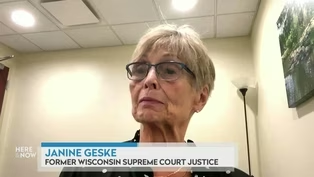
Our next guest is former Wisconsin Supreme Court Justice and Marquette Law School professor, where she was director of its Restorative Justice Center.
Janine Gajewski joins us now.
And thanks very much for being here.
>> Oh you're welcome.
>> What do you think about commutations being reinstated in Wisconsin after 25 years?
>> I think it's a very important move, particularly on some of these cases that, you know, people have been incarcerated for a long periods of time.
And I can tell you, as a former sentencing judge, you know, you wanted them to be reevaluated as they go through the years.
And, you know, I have I have inner worked in the community in Milwaukee with a number of formerly incarcerated first degree murderers who are doing incredible work and were released either on parole or for other reasons.
I think it's good to look at them and make the decision based on all the factors they have to consider as to whether they can shorten their sentence, but they can also make them parole more quickly.
They can they can adjust.
They can put supervision longer so that the the governor ultimately has a lot of discretion on how he handles each case.
>> Does reducing the sentence, though, of a person convicted of first degree intentional homicide, for example, make Wisconsin soft on crime?
>> No.
How's that for a quick answer?
You know, I'll give you an example of of a defendant that I worked with.
There was a woman who had been active in the community, had done all sorts of good work, no prior record.
She had a very challenging domestic situation, and she wound up murdering her husband.
You know, the likelihood that this woman was ever going to commit another homicide or violent act was really small, and yet she served.
She stayed in prison until the day she died.
And, I mean, that's just an example.
There's certainly other, you know, a lot of these defendants that they're looking at are people who committed these crimes when they're 14, 15, 16 years old.
And you look at them 20 years later and they're different people.
And the one thing I like to emphasize with people is these the people that are incarcerated are supervised 24 hours a day.
So for 20 years, 24 hours a day, they've been observed and there's a good there's a good track record of how they're doing and whether or not they continue to pose a risk to the community.
restorative justice in a big way.
What is that?
>> Well, it is it's a harm victim focused process.
In particular, relevant to this issue is that victims and survivors who are interested in having a face to face meeting with the perpetrator of their crime.
And we did a lot of homicides.
We we work with them for about a year and a half, both sides.
And then we let them have a conversation.
It's an incredibly healing process for those survivors who are interested in it.
And it's really an amazing, amazing process.
And those questions that victims have finally can get answered.
>> But does commuting a sentence undermine justice for victims of crime?
>> No.
And this process allows the voice of the victim there.
So the victims are notified.
Now, a lot of survivors, 20 years later, are either no longer in contact with corrections or have moved on.
But there are survivors of surviving family members who are interested, and they have a voice, and that's supposed to be consideration.
In addition, I see that on the commission itself, there are there are victim advocates, people who are expert in trauma and expert in victims issues.
There's a former police officer, a former prosecutor.
So I, I have no doubt that that will be a factor in looking at whether or not to have someone released, but it doesn't mean that the victim will have the sole say over the individual.
>> So the governor's executive order on commutation prioritizes youth offenders sentenced to life in prison.
Why are juveniles carved out in this way?
>> Because because we have learned through the years, and I've learned since I was on the bench, the whole development of the juvenile brain and how that changes.
And I guess I should have known that I was a school teacher.
But but when you know how kids think and approach things, it's very different.
And if you wait 20 years and take a look at them, they are usually different people.
One of the individuals that I have encountered in the community was someone I sentenced for first degree murder at age 14.
It was it was an awful murder.
And I remember sitting as a judge thinking, how long do I set the parole eligibility date on this kid?
Because he's, you know, is he salvageable?
You know, is he always going to be violent?
And I gave him a pretty significant full eligibility date.
Well, he's out in the community now.
He actually contacted me.
He served decades and he is doing such incredible work with the Medical College of Wisconsin on violence, interruption in the community.
And is, you know, it was just the most wonderful day for me to meet him and see how different he is than the young kid that sat in front of me who killed another kid.
>> Janine Geske, thanks very much.
Thanks for your thoughts.
>> You're welcome.
>> For more on this and other issues facing Wisconsin, visit our website at PBS wisconsin.org and then click on the news tab.
That's our program for tonight.
I'm Frederica Freyberg.
Have a good weekend.
>> Funding for "Here& Now" is provided by the Focus Fund for Journalism and friends of PBS Wisconsin.
 New
NewCharles Franklin on Polling Voters About Crowley and Tiffany
Video has Closed Captions
Clip: S2500 Ep2509 | 5m 2s | Charles Franklin on what voters say about 2026 governor candidates and the Legislature. (5m 2s)
 New
NewHere & Now opening for August 28, 2026
Video has Closed Captions
Clip: S2500 Ep2509 | 1m 17s | The introduction to the August 28, 2026 episode of Here & Now. (1m 17s)
 New
NewJanine Geske on Wisconsin's Commutation Advisory Board
Video has Closed Captions
Clip: S2500 Ep2509 | 6m 14s | Janine Geske on restorative justice and the state's process to commute criminal sentences. (6m 14s)
 New
NewJohn Miller on How the US-Canada Trade War Affects Wisconsin
Video has Closed Captions
Clip: S2500 Ep2509 | 6m 29s | John Miller on How the US-Canada Trade War Affects Wisconsin (6m 29s)
 New
NewWisconsin's Economy, Environment and Fight over Data Centers
Video has Closed Captions
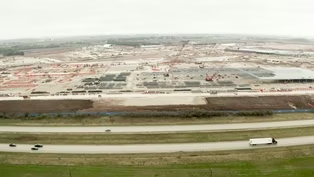
Clip: S2500 Ep2509 | 7m 9s | Development of data centers has become a major community issue across Wisconsin. (7m 9s)
Providing Support for PBS.org
Learn Moreabout PBS online sponsorship New Episode
- News and Public Affairs

Top journalists deliver compelling original analysis of the hour's headlines.
 New Episode
- News and Public Affairs

Today's top journalists discuss Washington's current political events and public affairs.


 New Episode
 New Episode
 New Episode

 New Episode
 New Episode
 New Episode
Support for PBS provided by:
Here and Now is a local public television program presented by PBS Wisconsin