
February 17, 2026 | Carolina Impact
Season 13 Episode 1316 | 25m 59sVideo has Closed Captions
Coca-Cola Consolidated, Inc, Chef Roberto Mendoza, Charlotte Shoe Man, & Trash Fairies
Charlotte based Coca Cola Consolidated's massive recycling efforts; after growing up without enough food, see how one chef makes sure others have plenty; Adam Brooks uses his interest in vintage shoes as a way to give back to his community; & Plaza Midwood’s “Trash Fairies” don tutus to clean their neighborhood each month.
Problems playing video? | Closed Captioning Feedback
Problems playing video? | Closed Captioning Feedback
Carolina Impact is a local public television program presented by PBS Charlotte
February 17, 2026 | Carolina Impact
Season 13 Episode 1316 | 25m 59sVideo has Closed Captions
Charlotte based Coca Cola Consolidated's massive recycling efforts; after growing up without enough food, see how one chef makes sure others have plenty; Adam Brooks uses his interest in vintage shoes as a way to give back to his community; & Plaza Midwood’s “Trash Fairies” don tutus to clean their neighborhood each month.
Problems playing video? | Closed Captioning Feedback
How to Watch Carolina Impact
Carolina Impact is available to stream on pbs.org and the free PBS App, available on iPhone, Apple TV, Android TV, Android smartphones, Amazon Fire TV, Amazon Fire Tablet, Roku, Samsung Smart TV, and Vizio.
Introducing PBS Charlotte Passport
Now you can stream more of your favorite PBS shows including Masterpiece, NOVA, Nature, Great British Baking Show and many more — online and in the PBS Video app.Providing Support for PBS.org
Learn Moreabout PBS online sponsorship(lively music) - [Announcer 1] This is a production of PBS Charlotte.
- Just ahead on "Carolina Impact," you know the brand, you drink their sodas, but you may not know what a major company is doing behind the scenes to cut waste and protect our region.
Plus, meet a local man turning vintage shoes into second chances, one pair at a time, and a group with wings, tutus, and a whole lot of heart shows us there's a little magic in keeping our communities clean.
"Carolina Impact" starts right now.
(uplifting beat music) Good evening, thanks so much for joining us.
I'm Amy Burkett.
Over time, we've become a disposable society.
If something breaks, we're more likely to toss it as opposed to trying to fix it.
Not only is that more costly, it's also bad for the environment, but one local company tries to do its part to change that.
"Carolina Impact's" Jason Terzis joins us with the details.
- It's estimated that only about nine percent of all plastic waste produced worldwide is successfully recycled, with the vast majority, about 80%, ending up in landfills.
The rest gets incinerated, and those numbers are actually even worse in the United States, but Coca-Cola Consolidated in Charlotte has developed programs to do its part and ultimately help those recycling numbers.
(somber orchestral music) - How about a bottle of Coca-Cola?
- Oh, thank you, Mr.
Thompson.
- [Jason] The commercials are legendary, from the animated polar bears in the '90s.
- Want my Coke?
- [Jason] To the Mean Joe Greene jersey toss in 1979.
- Hey, kid.
Catch.
- [Jason] And one of the most iconic of them all, the 1971 Hilltop ad.
♪ I'd like to buy the world a Coke ♪ ♪ And keep it company ♪ - [Jason] For well over a century now, Coca-Cola has stood as one of America's most renowned brands.
- And I think it's something that folks feel very comfortable around and feel familiar with.
- [Jason] In Charlotte, Coca-Cola Consolidated is a longtime partner with Coke.
They are two separate companies.
Coca-Cola owns the brand, sells the drink concentrate, and handles global marketing, while Coca-Cola Consolidated buys the concentrate and then produces, bottles, sells, and distributes the finished product.
- Coca-Cola, I always refer to it as the mothership in Atlanta, and they've got several business units around the world.
And we're in the North America Business Unit.
We are one of many bottlers and we're the largest bottler in North America.
(machinery rumbling) - [Jason] Consolidated's sprawling facility on Charlotte's Northwest side has six total lines, four for bottling, two for canning.
- So we are in one of the bottling lines, and what you're seeing is a Fanta product.
- [Jason] Manufacturing this much product leads to waste, lots of it, and that's why Coca-Cola Consolidated is making large-scale efforts to recycle and reuse as much of its product as possible.
- As a company, we also realize we make a lot of bottles and cans and we want to keep reusing them and, reusing the plastic and the aluminum to keep making them.
- [Jason] Consolidated is prioritizing three main focus points that use innovative techniques to reduce waste, conserve water and energy, and build toward a more sustainable future.
- One is package recycling in increasing recycling rates, the other one is water leadership.
We are trying to help communities improve water quality and address water issues.
- So water's our main ingredient.
It goes into every product, so it's a very critical ingredient for us, and we do measure it, we do a water use ratio to track how much we're using.
- And then emissions reductions, where we're trying to reduce carbon emissions that are released into the atmosphere.
- By reducing our bottle and cap weight, or the content of those materials, and making them lighter, we're actually reducing emissions and reducing packaging material as well, so we're saving on product and we're saving on energy.
- [Jason] Coca-Cola Consolidated's Refresh, Recycle, Renew program aspires to make 100% of their packaging recyclable.
- [Announcer 2] When you finish enjoying our products, the bottle's lifecycle isn't over yet.
Please recycle, so the bottle can be sent on a journey to be remade.
- [Jason] There are other ongoing efforts as well.
Consolidated has a buyback program to recycle its wooden shipping pallets.
Warehouses are converting to LED lighting to lower energy consumption.
And Coke product, Sprite, recently ditched its longtime traditional green plastic and went clear in an effort to increase recycling probability.
- Zero waste really means zero landfill.
So what we do is we have programs at our plants to recycle all of the materials that come back in.
If there is anything that's not recyclable, which could happen, we have what's called a waste-to-energy container, and all the materials go in there and it goes to a facility where they burn the waste and they reuse the byproducts for other processes.
- It's basically reusing our natural resources instead of continually keeping taking some from the earth.
We have it, it's there, we have figured a way to reuse it.
So environmentally speaking, that is a more sustainable, better practice.
- [Jason] To help meet their renewable goals, Consolidated partners with multiple large-scale vendors, school districts, Charlotte Motor Speedway, Spectrum Center, and Bank of America Stadium.
- We are a sports and entertainment company, but I think that we recognize that we've got a lot, we've got a larger responsibility than that.
I think that Coca-Cola Consolidated feels the same way.
Sustainability is something that's not just important for them or us, but for our community and our our world as a whole.
It's something that was important to our relationship.
- For recycling to be successful, and for human beings, or for us to participate, you have to make it as convenient as possible and as simple and easy as possible.
- [Jason] And that's why you'll find recycling receptacles all over Bank of America Stadium.
A typical stadium event, like a Panthers game, fills three 40-yard dumpsters with recyclables.
- So one of the things with Coca-Cola Consolidated that we did was create a lot more opportunities, specifically in the 300, 400, 500 levels, just more receptacles.
And then also following the game, you've got individuals that are going out by section and going through and picking up these plastic bottles, and again, putting those into recycling receptacles.
- [Announcer 2] Bottles are separated, shredded, melted, and turned into pellets.
These pellets become brand new bottles ready to be filled and enjoyed again.
- [Jason] And much like football, recycling is a team game.
If you toss it in the trash, it goes to the landfill.
Toss it in the recycle bin, it hopefully gets reused.
If everyone does their part, the world ultimately wins.
- Just how big is our local Coke distributor?
- They're pretty large and they have a big footprint in a vast majority of the country here.
While Coca-Cola Consolidated is the largest Coca-Cola bottler in the United States, it has 11 manufacturing facilities and 60 distribution and sales centers, and it's been at it for 125 years.
It's quite the operation.
So it was interesting just to see not only the facility here, but, like, then to realize, okay, they've got these things going everywhere, so, yeah.
- Making an impact, thanks so much, Jason.
As we just saw, recycling is about responsibility of what we choose to save instead of throw away.
Sometimes responsibility shows up in far more personal ways.
For many chefs, food is life.
It's their craft, their passion, and yes, their bread and butter, pun intended.
Their days revolve around creating meals for others.
For one local chef, food carries an even deeper meaning.
Before he made a living feeding people, there were times he didn't know where his next meal would come from.
Those memories never left him, and today they're the reason he's committed to making sure no one around him goes hungry.
"Carolina Impact's" Dara Khaalid and videographer Russ Hunsinger show us how that now drives him.
(slaps clapping) (gentle tempo music) - [Dara] That sound, smacking the cornmeal-based dough between her hands until it's flat, is the sound of making pupusas, a thick griddle cake that's popular in El Salvador.
It's a dish that reminds world-renowned chef, Roberto Mendoza, of the flavors of his home country.
So, he had to have them on the menu at his new Charlotte restaurant, La Riviera Marisqueria.
- You make that a special tomato sauce and some kind of coleslaw, and you eat it with your fingers.
- [Dara] Pupusas aren't the only items at La Riviera that give customers a taste of El Salvador.
- [Roberto] We eat a lot of rice and beans.
- [Dara] Roberto also likes to put his own spin on dishes by blending Salvadoran cuisine with American cuisine.
For example, this juicy rib eye sizzling on the grill and veggies sauteing in a flaming pan.
They represent the US, and Roberto serves them on the plate beside rice and beans that represent El Salvador.
- The beauty of blending is you blending cultures.
You give me the opportunity to know your culture, and you have the opportunity to know my culture.
- [Dara] He has another philosophy too when it comes to food, cooking should be fun.
- Every time I cook, I try to be happy.
I try to be smiling, you know, joking with my cooks and having fun and dancing.
- [Dara] When people meet Roberto, they get to see for themselves just how joyful he is.
But what few probably know is that he has every reason not to smile based on what he endured in the early part of his life.
- When I was little, helicopters pass by and they throw 500-pound bombs and just destroy everything.
And you under the table shaking, thinking that it's gonna be your last day.
- [Dara] Roberto remembers the horrors of growing up in El Salvador during the Salvadoran Civil War that lasted from 1979 to 1992, killing more than 75,000 people.
- One day, I went to bed without eating anything, and like one o'clock in the morning and I wake up and I say, "at least a glass of water I gonna take."
When I open the faucet, air came out and... Because they shut the water off.
So I cry and cry and I say, "Lord, when I grow up, "I don't wanna suffer hunger."
(gentle guitar music) - [Dara] Despite those hardships, he persevered until he was admitted into the University of El Salvador to major in accounting.
Just as Roberto was enjoying all the hope that getting an education brings, the perils of the war still found a way to wreak havoc on his life.
- They get inside of the university and took 28 students.
They tied me up... and tied my... eyes, too.
Throw me in the truck.
Finally, like a couple hours later, they throw me in the room... and they start to hit me.
- [Dara] After about a month of surviving a situation that many Salvadorans during that time didn't survive, Roberto was released.
From there, with the help of the Salvation Army, he was moved to Guatemala, then Canada to continue his education.
- They saved my life.
- [Dara] Once his time was done in Canada, Roberto moved to Los Angeles, California, in 1994.
After searching for accounting jobs and not having any luck, he was hired to work at a local restaurant.
- I start to wash dishes and pots and then I start to do salads and cook.
So, I went to the school in Pasadena to become a chef.
I ended up working for Loews Santa Monica Beach Hotel in front of the pier.
- [Dara] It was there that he got to cook for the late soccer legend Diego Maradona.
But that was just the beginning of Roberto's journey, cooking for big names.
He eventually became head chef at The Beverly Hills Hotel, where he whipped up a salmon dish for the prince of Saudi Arabia in 1998, who Roberto says loved it so much that he put in a good word for him at the White House.
- He called... former President Clinton for a meeting.
So, I passed the security check and I ended up cooking for both of them.
Then, Bush come in place.
- [Dara] His presidential cooking didn't stop there, even after moving to Charlotte.
- President Barack Obama, at Wake Forest University, I cook for him And then, Trump, Biden, and I still part of the team for the White House, every time they have big events.
- [Dara] Despite making meals for top leaders, Roberto knew he wanted his food to feed those in need like he was growing up.
So, he started Chef Heaven's Kitchen in 2009 to formally feed the homeless and immigrants in the Charlotte area.
Plus, hungry kids in countries like the Dominican Republic, Pakistan, and El Salvador.
- When you see that little face smiling, having food, and say, "Thank you, Chef."
Oh my God, that feeling in your heart.
- [Dara] Between giving to those in need and cooking for folks around the world, Roberto still makes time for his son Duvan, who aspires to be a chef just like him.
- To come so far from that point of not even having a glass of water to drink, to being able to feed the less fortunate, I'm proud of him for that.
- [Dara] Food, the thing Roberto didn't have enough of in his youth, has now given him more than he could have ever imagined, a career, gratitude, and a way to always serve others.
And for that, he's truly thankful.
For "Carolina Impact," I'm Dara Khaalid.
- Thank you, Dara.
Whether he's helping feed people here in our region or overseas, Chef Roberto could always use an extra hand.
If you're interested in volunteering or donating, head to our website at pbscharlotte.org for details.
He's not the only one turning compassion into action across our community.
For some, giving back comes through a hot meal, for others, it starts with something much simpler, an old pair of shoes.
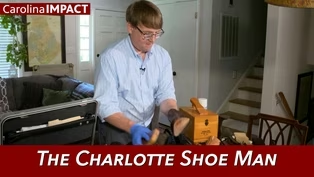
He's known as "The Charlotte Shoe Man."
Adam Brooks has a knack for finding high-quality vintage men's shoes, restoring them, and gifting them to men who need a pair.
Producer Russ Hunsinger shows us how this is more than a hobby for Adam.
It's a mission rooted in kindness and a hope that others will pay it forward, too.
(atmosphere whooshing) (pleasant horn music) - Hi, I am Adam Brooks, I'm "The Charlotte Shoe Man."
I love a good quality shoe.
The origins of this, for me, I got a promotion and spent a lot of money on a pair of shoes, more than I had before.
So, I was very disappointed, spent a lot of money and didn't have the result that I expected, so I started researching.
And guys, they really don't make them like they used to.
(pleasant horn music) So I started getting into vintage shoes.
(upbeat music) The thing I like most about it is it's taking a hobby, it's something of interest, and applying it to being in service, right?
So I'm able to serve other people, I'm able to meet other people.
We've got some amazing stories, I've met some amazing people over the years.
So I think that the people side of it is much more of a motivator.
'Cause after a while, you have too many shoes.
My wife would say I have way too many shoes.
- My name is Greylan Counts.
I'm a multidisciplinary artist.
I went through a season of trying to elevate my dress and attire, and one of my buddies found this pair of Towncrafts on Facebook Marketplace that were by a guy named Adam.
And I saw them, knew I could not afford them, and my buddy explained to me that Adam was giving them away for free.
What Adam's doing with the mission of "The Shoe Man of Charlotte" is this jumping off point of a very, very small act at the foundation of the human, right, the foot.
And the impact is incredible.
The simple aspect of getting these shoes and then needing attire that went with them put me into a position of looking like the kind of person who would dress like that, and being invited into higher rooms, better positions as an artist, higher paying gigs in ways that have provided for me and my family.
- I don't really like receiving cash.
Someone will try to, you know, pay me or whatever, and honestly I think it just muddles it.
It's not why I do it.
I'm happy to give the gift.
What I'd like to see is the gift resonate with someone and create a ripple effect where they're gonna create action and someone else is gonna create action and someone else is gonna create action.
So that's the challenge.
I ask everyone that receives a pair of shoes that in their own time and in their own way, so they may not be able to do it in that moment, that's fine.
A gift can be amplified by you paying it forward and doing something in your own way and in your own time, right?
So that's the challenge, right, it's not a requirement.
♪ Best day ever, best day ever ♪ - In addition to being a multidisciplinary artist, I'm also an arborist, and I had a client who needed some tree work taken care of, but did not really have the budget, and the estimated cost of that job... (cash register ringing) was roughly the same price as the shoes, so I volunteered.
- I like that it's been able to take something that's just a passion.
You know, I'm not a cobbler, I'm an IT guy.
I'm an enthusiast, okay, so it's something I have an interest in and I have a passion in, and it allows me an opportunity to take a passion and then put a purpose behind it and serve and give, you know, to other people.
I think the message I would get across to anyone is don't wait.
If anyone's waiting to get active in serving, don't feel like you need permission.
- Mid-grade shoe.
- Okay?
- So you don't have to have enough money, you have to have enough heart.
You don't have to have a business, you just have to have a passion.
You don't have to have permission, you just have to have a willingness.
I don't believe that there's any small way to serve.
- Thank you, Russ.
Adam says he's gifted 483 pairs of shoes since starting his Charlotte Shoe Man ministry back in 2017.
Tonight, we've shown you how kindness can be recycling, a hot meal, or how it can show up as a pair of shoes at just the right moment, and sometimes it comes with wings.
In Plaza Midwood, there's a little magic in the air once a month, a group calling themselves "The Trash Fairies" put on tutus, wings, and bright colors, not for a performance, but to make something disappear.
"Carolina Impact's" Chris Clark has more.
("Dance of the Sugar Plum Fairy" by Tchaikovsky) - [Chris] They appear just after sunrise on the first Saturday of the month, a brightly colored species moving quietly through Plaza Midwood.
- They've been coming for years.
We've been helping them for years.
- [Chris] Long enough, locals say, to become a neighborhood legend.
- They're really elusive.
- [Chris] Rarely seen, almost never caught in the act.
- Muscular, strong, ready to clean up after you.
- [Chris] All that remains, maybe a feather, scrap of tulle and a suspicious dusting of glitter.
- They just leave the place beautiful afterwards.
- [Chris] Every neighborhood has its legends.
Around here, they're called "Trash Fairies."
- Everybody's like, "The what, what are you talking about?"
("Dance of the Sugar Plum Fairy" by Tchaikovsky) - [Chris] Despite their plumage, this is not ceremonial, it's civic maintenance.
For over a decade, Plaza Midwood business owners have been cleaning up their backyard and the backyards of their neighbors.
- When we started, there was a lot of trash.
We actually, you know, received complaints about trash in the neighborhood and sort of wanted to do something to help with that.
- [Chris] But in its earliest form, the ritual lacked spectacle.
- We would joke around about different ways to make it fun and more engaging.
Anything from like a trash tournament, like a fishing tournament.
- [Chris] Under pressure, adaptation was inevitable.
Faced with speeding traffic, bright defensive plumage was developed.
- Generally, people wear like some sort of a neon vest or something.
We feel like we are, like, magical fairies that are just doing this work.
Michelle Castelloe just jumped right on it and ordered tutus.
- [Chris] It was in that moment, the Trash Fairies took form.
- To be honest, I thought it was kind of in name only.
I thought, I thought the tutus was for like the board of director type of thing.
- It just ties into kind of the spirit of the neighborhood.
You know, it's been a wild bohemian neighborhood for so long.
(lively music) - [Chris] Armed with grabbers, gloves, and bags, they move in pairs, surveying the terrain.
- I feel like I'm gonna find some magic trash.
- [Chris] What they find ranges from the mundane- - Diapers, food bags.
- Somebody was here from NYC, I guess.
- [Chris] To objects that defy explanation.
- That's like a $3,000 piece of, oops.
- A lot of times we'll end up finding things that you really don't know what it is.
Looks like part of a bow and arrow or... (volunteer laughing) an antenna or a walking stick.
That might be, look like a medical device.
- [Chris] Some artifacts refuse removal, slowly fusing with the pavement.
- Flattened, water-soaked, eroded, they now become part of the sidewalk, cardboard or paper products.
Just like, err, trying to get it to come up a little bit so you can grab a lip.
- [Chris] Others suggest a story interrupted.
- You'll come across little scenes, you know, like a stuffed animal with a couple of small liquor bottles next to it.
- [Chris] Some rituals repeat with precision.
- There's a specific spot in the neighborhood where we inevitably find a lot of tequila bottles.
Oh, look at that, man.
Full-size tequila bottles.
Like, who is drinking all this tequila?
- [Chris] Fragments of impact mark this pavement.
- Car parts.
There's always, you know, just from wrecks or whatever, I guess, like shrapnel.
There's like fenders and hub caps.
Somebody didn't use all their ketchup.
- [Chris] Remnants of appetite abandoned mid-meal.
- Oh my God, I can smell that.
Whoa!
- Yeah, no, it's really bad.
- Half-eaten slice of pizza or a, you know, a plastic bag that looks like something was spilled on it that might be toxic.
- I have a really bad gag reflex, so I'm just going to cover that up.
Look at that, see that fabulous fold?
- [Chris] And occasionally they run across something fragile.
- You're walking around, picking up trash, and you see like a little toddler shoe, you know, just must have fallen off a kid or whatever while being walked in the stroller.
- [Chris] The work might be heavy, but the mood is not.
- [Clifton] No talking trash.
Nyuk, nyuk, nyuk, nyuk.
- I think these types of experiences attract a certain kind of person who's just gonna look for opportunities to have fun.
- [Clifton] I'm gonna really feel silly if this thing isn't really on and I'm just talking to myself like this.
- [Chris] Each object adding weight.
- Every person just about fills the bag, either, you know, halfway or all the way.
Sometimes end up bag number two.
- [Chris] Each bag filled draws the merchants out from behind their counters and back into the streets they call their own.
- Getting the small business owners connecting with each other, connecting with the residents in the area and the Trash Fairies and our monthly cleanup has been a way to do that.
- [Chris] They clear the debris without letting it harden them.
- Everyone's at different stages in their life.
I try to have grace and compassion and just, I have no idea what they're going through.
- [Chris] By mid-morning, the work is all finished.
The bags are tied, the street breathes easier.
They drift back toward The Common Market, grabbers collected, gloves discarded, promising to return.
Until next month, they fade quietly back into the neighborhood that's summoned them.
- There is a certain feeling of mindfulness or contribution or even, even kind of a spiritual part of just, just walking, getting exercise, cleaning up.
You lose yourself in it.
- [Chris] And when the first Saturday comes again, the fairies will return.
For "Carolina Impact," I'm Chris Clark.
- Thank you, Chris.
For more than a decade, their fairy-tale cleanups have swept thousands of pounds of trash from neighborhood streets, proving sometimes a little sparkle really can change the world.
Thanks so much for joining us tonight.
We always appreciate your time and I look forward to seeing you back here again next time on "Carolina Impact."
Good night, my friend.
(uplifting guitar music) (lively music) - [Announcer 1] A production of PBS Charlotte.
Chef Roberto Mendoza | Carolina Impact
Video has Closed Captions
Clip: S13 Ep1316 | 6m 51s | After growing up without enough food, see how one chef makes sure others have plenty. (6m 51s)
Coca-Cola Consolidated, Inc | Carolina Impact
Video has Closed Captions
Clip: S13 Ep1316 | 6m 26s | Charlotte based Coca Cola Consolidated's massive recycling efforts. (6m 26s)
Trash Fairies | Carolina Impact
Video has Closed Captions
Clip: S13 Ep1316 | 5m 55s | Plaza Midwood’s “Trash Fairies” don tutus to clean their neighborhood each month. (5m 55s)
The Charlotte Shoe Man | Carolina Impact
Video has Closed Captions
Clip: S13 Ep1316 | 4m 44s | Adam Brooks uses his interest in vintage shoes as a way to give back to his community. (4m 44s)
February 17, 2026 Preview | Carolina Impact
Preview: S13 Ep1316 | 30s | Coca-Cola Consolidated, Inc, Chef Roberto Mendoza, The Charlotte Shoe Man, & Trash Fairies (30s)
Providing Support for PBS.org
Learn Moreabout PBS online sponsorship
- News and Public Affairs

Top journalists deliver compelling original analysis of the hour's headlines.

- News and Public Affairs

FRONTLINE is investigative journalism that questions, explains and changes our world.











Support for PBS provided by:
Carolina Impact is a local public television program presented by PBS Charlotte