
February 10, 2026 | Carolina Impact
Season 13 Episode 1315 | 25m 40sVideo has Closed Captions
Leader on Loan, Embracing Flaws Through Kintsugi, Upcycled Fashion, & High Octane Coffee.
Bank of America's "Leader on Loan" places executives into non profits for short term work; visual artist Eva Crawford guides participants through a hands-on Kintsugi experience; a local woman upcycles thrifted items into unique creations; & A historic gas station reborn as café, fueling Monroe with Colombian coffee and community.
Problems playing video? | Closed Captioning Feedback
Problems playing video? | Closed Captioning Feedback
Carolina Impact is a local public television program presented by PBS Charlotte
February 10, 2026 | Carolina Impact
Season 13 Episode 1315 | 25m 40sVideo has Closed Captions
Bank of America's "Leader on Loan" places executives into non profits for short term work; visual artist Eva Crawford guides participants through a hands-on Kintsugi experience; a local woman upcycles thrifted items into unique creations; & A historic gas station reborn as café, fueling Monroe with Colombian coffee and community.
Problems playing video? | Closed Captioning Feedback
How to Watch Carolina Impact
Carolina Impact is available to stream on pbs.org and the free PBS App, available on iPhone, Apple TV, Android TV, Android smartphones, Amazon Fire TV, Amazon Fire Tablet, Roku, Samsung Smart TV, and Vizio.
Introducing PBS Charlotte Passport
Now you can stream more of your favorite PBS shows including Masterpiece, NOVA, Nature, Great British Baking Show and many more — online and in the PBS Video app.Providing Support for PBS.org
Learn Moreabout PBS online sponsorship- [Announcer] This is a production of PBS Charlotte.
- Just ahead on Carolina Impact, you've heard of banks loaning money.
What about loaning their employees?
One local bank does just that to help nonprofits.
Plus, we'll introduce you to an ancient art form using broken porcelain to help people heal and see a local woman who upcycles thrifted items into must see creations.
Carolina Impact starts right now.
(bright music) Good evening, thanks so much for joining us.
I'm Amy Burkett.
You likely know Charlotte is one of the nation's largest banking hubs with an estimated 100,000 people working in financial services across our region.
You might be surprised to learn some of those executives aren't spending their days inside bank walls.
Instead they're lending their expertise where it's needed most.
Carolina Impact's Jason Terzis joins me now with the details.
- All right, so picture this.
You've been at your job for a long time, years and years, picked up tons of skills and expertise along the way, but then your bosses ask you if you'd like to go work somewhere else.
No, they're not firing you.
Instead they're loaning you out where you'll go to work for a nonprofit for a year or two, helping them learn and grow with the skills that you've mastered along the way.
You'll still be getting paid by your employer and eventually go back there.
What would you say?
Would you do it?
(interviewee speaking in Spanish) - [Jason] Spend a little time around the Camino Health Center and you'll hear a lot of Spanish.
- Our mission is to equip people to live healthy, hopeful, productive lives and we serve primarily the Latino immigrant community.
- [Jason] A bilingual and multicultural non-profit, Camino's wraparound services include a little bit of everything.
- From healthcare, dental, behavioral health, nutrition.
- [Troy] Pastor Rusty Price is the founder and president of Camino.
His mission, simple, help people, but business not necessarily his strong suit.
- I don't think about money.
If I'm doing what I'm supposed to do, the money will come.
I don't ever think that way at all, which is good, but it can also be not great for an organization.
Right?
- So about eight years ago, Rusty got connected with Grace Nystrum, a senior VP with Bank of America.
- I was not familiar with this organization at all.
- [Jason] Grace was asked to temporarily leave her role at BOA and go to work at Camino as the interim executive director.
- It was positioned to me as an opportunity.
Grace, you're heavily engaged in the community.
You're very passionate about serving the community.
- [Jason] Her one year assignment turned into two, Grace helping Camino become more efficient and grow its organization.
- And to help them deliver on their strategic plans.
Actually, they didn't even have a strategy at the time.
They were just fulfilling the mission.
- The corporate world is very different, so she brought things like agenda to meetings.
Next steps, we learned that.
Next steps.
- We had a staff, a very small staff, less than 10, and by the time I left, we had close to 30.
Today, they have over 110.
- [Jason] Grace was Bank of America's first executive on loan, now known as Leader on Loan.
The idea, place senior executives into short term leadership roles at area non-profits and use their expertise to address needs.
- It can be anywhere from finance, to communications, to strategy work, to project management.
It's based on the need of that organization.
- Within Bank of America, we are very focused on community from volunteering two hours a week, to making donations having a matching gift to also making sure that we bring organizations to our home so that we can collaborate and support them.
- [Jason] Bank of America doesn't just wanna provide banking and financial solutions like they do on an everyday basis.
They wanna be good community partners and by helping provide strategic support for nonprofits to be more efficient, free of charge, everybody wins.
- The bank is very committed to doing this, okay, not just here in Charlotte, but all over the United States.
- We have had over 50 Leaders on Loan across the country.
- When we talk about lending a leader, I am not having to report to Bank of America every day.
I'm able to go and live my passion and purpose with a nonprofit organization that I believe in that aligns with my morals and my values.
That's priceless.
- I don't think if Bank of America would've given us a million dollars, it would've been as big of an impact as it was them sending Grace.
She made a bigger impact than if they had given us a million or $5 million.
- It absolutely benefits the community, but it also benefits the bank.
Okay?
We get a better feel for what's going on in the community.
- [Jason] Over at Charlotte Mecklenburg School's main headquarters, John Schleck isn't an educator, nor is he an administrator.
- I have got 40 years of experience in the financial services business.
Spent the first 35 years in the consumer lending space doing mortgages and auto loans.
- [Jason] But for the last year and a half, John's been on loan to CMS helping on the business side of running the nation's 16th largest school district.
- I was assigned to the Office of Strategy Management when I first got here.
When I came down, I had a lot to learn and I just spent a lot of time just sort of getting to know what was going on and you know, just learning about what the issues were and where the problem areas were or the areas that CMS wanted to try and tackle.
- [Jason] While he can't help with teacher pay, which is controlled by the state, John is working on other initiatives to help teacher finances.
- And one of those ways is through housing.
And so they asked me to get involved and we created an initiative called At Home in CMS, working with local developers, landlords, what have you, trying to find programs and put programs together for reduced rent.
- [Jason] And at Dress for Success, a local nonprofit that supports unemployed and underemployed women.
You'll find yet another longtime Bank of America employee working on loan.
- Frenchie Brown, we have known her for a long time, is not just a friend of the organization.
She is a partner in our organization.
- In my 28 years at the bank, Jason, majority of the roles that I've had, I've only had to apply for two.
Every other role was what we call a tap.
And that tap is because you are performing, we see you.
We need your skills and there's an opportunity for you.
- [Jason] Working with Dress for Success for over a year now, Frenchie helped the organization with all the logistics and moving to its new location on Remount Road.
- We knew that we were heading into a season of change with a new building with the construction that goes into that.
I could have never predicted how extensive and intensive moving an organization, not to mention doing upfit and construction before moving would be.
- The second week that I was enrolled, I sat down with the executive director and we talked about the transition.
I created this whole end-to-end project plan and sent it to her.
She said, oh my gosh, all of this is in your project plan.
I'm like, yeah, all of these things we need to think about from your operating budget, your capital campaign budget, what are the tactical things we need to do?
What happens if we don't hit those timelines?
- Because I had another executive to walk alongside me to say, here are the needs that I'm identifying.
What needs are you identifying?
I've got this.
And knowing that I could trust her, that she understood my vision and our team's needs and that she really has our clients at heart.
And so I really don't think we could have done this successfully without Frenchie's partnership and without the investment from Bank of America.
- I love the concept Jason, but why does Bank of America do this?
- It's interesting.
I think what it is, for them, it all goes back to community investment.
The thinking being that a stronger community is a better community.
We recently highlighted their Sports with Us program, which teaches life skills to kids through sports.
They also have another program called Neighborhood Builders, which focuses on economic mobility.
All told in the last 20 years or so, Bank of America has invested $350 million into nearly 2000 nonprofits across the United States.
You know, they wanna support the city and this is a really unique way that they're doing it with this program.
- And I love how you keep digging throughout our community to find these types of hidden gem stories.
Thank you Jason.
- They're really fun to tell.
- We've shown you how economic growth can lift a region.
Now we turn to a story about what lifts people up.
What if the cracks in our lives were something to be celebrated and not hidden?
Visual artist Eva Crawford is using Kintsugi, the traditional Japanese art of repairing broken porcelain to guide others through a creative experience that turns fragility into beauty.
Producer Russ Hunsinger has that story.
(plate shattering) - Most of us in life will not get away with experience some type of deep flaw and hurt and brokenness.
- The whole idea about a kintsugi experience versus just a workshop is showing people through physical broken pieces how we all are broken and taking them through the process of the slow art of mending and healing.
- This sweet angel, I just love, my husband Bill gave it to me.
- And people are always excited to show what broken piece they brought in.
But once I have them sit with it and breathe and behold it and talk about like the story that's behind the piece, then they start to apply it to their own brokenness.
Sometimes people bring something in that has no sentimental meaning and they break it and they still learn.
But I think the most moving experiences have been when someone has brought something in that has meant something to them.
It belonged to a family member.
- I brought in two pieces that were toys of my grandmother's that I actually also played with as a child.
She was always for me and was always so kind and loving to me regardless of what I had done or who I was at the time.
This meant a lot to be able to take this tiny little repair and it to be a symbol of the things over a span of her life and then my life of mending and healing broken parts.
- We think about like fixing something and making it the same shape it was before.
We're putting it back in the format it was before but truly it is a new creation and that is key to this mending process.
- What I was looking at, I noticed that you could almost, it almost looks like y'all are at the right angle.
It is not broken.
There was a piece that almost didn't look damaged because all of the damage was hidden.
So you can kind of as a person turn that side of yourself to the world so no one can tell that you're damaged or hurt and you seem whole.
And so I think this process helped me think through how that's actually not a place of strength because you're trying to hold it all together by yourself instead of getting help from your friends and family and people who love you.
- When they finally get through the steps, some of them are more messy and some of them are very frustrating.
They get to that final step of applying the gold.
You can see everybody's shoulders relax and enjoy the process of applying the gold.
It's so satisfying, they start to relate to it and then that's what makes the Kintsugi experience powerful.
- I think one of the things that's powerful about it is that you come out of the experience with this physical reminder, not only of the process that you just went through and maybe the event in your life that caused you to want to come do Kintsugi and think about making something beautiful out of something hard.
So now I can put this in my home and think about not just the damage and the hard thing but this new opportunity that I've been given, this new beautiful piece of art.
- It meant a lot to me to be able to fix this but also have a story behind fixing these pieces together.
The flaw being seen and being made pretty and beautiful again has great significance because the repair work is prettier because of the flaw, I think is the beauty and that's what we remember with kintsugi.
- What a beautiful art form.
Thanks so much Russ.
You may be wondering about the word kintsugi.
It translates from Japanese as golden joinery and the craft work is believed to go as far back as the late 15th century.
Now we get to meet another person in our community whose creations are making an impact.
Shelby Mengel's fascination with thrifting and sewing started in her teens, now she transforms old items into eye-catching pieces.
Producer John Branscum shows us how she takes her passion for fashion to the next level in a sustainable way.
- [John] Several days a week at Copycat Printing, you'll find Shelby Mengel tucked away in a corner.
- [Shelby] During the day, I'm a graphic designer.
- [John] It's challenging and creative work, but when she's done with the keyboard and the mouse of the office, at home, she has something else up her sleeve.
- I am an artist, designer and I create art and designs under Shelby Lynn Lives.
- Her medium of choice?
- I love to work with upcycled materials.
I love to use a lot of blankets, heavier things that you know maybe wouldn't be assumed to get turned into fabric for clothing.
- [John] Shelby remembers that spark that first ignited her interest.
- I learned how to sew a button in home ec in middle school and I thought it was the coolest thing in the world.
We were allowed to like go home with it 'cause what were they gonna do with it?
I think I sewed like eight buttons on it that night.
From there I had a lot of assistance from my grandmother learning me the basics.
She absolutely helped like ignite my love for it and certainly my confidence with it.
- [John] With a solid foundation, she quickly moved past buttons.
- Things I'm like seeing online and I'm like looking at my own clothes, trying to figure out how I can do that or things like it.
So using clothes and fabrics that were laying around that I already had are pretty much how I learned how to do everything that I do was through upcycling, but at that time it didn't have the word upcycling, - [John] No matter what you call it.
One thing's for certain.
Shelby is hooked and she is always hunting for raw materials.
- All but exclusively thrift stores.
Anything can be turned into anything.
Sometimes I know immediately what I'm gonna make out of it and other times to the detriment of my storage, it sits around for a little bit until just like that one day that like the idea hits.
When it comes to using the heavier materials, blankets, quilts, those things are generally turned into sweaters, vests, jackets even.
Just got a bit of everything.
- [John] The Pennsylvania native moved to Charlotte in 2023, but before the QC, she spent a few years in Beantown.
It was while living in Boston, she entered the popup market scene.
- It's a social event as much as it is a shopping event and honestly, I like immediately felt like I found my community, my creative community.
Like I kind of joke that I pay to like be at events with my friends.
- [John] At first, Shelby focused on selling hrr custom paintings.
- When I first started, I would say painting was 80% and clothing was 20%.
That has like very quickly, completely reversed and I would say confidently now that clothing is probably like 80 to 85% of my business.
The price range on my clothing, you know, simpler, maybe like anywhere from like 30 to $50 range depending on what I've done to it or how much altering I needed to do, completely from scratch tends to be anywhere from like 60 to over a hundred dollars.
- It's just so incredible that someone is able to create all this stuff and takes the time to, you know, puts so much energy and thought into such unique pieces and share it with the community.
- [John] It didn't take long before her clothes and her techniques caught the eye of fellow upcycler CT Anderson.
- Oh my gosh.
I met Shelby at a market and I was like, oh my gosh, this woman is amazing.
This sweater that she made out of a Chapel Hill throw, University of North Carolina throw is amazing.
- [John] With a professional background in corporate sustainability, CT is the founder and creative director of Spring Clean.
- Spring Clean is a resale boutique with a twist.
We focus on creative reuse.
You can donate your clothes, you can get them altered or repaired.
We have fun sewing workshops and we make sure that 90% of what we collect doesn't go to waste.
- [John] With their shared interest in upcycling, CT invited Shelby to stop by.
- You should come hang out with us and teach a workshop.
And then she showed all of these beautiful throws and bags that she makes and I'm like, well, you can actually come sell it in our shop.
Like we feature artists all the time.
That's the goal of Spring Clean is to not just highlight our items, but items of others in the community that are offering creative reuse.
- [John] CT says there's more going on here.
Their creative reuse is really a win-win for the environment.
- Takes 700 gallons of water to make the average T-shirt.
Only 1% of clothes that get donated are actually recycled or reused.
1%.
When you donate your clothes to a traditional thrift shop, only about a third of them get resold.
The rest of them are shipped overseas to countries that have less of a waste =infrastructure than we have in the US.
- [John] And as for that term upcycling?
- It's funny, I don't think it's a novelty.
I think we just put a name on it.
People have been reusing and remaking things for a very long time.
A lot of artists use what they call found materials and make things out of it.
We're just making wearable art.
- [John] In the end, for Shelby.
- If I'm making something, I'm happy.
That's the goal is just keep playing around, keep trying new things.
The fact that I can do something I find so fun, getting to do this for whatever portion of my time and my life I get to do is in itself like so rewarding.
- Thank you.
- For Carolina Impact, I'm John Branscum.
- Thank you John.
Shelby sells her creations at various popup events across the Queen City.
If you wanna catch her at the next one, we have more information on our website at pbscharlotte.org.
Finally tonight, a long forgotten building in downtown Monroe is getting a new chapter.
What started as a passion for preservation has turned into a place built on family, risk and reinvention.
Carolina Impact's Chris Clark shows us how history helped spark something new.
(bright music) - [Chris] Since 1947, the corner of Stewart and Lancaster has been where Monroe comes to fuel up.
Unlike its neon blasted interstate cousins with 24 pumps and a mile of asphalt, this place is a time capsule, old school pumps out front and Dino the Dinosaur standing guard.
- It kind of caught my eye, that's why I wanted to come over here and check it out.
- [Chris] These days, the difference is what they're pumping.
The product isn't measured by the gallon anymore, it's measured by the shot.
Welcome to High Octane Coffee where the pumps are quiet but the corner still fuels the town.
- The community received this place with arms wide open.
- [Chris] The transformation from gas station to coffee shop didn't happen overnight and it wasn't a straight line.
Originally, this building wasn't meant for cappuccinos at all.
- I was looking for a location to house my corporate headquarters and my business and my shop.
- [Chris] Antiques dealer and fine arts appraiser Peter Carlin built his career preserving American history, so when he found a historic 1947 gas station in Monroe, it seemed like the perfect fit, but the station he found looked nothing like the one standing here now.
- It was a disaster.
It was basically falling apart.
The roof was caving in, there was water coming through the ceiling and I'm a real history geek, so I was like, you know, the old gas station is cool, I'd like to renovate it.
- [Chris] And that's exactly what he did.
One pump, one can and one sign at a time.
- The one that everybody wants to buy is the old Welcome to Monroe, North Carolina, We're Friendly Folks sign and it used to be and somewhere posted on the outskirts of like as you came into town, it was one of the original signs.
- [Chris] Once the restoration was finished, the place looked spectacular, but the building wasn't alive.
His work had him on the road a lot, which presented a problem.
- People would come up and I would see 'em on the security alarms like looking in the window and people were like, when is this guy open?
I'm the antique store that's never open.
- [Chris] Instead of becoming a gathering place, it sat locked behind glass.
Full of history, but empty of people.
- It was a glorified storage unit, that's not really great for the community.
You know, it's like I wanted this to be something that the community could enjoy.
- [Chris] And as fate would have it halfway around the world, the answer was already taking shape.
Peter's sister-in-law and her husband were ready to walk away from successful banking careers in Columbia and bet on a dream of their own.
- Every time that we had the chance to on holidays, vacation, the first thing that we do is go to these cozy places to get a really good cup of coffee and some pastries.
During pandemic, we start thinking that we love that.
Why don't we start our own business?
- [Chris] Oscar and Adriana didn't stumble into coffee, they chased it.
They traveled across Columbia meeting farmers, learning the craft from soil to cup, even training as baristas.
The plan was to build their dream back home until a family trip to North Carolina revealed where their Columbian coffee truly belonged.
Here.
- We went to mountains, Boone, Asheville, and one day we came to Monroe.
We see a couple of places like brewery, these kind of places, but we say-- - Why not?
We can share about our culture, coffee culture with other community.
- [Chris] Monroe gave them a town and that town led them to a corner and that corner led them to an old gas station ready to run again.
- We're talking about doing a food truck kind of just morphed into, well why don't we just make this the coffee shop?
- We didn't have the name for the business, but when we see all the gas pumps, High Octane Coffee, the perfect match for the energy, the vibe, the coffee.
- [Chris] After months of renovation, the doors finally opened.
An idea is easy to dream, but harder to trust.
Every new business carries a quiet fear of what if no one comes?
On opening day, Monroe answered and they haven't stopped showing up since.
- It was crazy, but it was nice to see all the people.
- My daughter, she really loves coffee and I love the atmosphere.
- [Chris] And inside, the menu has its own crowd favorite.
- Yeah, the waffles.
- [Chris] It's tough to go wrong with a hot waffle on a cold day, especially with this assortment, even the building's original owner stopped by to see what his shop had become.
- He started telling me the whole story about the downtown area, how he buy this property, all this story behind this.
We have customers that used to work here when this was a gas station.
- [Chris] Sometimes the restoration is so convincing, people still think the pumps are working.
- We don't block the gas pumps like now, and the people is still coming, parking there asking for gas.
- [Chris] For a corner that once ran on gasoline, the energy now comes from people.
- The community has been very warm, very helpful with us.
- [Chris] And nearly 80 years after this station first fueled Monroe, it still does just one cup at a time.
For Carolina Impact, I'm Chris Clark.
- How exciting to see a new lease on life for that facility.
Thank you, Chris.
What once sat empty is now filled with purpose and possibility.
It's a reminder that fresh starts can come from unlikely places and sometimes from old ones made new again.
Well our region is filled with hidden gems like these and we need your help to learn about them.
If you know of an interesting person or place, we should spotlight here on Carolina Impact, please email the details to stories@wtvi.org.
Before we leave you tonight, I'd like to thank our special guests from Central Piedmont NextGen Program and the TMSA Charter School in Concord.
They were amazing young people with wonderful questions.
Thanks so much for joining us.
We always appreciate your time and we look forward to seeing you back here again next time on Carolina Impact.
Goodnight my friends.
(bright music) - [Announcer] A production of PBS Charlotte.
Embracing Flaws Through Kintsugi | Carolina Impact
Video has Closed Captions
Clip: S13 Ep1315 | 4m 22s | Visual artist Eva Crawford guides participants through a hands-on Kintsugi experience. (4m 22s)
High Octane Coffee | Carolina Impact
Video has Closed Captions
Clip: S13 Ep1315 | 5m 50s | Historic gas station reborn as café, fueling Monroe with Colombian coffee and community. (5m 50s)
Leader On Loan | Carolina Impact
Video has Closed Captions
Clip: S13 Ep1315 | 7m 21s | Bank of America's "Leader on Loan" places executives into non profits for short term work. (7m 21s)
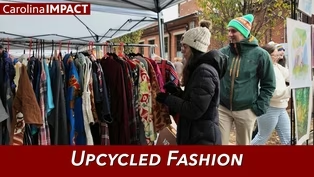
Upcycled Fashion | Carolina Impact
Video has Closed Captions
Clip: S13 Ep1315 | 5m 33s | A local woman upcycles thrifted items into unique creations. (5m 33s)

February 10, 2026 Preview | Carolina Impact
Preview: S13 Ep1315 | 30s | Leader on Loan, Embracing Flaws Through Kintsugi, Upcycled Fashion, & High Octane Coffee (30s)
Providing Support for PBS.org
Learn Moreabout PBS online sponsorship
- News and Public Affairs

Top journalists deliver compelling original analysis of the hour's headlines.

- News and Public Affairs

FRONTLINE is investigative journalism that questions, explains and changes our world.












Support for PBS provided by:
Carolina Impact is a local public television program presented by PBS Charlotte