Detroit PBS Documentaries
The Calling
Special | 1h 5m 38sVideo has Closed Captions
Venture beyond the convent door to gain a deeper understanding of the lives of religious sisters.
From award-winning producer/director Keith Famie and his team at Visionalist Entertainment Productions, this film ventures beyond the convent door to gain a deeper understanding of the lives of religious sisters. These remarkable women selflessly choose to dedicate their lives to God and the betterment of humanity, often facing misconceptions and misunderstandings along the way.
Problems playing video? | Closed Captioning Feedback
Problems playing video? | Closed Captioning Feedback
Detroit PBS Documentaries is a local public television program presented by Detroit PBS
Detroit PBS Documentaries
The Calling
Special | 1h 5m 38sVideo has Closed Captions
From award-winning producer/director Keith Famie and his team at Visionalist Entertainment Productions, this film ventures beyond the convent door to gain a deeper understanding of the lives of religious sisters. These remarkable women selflessly choose to dedicate their lives to God and the betterment of humanity, often facing misconceptions and misunderstandings along the way.
Problems playing video? | Closed Captioning Feedback
How to Watch Detroit PBS Documentaries
Detroit PBS Documentaries is available to stream on pbs.org and the free PBS App, available on iPhone, Apple TV, Android TV, Android smartphones, Amazon Fire TV, Amazon Fire Tablet, Roku, Samsung Smart TV, and Vizio.
The Pulte Family Charitable Foundation is honored to help bring the Calling to Life.
Established in 2018, our foundation has given more than $150 million to over 300 charities across the nation and around the world.
Rooted in faith, we remain committed to serving society's most vulnerable.
Conrad N. Hilton, the founder of the Hilton Hotels, committed his wealth to improving the lives of others.
Catholic sisters were an enduring influence in his life, accompanying him through challenges and successes.
Today, the Conrad N. Hilton Foundation is a significant funder of Catholic sisters globally, supporting the leadership of sisters themselves, as well as Sisters Outward Ministries and advocating for sisters to age with dignity.
It's 70 years since I left home, and every moment of it has been a joy.
And I can say that sincerely.
That doesn't mean that there weren't setbacks.
That doesn't mean that I wasn't crying my eyes out sometimes, you know?
But in the end, whatever has happened in my life has made me what I am today.
And I'm grateful to God for every moment of it.
And if he would give me 70 more years again, I would do it all over again.
Like so many folks in Michigan, I was taught by nuns and nuns were the workhorses of the Catholic Church during its boom years in this state, when baby boomers were surging through Catholic schools and the impact they had on shaping so many people in Michigan, shaping towns and shaping schools and shaping young people in the Catholic faith and in reading, writing and arithmetic.
You can't help but be grateful for their years of sacrifice and service.
Catholic nuns were some of the first feminists before anybody knew what the word meant.
They went places where other people didn't go.
They went to established schools.
They went to establish hospitals.
They went to help ethnic groups assimilate into American life and grow here and prosper here.
The reason these Catholic nuns.. so many is because so many were educated themselves.
They knew how to speak multiple languages sometimes, plus they knew how to read and write, which wasn't always the case for so many immigrants who came here from faraway places.
One of the congregations that came here was the Sisters of Mercy.
They came here to help lumberjacks in Northern Michigan with health care.
I mean, when Michigan was a wilderness before Michigan was even a state, sometimes there were these pioneering women who went to far off places with no development, and they helped create the spiritual landscape that benefited so many parishioners, so many Catholics, and benefited their children and gave their children an education that a lot of the parents didn't have.
The difference between sisters and nuns is that sisters are more apostolic, which means that they live more of a life of outward service.
You see them a lot more, whereas nuns are typically cloistered sisters, so they live a life of a lot more contemplation and prayer.
Even though sisters who do serve are meant to be balanced in both prayer and being contemplative, and then going out and serving in the Chaldean community, it's a little bit different because we're eastern rite.
So the technical definition in our canon law is nuns.
We have nuns and monks.
So for us, there's not that much of a distinction.
Where in the Latin rite You do have nuns and sisters.
There's a clear difference.
Saint John Paul the Second puts it beautifully that the church is two lungs.
So you have the West and the east.
The main difference between the church and the east is that there are a bunch of little different rites or different varieties, you could say.
Then the West, which is mainly the Latin right, or the Roman Catholic Church.
For us, Chaldean specifically, we have ori I think one beautiful aspect of the consecrated life and women religious right now is we point the way of hope.
You know, everybody knows that they were created for something the world.
And especially right now, all of the messages that people receive is that you're going to be filled and you're going to be happy with all of these other things that you can fill your life with, whether it's achievement or it's things.
Women, religious.
We've taken vows of poverty, chastity and obedience, and we've said that all of these external things are beautiful.
But I want something more.
I want this relationship with God.
Our role in the church, of being a symbol that we're all part of this life of heaven, but then also is like living this life of charity right now and serving the different needs of the church, whether it's through our apostolate of teaching or through some communities do nursing, some community do pastoral work.
And so we all have a mission and serving the faithful chanting chanting When you hear sisters talk about charism an.. The charism is the special gift.
It's the gift of the Holy Spirit to each religious institute to make them unique.
Our charism, we interpret is making people part of the liberating mission of Jesus, bringing them into that fold, helping them find freedom within themselves, freedom within society, freedom to be and do whatever God is calling them to do, whether that's services to prayer or presence, whether that's our charism.
singing singing singing singing singing singing singing singing singing For many Catholics in the Detroit area, the biggest teaching order were the sisters, servants of the Immaculate Heart of Mary out of Monroe, Michigan.
They were known for their royal blue habits.
Today, the IHM sisters are still making an impact in a variety of ways.
Many of them remain educators, both here in this area and in other states and in other countries.
They have a long tradition of missionary work, and many of them now work on the border helping migrant communities.
But they've also distinguished themselves as environmentalists, as artists, as conservators, for people who are disadvantaged, as social workers, and as women who fight against human trafficking and assist those who are impacted by human trafficking.
Sisters.
Servants of the Immaculate Hea.. We were founded in 1845 by a Redemptorist priest, Louis Gillet, and a sister, Theresa Maxis, who originall was an Oblate Sister of Providence in Baltimore, which is the first permanent congregation of women of color.
Theresa Maxis was born to a Haitian woman and a British soldier.
I believe he was military and grew up in Baltimore, in a family that valued education and gave her a really good education.
And that's part of where our charism of education comes from, the recognition that education has the power to transform lives.
She knew that she lived that, and that has been part of our charism, that founding spirit, that founding impulse, that gave rise to this congregation.
It has been part of us all 180 years now that we've been in existence.
And when there was a need here in Monroe for someone who could provide education, especially for the French immigrants, because sisters often followed those major waves of immigration, she was well-educated.
She spoke French, Louis Gillet knew her and knew of her, and invited her out to the frontier land of Monroe, Michigan.
I think many people can visualize there would be no running water, no electricity, no powered anything.
They came on November 10th, 1845, and by December 25th they put an ad in the paper in Monroe saying, we are opening a school in January next month.
And they did.
That school became Saint Mary's Academy over the years.
But I say this because it is in the very genes of IHM sisters to be educators.
And we continued educating and still do in different ways.
And so we were sought after as the immigrants came from particularly Europe after the potato famine in Ireland and the wars in mid-Europe.
Many of them were Catholic, so the bishops wanted teachers, they wanted nuns because that's the only people that taught in schools at the time.
So we were, as I was, very much in demand and many, many, many women were joining the community at that time.
So we were growing from the very beginning.
We adopted a model of theory of education, which came from Belgium, because our priest, Father Louis Florent Gillet, was a Belgian.
He asked the sisters to adopt the Saint Andre method, which was for its time.
Now we're talking 180 years ago, a very holistic approach.
So it was traditional education for literacy and math and history, but also culture and the arts and certain respect for the individual and a holistic approach to the person.
So that was really the background of our approach to education.
By the time of the 20th century, it became clear that the public schools were beginning to set standards for education.
And so they were becoming better teachers in terms of preparation.
And we were so by the 40s, it became clear that our teachers were not keeping up.
Two members of our community were leaders in what became called the Sister formation movement, which was like 48 into the 60s.
Sisters were educated and received their degree, sometimes advanced degrees, masters and PhDs.
Because that way they could best serve the people of God.
A good Catholic should be well-educated to be able to serve others, should be well educated, be able to care for their families, be well educated to know their faith.
All of this would have a transformative effect, not just on the individual, but on the world.
A significant thing that happened in Michigan in 1970, there was a ballot issue to amend the Michigan Constitution to prohibit state dollars going to private schools, and that was called proposal C, it passed.
Well, that was a very, very significant factor in the diminishment of Catholic education in Michigan.
That was the beginning of many items not staying all in education.
As the number of schools diminished, we became active in many ministries, including religious education, for students that weren't going to Catholic schools.
We called it CCD.
They became hospital chaplains.
They went into social work.
I went into law just a lot of various ministries, but always with a sense of liberation, which is what the meaning of education is to liberate.
Who we are as IHMs are women who are committed to helping people become most fully who they are.
Education is an incarnation of that spirit of I. It's one that fulfills a very important need at the time, and has continued to do so even now, when we express it in a different way our ministries, education, our ministries in social justice, our ministries in caring for the earth.
Our ministries in the churches, the parishes, the border, wherever we are.
That mission, that central motivator, is expressed.
We find God in the marketplace.
We find God in the activity of service.
It's a blend of contemplation and action, which is the story of the Sisters of Mercy from Dublin, Ireland, where we were founded in 1831 by one woman, Catherine McAuley.
She started a House of mercy in 1827.
Ireland.
At that time we had a lot.. There were a number of women who came looking for jobs and had none.
They needed to be trained.
So basically she was training women for domestic work in.. of the wealthy.
She wanted the rich to be aware of the poor, and she.. to have opportunities to be employed by the rich.
Catherine McAuley felt that education was a tool, a tool that was important for the people we served.
What she said was our schools have to be not only as good as other schools, but in a sense, they have to be better.
And she highly then recommended the education of the women in her congregation in order to provide for them excellence.
Mercy High School was founded in Detroit and Southfield in Outer Drive in 1945, and in 1965 the decision was made to move the high school to Farmington Hills at Middle Belt.
Part of the reason was the college was expanding because on that 40 acres at Southfield Now Drive, we had a college, we had the high school, and we had the formation.
That's where my formation for eight years was in terms of being the sister of mercy.
And the 40 acres was getting too crowded and the college was growing.
It was a hard decision, but we made the decision to keep the college in Detroit and then eventually that was consolidated with the University Detroit and now is University Detroit Mercy.
This is a photo taken at the Detroit campus of Our Lady of Mercy High School in 1956.
And these are the four, freshman class officers here.
This is me, Mary Ellen Howard.
This is me, Linda Werthman.
And these buildings were the two buildings on the campus that were, the high school buildings.
Mercy High school.
It also has evolved.
My parents paid $99 a year for me to go to school here.
It's not that now.
And the girls have a much different education than I did.
Now, they do get a wonderful education in the basics, but the development of them as human beings, as women, is much more amplified and full.
These girls leave us with a maturity that is something to be very proud of.
I mean, they accomplish.
They know who they are.
They have no problem about setting a goal and saying, well, sure, I could do that.
And it's that kind of confidence built on a strong critical language arts they know how to analyze.
This is a very whole and complete education.
I love going to an all girls school.
I feel like everybody gets to really, like, grow into themselves and like gain their confidence and find their voice here.
So I really like that.
At mercy, we really do try to stick to our like core values, like educational courage.
We all try to like work to be our best in school and.. the classes we feel like we can thrive in, and I really like that about it.
I feel like we really become the best version of ourselves here.
And I just feel like there's a lot of like sisterhood here, and it g.. I go to mercy now and like, I get to talk to these people who went like 20 years ago.
We always say, like, once a mercy girl, always a mercy girl.
So that's what I love about it.
I went to Our Lady of Mercy High School.
It was called back in those days.
Graduated in 60.
I didn't want to be a sister.
I sort of was running in the opposite direction.
But God wouldn't let me go.
God wouldn't let go of me.
The thought of that's what I ought to be doing was always in my mind, even though I was resisting it.
Finally I said, I'll try it out.
And, my friends were placing bets on how long I'd last, and I, I won all those bets.
Ha ha.
The sisters that had taught me in high school.
I was really impressed by them, that they were informed about what was going on in society and how it was very hard for us to put anything over on them because they they knew what we were doing.
The other thing is that sort of attracted me was they were happy women and they liked each other.
That was so obvious to us as kids in high school, and they took an interest in us individually.
Those things were so important.
This is just a mercy.
When they first came over here, they were about meeting the needs, whatever the needs were.
And those days in the late 1800s, health care was non-existent.
So when they first came to Pittsburgh, they were educators and they were looking at that.
But the need was health care at that time.
So the very first Mercy Hospital was established in Pittsburgh.
When we first began in Big Rapids, we established a hospital, and that was for the loggers.
We would sell them a $5 coupon for the year, and that gave them the right to come to the hospital.
That's the beginning of insurance plans.
These women were very creative because they were focused on delivering health care and whatever that took to provide quality care.
We didn't found most of these hosp.. We always found either a business person or a woman where an inheritance or a doctor who wanted to establish the hospital and heard the reputation of the Sisters of Mercy and invited them.
An example is in Detroit in 1923.
Sisters came from Iowa, bought a hospital.
The doctors had started ten years previously in 1913, and they took over that hospital and we called it Saint Joseph Mercy Hospital.
Most of our hospitals were called Saint Joseph Mercy Hospital because we believed and called on the intercession of Saint Joseph to protect this institution that we were beginning.
We were going into a diversity of ministries, not just education and health care, such as social work, such as religious education, such as pastoral care in parishes.
And the sisters had the freedom of choice in that.
I feel very strongly that this is continuing the tradition of the Jesus Christ, his only son, our Lord, who was conceived by the Holy Spirit, born of the Virgin Mary.
His father was crucified, died, and was buried.
He descended into hell.
The third day he rose again from the dead.
He ascended into heaven, sits on the right hand of God, the Father Almighty.
From thence he shall come to judge the living and the dead.
I believe in the Holy Spirit, the Holy Catholic Church, the communion of saints, the forgiveness of sins, the resurrection of the body, and life everlasting.
Amen.
Our father, who art in.. Thy kingdom come, thy will be done on earth as it is in heaven.
Give us this day our daily bread.
And forgive us our trespasses, as we forgive those who trespass against us.
And lead us not into temptation, but deliver us from evil.
Amen.
Hail Mary, full of grace, th.. The Felician sisters are one of many groups of Franciscans.
I used to like to tell my college students, there are so many branches of Franciscans.
Even God can't keep track of them.
We all follow the rule of Saint Francis, but we do it in a particular way, which was inspired by our founders, Blessed Mary Angela in Poland in 1855.
One of her wonderful directives was to say to the sisters, serve where you are needed.
When they first started, they were serving in the ghettos of Poland, reaching out to the poor, especially to women and children.
But very shortly after that, she discovered that it seemed like God wanted us to serve where we were needed.
And another candidate.
And so five sisters traveled in 1874 to Polonia, Wisconsin.
And that was the beginning of our Felician ministry here in the United States.
What we were doing was serving the immigrants from Poland who needed assistance, and the sisters who came here from Poland, of course, understood their culture, understood their language.
Throughout the United States, you'll discover that where we had mother houses were places where there were large Polish immigrant populations.
Originally, the sisters had stayed in Polonia for six year.. made the decision with Father Dombrowski that that was an out of the way place.
And so they decided to move to Detroit.
At all times the sisters main ministry was education of the children.
They always looked to the needs of the people and began teaching English to the Polish immigrants who were coming in from to sit sedan cities and other church groups that allowed them to come together and find support, to find inspiration, and to grow in their faith.
So when the sisters moved to Detroit, okay, it was across the street from Saint Albertus Parish that they built their motherhouse.
And their motherhouse was a mammoth structure because not only was the mother house for the sisters, but it was an orphanage for the children, and it was an academy for education of young ladies.
So it was really like a square block.
Saint Albertus ex.. a shrine rather than a parish church.
The sisters were in that area until 1936, when they began building the motherhouse here in Livonia.
In 1937, they began Madonna College.
It was Presentation College at that time just teaching the sisters.
Ten years later, they invited lay women to become part of that.
It was based on the values that we had as a Franciscan community.
We call them Franciscan values, and also our mission, which is the spiritual renewal of the world.
Now, since then, things have evolved because times have changed.
The needs of the people in Canada and the United States have changed.
And so to follow Blessed Angela's directive to serve where we are needed, we have ended up doing many different things.
Originally, we started a lot of institutions such as schools, hospitals, and orphanages.
Today, we're less inclined to establishing large institutions and more to reaching out to the people in need.
Sometimes that means going to the streets, bringing people in who need food and shelter.
We're in the trenches.
We're serving the elderly.
We're serving in places like here in Detroit and in Livonia.
Hospice work, trying to minister to those in need at the end of their journey to God.
Back in the day, a lot of our sister.. It was a time where there was a need to do outreach, not only to teach them, but also to help feed them wherever the need was.
That's where the sisters were at.
They weren't looking for fame or to be recognized.
They did it in their own simple, quiet way.
Our mission is to provide unconditional hospitality to those in Northeast Detroit that takes on various forms.
And one of them is through our Deo Gratias cafe.
We developed close relationships with our guests.
That's one of our ways of getting to know them more, and to find out what kind of needs that they might has that we can help service them with.
And we wanted to have a nice gathering place for them to come and feel safe and to feel accepted.
And.
The second thing is our choice based food pantry.
They can come in, we can serve them .. We can serve them snack foods.
And then just have a sit down conversation with them and find out what other kinds of services they would need from us.
Chanting Chanting Chanting Chanting The Chaldean sisters began in Baghdad, Iraq.
We were founded on August 7th, 1922 by two Chaldean priests from Mosul.
Their names are Father Anton Zabouni and father Philip Shoreez.
And the desire to begin the congregation came from all the poverty and all the suffering that Father Anton was seeing because of the war.
The thing that really broke his heart was as families were fleeing from the villages to Baghdad in order to find work.
A lot of the women, one convert to Islam just to be able to find a job.
That's where this desire to start a congregation for a woman, to keep them safe, to keep them in the faith, to help them have opportunities to serve their own community and their people.
That's where that really came from.
six young women from the Legion of Mary, one of the parishes in Baghdad, teamed up with father, and they helped him fulfill that desire.
And they were the very first Chaldean sisters.
A lot of their mission in the beginning was taking care of the orphaned and the poor children.
Because of the war, a lot of their dads would go off to war and they would die.
And so just a lot of this trauma that the community around them was going through.
They even would help sew and clean the soldiers uniforms, and they would teach the kids in their homes because there weren't any schools.
And so it really started from there.
And even till today, the Chaldean community is a persecuted one.
That's mainly the reason why so many of our people have come to America, especially Detroit.
The largest population of Chaldeans outside of Iraq is in Detroit.
You can still see in our community the consequences of war.
There's this fear of a lack of stability and a lack of having what we need.
And so that's why our community is so faithful and loves the church, especially because that's the only thing that was stable.
That was the only thing that they could count on, is that they had Jesus.
They had their church that would always be there for them.
As we've moved here and to America, we still very much are active in the parishes helping our priests.
And so that original mission has never changed.
What I'm seeing here in the metro Detroit area really is the Eucharist.
I never encountered such a community more Eucharistic than the one that I'm living in.
But we have an adoration chapel, all 12 of our churches, they're always full.
I'm always seeing young adults, teens filling our adoration chapel, whether you're East Side or West Side.
Eucharistic adoration was not a thing in Iraq, but it's becoming a thing here in America thanks to a Pope John Paul the Second and Bishop Francis here at our diocese, making the adoration chapels so available to us side by side.
Singing Singing Singing Our novitiate home is located here in Detroit, Michigan.
I myself am a novice, and I've been blessed to be a novice for about two years now.
It's a fancy word for a new, basically the novitiate, which is a stage of formation for a religious sister.
It lasts two years for us, so it's two years of just getting to try out the life, trying to live out what we hope to live out for the rest of our lives, and seeing if it's something that we could live forever.
And if it's something to that God is calling us to.
A question we do get asked a lot is why?
Why would you want to be a sister?
Especially being so young?
People are so amazed, like why you have your whole life ahead of you, why would you leave it all behind to do this?
What's the point?
And the simplest answer as to why is really the love of Jesus.
You know when you love someone, when you fall in love, you just.
You want to do everything for them.
Give up everything.
Go where they go.
Live with them.
You want to marry them.
It's that love that it makes you do crazy things.
It gives you the reason and the motivation to say this is something that I can do because I love you.
Friends and family don't always understand that, but that's p.. All of that, like they just see that we're in love and that's all that they need to know.
But we like Jesus in us.
We know the whole story.
And as I met the sisters, I started to understand what the entirety of religious life and what that vocation means and the foundation, the source of it, has to be that love.
But then obviously your love has to be put into action, has to go somewhere.
And so that's one of the big things our sisters do, is that we teach in schools, but then also that we serve in our parishes.
We're present to our community.
Chaldeans love each other so much.
We're very tight knit and I very much always wanted to serve my own community, a community that's raised me and has made me who I am.
So what greater honor and privilege to be able to serve them for the rest of my life and to be a mother for them.
And we do that in all sorts of ways.
And so for me, that's my own reason of why this world is passing and the pleasures of this world they don't fulfill, but only Jesus does.
And only in Jesus have I found fulfillment and joy and peace.
And in doing that, and now getting to serve and be with my community and be a mother to them, has also been self fulfilling and the greatest privilege of my life.
I would say there are four pillars .. It's prayer, study, community and service.
And so any Dominican community you want, even cloistered communities, have that in their charism, but they're always interested in the salvation of souls.
Saint Dominic was a canon regular born in Caleruega, Spain, and his mother had a when she was pregnant with Saint Dominic that she gave birth to a dog who had a torch in the dog's mouth, was going throughout the world to set the world on fire, and here she was pregnant with Saint Dominic, who would eventually do that.
He just he was incredible.
Just this wonderful, wonderful preacher.
The first thing that Saint Dominic did was to establish a cloistered Dominican community, because he knew that if he were going to have preachers out there, he needed their prayers.
So he established a cluster monastery there around 1216.
In the last 800 years, the Dominican charism has always been needed in the life of the church.
Because we preach Christ and we preach Christ, who is the way, the truth, and the life.
Our community as a new community.
We were founded in 1997 by our four founders, and that aspect of the New Evangelization is listening to the signs of the times.
What is happening in the world right now, and how are we called to bring Jesus into where the world is at right now?
There were four of us who asked to make a new foundation of Dominicans.
You gotta go through a lot of hoops to do this, all you want to do.. And I knew that if God stopped it at any point, that's fine.
But we got permission to do this for one year now.
In order to do this, you have to have a benevolent bishop.
I had helped Cardinal O'Connor with the Sisters of Life when he first started them.
So I knew him.
So he said, I will be your benevolent bishop.
Tom Monahan, the owner at that time, Domino Pizza, heard that we were doing this.
So he called me on the phone and I can remember telling him, I said, Tom, we want to found a religious community.
Now, I don't know how we thought we were going to do this.
We had hardly any money whatsoever.
If you're going to accept people, you have to have a place to go, he said.
Well, I'll help you do that.
Well, that was like, God, just put him in our life, you know, with some money to start a community to fund us, to build schools, give them to us.
It had to be of God.
I mean, we had nothing to do with it.
It just had to be of God.
So he would fly us out here to Michigan.
He would show us all this property and we could select and reject.
So we selected this property.
He really took care of us financially for ten years, built the first phase of our mother house, built these schools.
He was just wonderful.
All of the foundresses, they all have different Charisms you want to say Sister Mary Samuel is great with construction and plans and she has a big picture of everything, so she's the one that kind of planned the cemetery and the stations.
And the Wall Street Journal is now foreign all over the country with open like media getting the virtue program in all the schools around the country.
And then Sister Joseph Andrew was super in vocations.
She's the one that brought in these beautiful young women because that's her charism.
We all had such different gifts, and God just seemed to just put us together, because a community needs all those gifts.
And when a young woman enters the community, you're surrendering really everything.
So you don't actually know how God is going to use all the gifts that you are bringing with you.
God works with our natural talents, and when we enter, we go through a period of formation where you're learning about religious life, you're learning basic catechesis.
After you make your vows, we send her to get an education degree.
It's important for us in order to evangelize and to bring Christ to others.
Our first care is the care of souls, but also it's important that we can teach professionally in the schools.
So we want to be credible teachers of physics, of higher level math, if that's what the sister is teaching.
I would say that parents are really the number one educators for their children.
And then in the schools, it's an intentional mixture of sisters, laymen, women, each person, each vocation has so much to offer, but it's important for students to see the light of faith lived in a variety of ways and holiness.
And, you know, we hope that we are modeling the call to Christian discipleship, and we want them to see that lived not just as a sister or priest.
That's important.
And we want them to see that, bu.. And so we try to keep everybody in the mix.
When you enter, there's a lot of things that you're picking up in the culture of the community.
But also, like we emphasize, many of the things that form the whole person.
So it's important to continue to educate on an intellectual level and in the spiritual life, but also even something like the community life we enjoy being together, we enjoy doing things together, even things like keeping ourselves physically fit and taking care of our bodies as well.
So the sisters, especially the young sisters, really like to play sports.
We have a soccer field, we have a basketball court.
You'll see sometimes the sisters out playing tennis or going for walks, and that helps build commu.. Anybody's vocation is a mystery.
You know, the way God works in their life.
And you look back and you see things that God did to bring you to this special life.
I remember telling him, okay, Lord, I'm going to retreat, and I think I need a change in what I'm doing next year, but I don't know what it is and I don't need to know my whole life.
But if you could tell me what you want for next year, that would be really great.
And so I came.
And just seeing the joy of the sisters spending time with Jesus in the Blessed Sacrament.
We have all night adoration on those retreats.
And I was kind of very simple.
I just knew I couldn't have told you what a Dominican was.
I couldn't have I couldn't have told you a lot of things about what our life is.
But I just knew that this was what the Lord wanted, and this is the way he was going to make me happy.
And so I jumped in.
So my roommate and I both entered.
And it's been a beautiful life.
God is full of surprises and gifts that you never would think to ask for.
And he he gives them.
In the 60s, when I decided to join the community, I don't think I realized the significance and the importance of that step.
I had been a person who just loved learning.
I ended up studying music in English and theology.
I found as soon as I joined the community that my musical talents were used, and we were a community that made music constantly.
We sang at every occasion.
Our liturgies were full of music and so the gifts that I had were very much in demand.
So as I'm doing all this music, of course the world around me is just bursting with new ideas and new people.
And so when I think about my young years as a sister, I think about Peter, Paul and Mary, and I think about the Beatles and I think about Simon and Garfunke.. who were creating a whole genre of folk music.
And of course, that folk music came into the church, and we ended up singing some of those things as part of our worship.
And I said, this was fabulous, this is wonderful.
This is the church expressing itself in the culture of the time.
You know, when you're in the middle of a huge cultural change, sometimes you don't realize it till you step back and reflect upon it.
The role of women, both in the church and in the nation, was evolving.
There was this understanding that where else do you see women running institutions except nuns?
Nuns were running hospitals.
They were running universities and high schools and orphanages, and they were doing it really well.
And there was this sense that they were really on the cusp of change, even though I think perhaps the sisters themselves did not realize it.
At their peak, there were almost 200,000 Catholic nuns and sisters in the United St.. And that was in the 1950s.
That's when baby boomers were surging through schools, and the need was great for Catholic schools to be established for teachers, for those schools.
And the nuns were cheap.
The nuns worked for pennies compared to a lay teacher.
And so there was a great desire for sisters.
It reached its peak about the same time in the 60s, when tumultuous cultural change was happening.
You had the women's movement, you had the civil rights movement, you had all the impact from the Vietnam War.
You have to remember that whole cultural change is happening and it's affecting the Catholic Church, the Catholic Church under Pope John, the 23rd establishes the Second Vatican Council, and that precipitates a whole cascade of change and new opportunities for laypeople in the church.
And it also brought about profound changes for Catholic sisters.
Regulations that kept them isolated, made them take different names and their birth names that required them to wear head to toe habits.
All that changed because of Vatican Two, Vatican two told Catholic sisters and nuns.
You can wear modern dress if you want to.
You can return to your original name if you want to.
And it opened other possibilities for sisters in terms of work.
I was one of the people who were almost impatient for change, so I wasn't one of those who says, whoa, let's slow down here.
No, I was the one who said, let's keep moving.
And so I was very committed to change.
And I believe that God speaks to us in the now moment.
And so you can't be paying attention to what God said in the past.
That was good for the past.
But we're living in the present, which shows us what he's.. what he's asking us to be.
I mean, it was timing, all timing.
Vatican two, the war on poverty, the Vietnam War, all those things shaped me.
Up until 1968, I wore the full habit.
I thought it was beautiful, but it was a lot of upkeep.
And try wearing that headgear.
And that happened for a whole week, right?
We had ways of airing it out and things like that, but it wasn't necessarily the most sanitary of garments.
So when Vatican two came along and we were challenged as women religious to go back to the charism of our founders, Catherine McAuley, we realized that she wore the street garb of the time, that the way she looked was the way women dressed.
And so we realized, okay, well, maybe we should be dressing more contemporary.
So we went into a modified habit.
So it came mid-calf our hair was showing in the front.
We could choose to go back to our baptismal name.
So I had been given the name Sister Mary Eugene.
My grandfather and my brother were called Eugene.
When I got that name, that wasn't my first choice.
I wanted to be sister Marie-Louise after my favorite grandmother.
So I kept looking in the mirror, thinking, I don't look like Eugene.
So when we changed our name, my brother Eugene said, well, you just change your name, throw up my name.
And I said, listen buddy, you walk down the street being called Linda and I'll go back to Eugene.
That was it.
So.
There was a move to urban centers, because the recognition was that holiness was to be found in the world among the people, not apart from the world and theologically, that was reflected in choices about habits for us.
And not everybody thinks about it the same way in religious life.
But for us, we view the habit is not not intrinsic to our life of holiness.
In fact, in some sense, it's a separation because we look so different wearing basically medieval garb in the 20th century, you're going to stand out.
Our own theology was that we would wear the simple clothes of people.
That's how most religious started anyway, and that the habit, well, we loved it.
It is a wonderful piece of our history.
It is for that theological reason that we adopted the simple clothing people.
It was to be with the world, not to be apart from the world.
At Vatican two it was very traumatic.
I mean, for religious life.
I'll just have to admit that it was just I think there was just a lot of confusion.
There was just so much confusion, like the new wave of religious life is going to be more moderate.
And it was just total confusion.
But yet we had a mother general at that time who was wonderful, and she said, go back to the major sources, you know, just to keep your head on straight, you know, just think about it.
So that's what we did.
I think that that preserved a lot of the communities just to say, pray and keep your head on straight and say, is this the better thing for the church or not?
And who knows, only God can judge the people of this time.
All I can say, I just think there was a lot of confusion.
Chanting The habits all of it.
So you have the veil We wear two pieces, so you have the gown and then we call this the scapular or in Arabic it's scheme.
Now the veil is probably my favorite part of the habit is beautiful, because the history of it goes back to ancient times.
Women who were engaged to be married would wear white veils symbolizing like, I'm taken basically.
And then when you were married, you would change to a darker colored veil.
So they didn't wear rings.
They had the veils, which were distinct, like who's married and who's not, who's available on a and then the scapular on top.
It sort of looks like an apron.
It's meant to symbolize that because we are daughters of Mary.
And Mary said, behold, I am the handmaid of the Lord.
She's the Lord's servant.
Like a woman who serves her family, serves for people.
Usually you'll wear an apron in the kitchen, so that's sort of where it comes from, is to symbolize, like, we're always ready to work.
We're always ready to serve.
Chanting Chanting Chanting Chanting Habit no habit, We have a habit.
And most of us will say this is our habit, because every Felician sister wears this wooden crucifix.
Chanting Being a Catholic sister or a Catholic nun brings to mind for many people specific images of what we should look like, how we should be in the world, and a lot of it is based on the images of women religious, just before the Second Vatican Council.
So it's a challenge sometimes to be seen for who I am as a Roman Catholic woman, religious in today's world, because I have a lot of barriers that I have to take down in terms of people's understanding of sisters.
And so there's always a little bit of an education piece of explaining a little bit about the history of religious life, but also showing that none of us, even those of us who wear a habit, are not equal to what we look like, how we dress and what we do.
The life of women religious is so much more rich and adventurous than that, and I think sometimes people take comfort in a certain version of us that they find inspiring or knowable.
It's a lot harder to have an image of women religious that is diverse, that is always changing, that is always adapting to the times that we live in.
You know, we're like shapeshifters in some ways, because we always want to be where the people are and where God calls us.
We adapt to where we are needed and we are part of the culture.
We are not separate from the culture, and we are in and of the world.
Part of our mission as women religious is to speak up and amplify the voices of people, especially those who have historically had their voice taken away.
And that includes the earth as well.
We have always paid at.. What else is calling us?
Who else is calling us?
This is a gradual, evolving sprouting, if you will, of the opportun.. for doing something else.
Human tr.. usually women and young girls and sometimes children.
Human trafficking is everywhere.
If you live in small town Iowa and there's a highway going through town, it's everywhere.
Airports, train depots, bus staples.
Take your pick.
Mercies have often been described as locomotives wrapped in velvet.
60,000 religious sisters involved in this.
It's amazing.
Human trafficking is the sale of human beings.
It's slavery, but it has been defined by the United Nations as the sale of a human person.
For the purpose of exploitation, by means of forced fraud or coercion.
It looked like a place where we could have an impact.
So as early as 2001, all of the superiors throughout the world made a promise that we would work to end human trafficking by any means possible.
I think that we're really uniquely suited to help people understand the phenomenon of human trafficking.
Because we're educators.
Education is the way to end human trafficking because you have to end it at the front end.
You have to prevent it.
Prevention is the most important thing because once a person becomes sucked into or tricked into human trafficking, once they are able to get out, if hopefully they are able to get out.
They require so many social services.
They require so much care for the rest of their lives.
In this time in the United States, the average age of a child being trafficked is between 11 and 13, and it can be anyone you're not snatched off the street and put into a car.
You're groomed online, and so parents need to be educated to to check their children's phones, to see what apps they have to know.
When a young child is on the phone, they are literally 2 to 3 clicks away from encountering a human trafficker.
In today’s society In today's world, each sister has their own opinion, their own feelings.
My feeling in particular is tied to the poverty and the the children.
I wish I could do anything to help in some way.
We have the nanny sisters who are here and they are getting their degrees from marriage here on the property and Madonna University.
But the solution, Sisters of North America are supporting them for room and board.
So they are.
They pray with us.
They are here with us constantly.
They suffer with us and we teach them English.
We are constantly practicing their English vocabulary and so forth.
And they come every day and we teach them idioms.
Please go over to Sister Nancy and say, don't tell her I told you.
Go over her and say, I'm going up now to hit the books.
They go up and Sister Nancy I'm going up now to hit the books, you know?
And she goes, where did you get that one from them.
So we they like anything like that.
Well, the term womb to tomb I learned that here from Livonia, these women were looking to serve the community at all levels.
So when we have womb to tomb, we have the hospital, you know, and then we have a montessori school and we have a daycare center, the nursing home, and we have hospice, and we also have Clergy Village on the property, which was wonderful foresight because we are able to have priests for daily mass.
Even as things get leaner and leaner, we still have the service of these wonderful retired priests.
So it covers a whole gamut of the needs of the community.
And I think that expands to the purpose of the whole congregation.
You know, because when you look at any area or any province across the congregation, sisters are working in every possible area to serve the communities that they live in.
And and they're prepared to do that.
Ultimately, I believe that the reason I entered the community was the inspiration of the spirit, because when my own cousin, who was a Felician sister, asked me why I wanted to become a sister, I stopped momentarily and said to her, actually, I'm not quite sure why I'm doing this.
And she said to me, that's a good answer because there's there's some sense that you're being carried away by an inspiration that's bigger than yourself.
When I first entered, a really big fear of mine was that I wouldn't know enough about the faith or the church or theology, and all these big concepts to be able to educate people, because at first I really thought people would be coming to me asking me these really big, deep, hard questions.
And when they come to a sister, they want an answer because they're trusting that you know something.
You're closer to God.
You probably have the answer.
So that's usually their motivation.
But as I started to really be more involved with the community, I realized that people don't look for that at all.
Like, people want someone who's in love more than someone who can speak well.
Or can give them all the answers to all their life's problems.
They want to see somebody that has joy, that has peace in them, that gives them a lot of hope because they see, like, I can have that too.
The presence of a sister has so much power, more than anything I could say or do.
Me just being sister Rose really is a witness.
And it's it's a it's a privilege.
In our own constitutions, one of the phrases at the beginning of one of the sections says, urged by the love of God, urged by the love of God, it's like we have this DNA that compels us to want to be for others in loving God and becoming fully who we are.
It's not just about us.
We have to lift up the whole of humanity and the whole of creation as well.
So that's why you would find sisters.
I am the Sisters of Mercy, Dominicans, Felicians in all kinds of places, because the whole world is sacred and is both beautiful and fragile, and you'll find us in those fragile places.
Those tender places that are in need of healing are in need of mending.
It's the place where we feel called.
We are going to stand with the people, and we are going to stand with the earth.
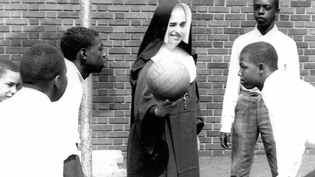
Clip: Special | 5m 5s | Venture beyond the convent door to gain a deeper understanding of the lives of religious sisters. (5m 5s)

Preview: Special | 52s | Venture beyond the convent door to gain a deeper understanding of the lives of religious sisters. (52s)
Providing Support for PBS.org
Learn Moreabout PBS online sponsorship












Support for PBS provided by:
Detroit PBS Documentaries is a local public television program presented by Detroit PBS